
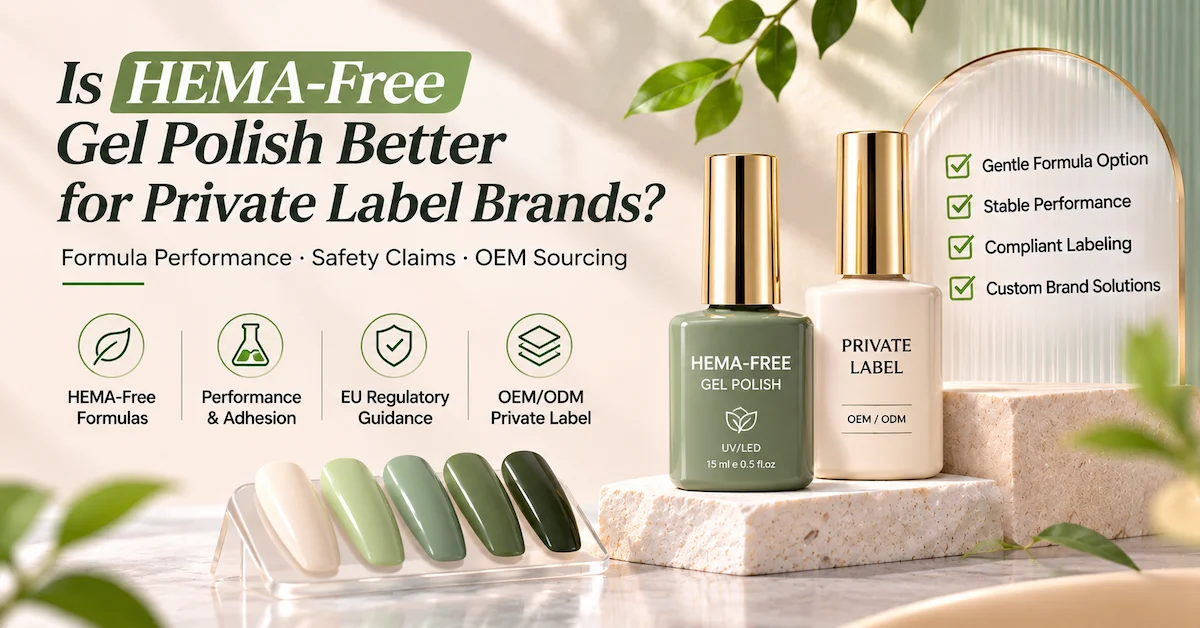
HEMA free gel polish for private label brands can be a valuable product-development option, particularly when a nail business wants to offer formulations without a specified methacrylate ingredient. However, removing HEMA does not automatically make gel polish safer for everyone, improve product performance, or guarantee compliance with international cosmetic regulations.
For professional nail brands, beauty distributors, salon chains, and OEM buyers, the real question is whether a HEMA-free formulation meets their customers' needs while maintaining appropriate adhesion, UV/LED curing, application characteristics, and manufacturing consistency.
Quick Answer: HEMA-free gel polish may be a better choice when a brand has a clear ingredient-exclusion requirement, suitable supporting documentation, and a validated formula that performs well in its intended application. Conventional HEMA-containing formulations may also remain appropriate in certain regulated professional-use markets. Neither formulation type should be judged by one ingredient alone.
JOUS provides professional nail gel manufacturing, formula customization, private label packaging, and HEMA-free product options for international B2B customers.
This guide compares formulation considerations, regulatory requirements, manufacturing costs, and supplier verification methods to help brands make informed purchasing decisions.
What Is HEMA-Free Gel Polish?
HEMA stands for 2-Hydroxyethyl Methacrylate, a methacrylate monomer used in certain UV/LED-curable nail products.
HEMA-containing formulations may use the ingredient as part of a system designed to achieve appropriate adhesion, film formation, or other performance characteristics.
HEMA-free gel polish is formulated without HEMA, although the exact composition depends on the manufacturer and product.
Importantly, a HEMA-free product may still contain other acrylate or methacrylate ingredients.
Does HEMA-Free Mean Acrylate-Free?
No.
HEMA is one member of a wider group of related chemical substances.
Removing HEMA does not necessarily mean removing every other potentially sensitizing component.
For example, HEMA and Di-HEMA Trimethylhexyl Dicarbamate are distinct substances. A formula described as HEMA-free should not automatically be assumed to exclude Di-HEMA TMHDC.
Professional buyers should therefore specify the exact ingredients they want excluded and request formula-specific supporting evidence.
JOUS lists relevant products in its TPO, HEMA and TMPTA-Free Nail Gel category.
The ingredient status of each selected formula should be confirmed before commercial purchasing or advertising.
Is HEMA-Free Gel Polish Better Than Regular Gel Polish?
HEMA-free gel polish is not inherently superior to every HEMA-containing formulation. Its suitability depends on ingredient requirements, the complete formula, intended users, technical performance, and relevant market rules.
HEMA-Free vs. HEMA-Containing Gel Polish
| Comparison Factor | HEMA-Free Formulation | HEMA-Containing Formulation |
|---|---|---|
| HEMA Ingredient | Intended to exclude HEMA | Contains HEMA |
| Ingredient Positioning | Supports a substantiated HEMA-free product claim | Requires accurate HEMA ingredient information |
| Sensitization Considerations | Other ingredients may still cause sensitization | HEMA is a recognized sensitizer |
| Adhesion | Depends on the complete formula | Depends on the complete formula |
| Flexibility | Must be tested | Must be tested |
| UV/LED Curing | Requires formula-specific validation | Requires formula-specific validation |
| Application Behavior | Depends on viscosity and formulation design | Depends on viscosity and formulation design |
| EU Market Requirements | Requires full product compliance review | HEMA-containing nail products face specified professional-use restrictions |
| Manufacturing Cost | Depends on materials and development requirements | Depends on materials and development requirements |
| Best Purchasing Decision | Suitable when exclusion claim and performance are validated | Suitable where the formula meets performance and legal requirements |
This comparison highlights an important distinction: ingredient exclusion can be a meaningful product specification, but it does not independently determine performance or overall safety.
When Might HEMA-Free Be the Better Choice?
A private label brand may prefer HEMA-free formulations when:
-
The intended product range has a defined HEMA-exclusion requirement.
-
Customers or distributors request that specific formulation attribute.
-
The brand wants to develop a differentiated professional nail collection.
-
Existing HEMA-free samples meet agreed technical performance standards.
-
The supplier can support the ingredient claim with appropriate documentation.
When Is HEMA-Free Not Automatically the Better Choice?
A HEMA-free formulation may not be the right choice if the brand assumes it is universally allergy-safe, neglects curing validation, or approves a formula that performs poorly in its intended nail system.
The best choice depends on evidence, not simply on which ingredient claim appears more attractive on packaging.
What Are the Safety Concerns Around HEMA in Gel Polish?
HEMA has been evaluated by the European Commission's Scientific Committee on Consumer Safety (SCCS).
In its 2018 opinion, the SCCS discussed the sensitization concerns associated with HEMA and Di-HEMA Trimethylhexyl Dicarbamate.
The committee concluded that appropriate application to the nail plate, while avoiding surrounding skin, was important to the assessed risk. It also identified risks associated with misuse, unintended skin contact, and professional exposure.
You can review the European Commission's SCCS scientific opinion on HEMA and Di-HEMA TMHDC.
Why Does Exposure to Uncured Gel Matter?
UV/LED gel formulations contain reactive components that are intended to polymerize under appropriate curing conditions.
Contact with uncured material can present sensitization concerns, depending on the formulation and exposure.
For professional applications, important controls include:
-
Avoiding unnecessary contact between uncured gel and surrounding skin.
-
Following the specific product's application instructions.
-
Using an appropriate, validated curing system.
-
Maintaining suitable professional hygiene and handling practices.
-
Training technicians in product-specific procedures.
These precautions remain relevant when using HEMA-free formulations because removing one ingredient does not eliminate all potential hazards.
Is HEMA-Free Suitable for People With Existing Acrylate Allergies?
A HEMA-free claim alone cannot establish that a product is suitable for someone with a known acrylate or methacrylate allergy.
Other reactive ingredients may still be relevant, and individual sensitivities vary.
Brands should not advertise HEMA-free nail gels as allergy-proof or universally suitable for sensitive customers without appropriate evidence.
For individuals with suspected or established allergies, professional medical assessment is more appropriate than relying on an ingredient-free marketing claim.
Are HEMA-Containing Gel Polishes Banned in the European Union?
No. HEMA has not been universally banned from EU cosmetic nail products.
Under Commission Regulation (EU) 2020/1682, HEMA and Di-HEMA Trimethylhexyl Dicarbamate are restricted to professional use in the relevant nail product categories and must carry specified warnings.
The required wording includes:
-
"For professional use only"
-
"Can cause an allergic reaction"
For the exact legal requirements, see Commission Regulation (EU) 2020/1682 on EUR-Lex.
HEMA Restrictions vs. TPO Prohibition
These substances have different regulatory treatment.
| Substance | EU Regulatory Position | Purchasing Implication |
|---|---|---|
| HEMA | Restricted in relevant nail products to professional use with specified warnings | Check formula, intended users and labeling |
| Di-HEMA TMHDC | Subject to corresponding professional-use restrictions and warnings | Verify separately from HEMA |
| TPO | Prohibited in EU cosmetic products since September 1, 2025 | Verify the exact formula does not contain prohibited TPO |
A product that is HEMA-free is not necessarily TPO-free.
Likewise, TPO-free status does not guarantee the absence of HEMA.
European brands should confirm the full formulation and applicable market requirements.
For related purchasing information, see the JOUS guide on TPO-Free Gel Polish Manufacturing for European Brands.
Does HEMA-Free Gel Polish Perform as Well as Conventional Formulas?
It can, provided the complete formulation is designed and validated for the intended application.
Removing or replacing a functional ingredient may require adjustments to other formulation components.
Performance cannot be predicted solely from the absence of HEMA.
1. Adhesion and Wear
Professional gel polish must perform appropriately with the intended nail preparation process and product system.
A HEMA-free formula should be evaluated for adhesion, lifting behavior, and performance under defined use conditions.
Avoid assuming that HEMA-free products always have weaker or stronger adhesion.
2. Viscosity and Self-Leveling
Viscosity affects brush control, product flow, and application technique.
A reformulated gel may require adjustments to achieve the desired working behavior.
The appropriate viscosity depends on whether the product is a base coat, color gel, builder gel, or another category.
3. UV/LED Curing Performance
A HEMA-free formula still requires appropriate polymerization.
Curing performance depends on factors including the formulation, lamp characteristics, exposure conditions, and applied layer thickness.
Product appearance or surface hardness alone is not sufficient evidence of adequate curing.
4. Flexibility and Structural Performance
Base gels, rubber bases, builder gels, and extension products have different mechanical requirements.
A formulation suitable for a thin color coat may not be appropriate for a structural nail extension.
Each product category should therefore have its own technical acceptance criteria.
HEMA-Free Gel Polish Testing Checklist
| Technical Parameter | What Buyers Should Test | Why It Matters |
|---|---|---|
| Formula Identity | Approved ingredient and formula reference | Supports ingredient claims |
| Viscosity | Agreed method, temperature, and range | Controls application behavior |
| Adhesion | Product-specific performance under defined conditions | Helps assess lifting and bonding |
| UV/LED Curing | Specified lamp conditions and appropriate test methods | Supports correct curing |
| Flexibility | Relevant product-specific evaluation | Supports intended applications |
| Color and Opacity | Physical reference and defined coat conditions | Ensures consistent appearance |
| Base/Top Compatibility | Complete intended gel system | Avoids incompatible combinations |
| Stability | Defined storage and packaging evaluation | Supports inventory quality |
| Batch Consistency | Comparison with approved specifications | Supports repeat orders |
| Ingredient Documentation | Formula-specific records and claim substantiation | Supports regulatory review |
The table provides recommended verification fields rather than universal test limits. Acceptance criteria should be agreed upon for each formula.
Which HEMA-Free Gel Products Should Private Label Brands Consider?
Not every brand requires the same product assortment.
A professional nail salon brand may focus on compatible base, color, and top coats, while a specialist nail extension business may prioritize builder products.
Product Selection Comparison
| Product Type | Main Application | Key Evaluation Priority |
|---|---|---|
| HEMA-Free Color Gel | Professional color collections | Pigmentation, finish, curing |
| HEMA-Free Base Coat | Foundation layer | Adhesion, compatibility |
| HEMA-Free Rubber Base | Selected leveling and reinforcement applications | Viscosity and flexibility |
| HEMA-Free Builder Gel | Overlays and structural applications | Working behavior and strength |
| HEMA-Free Top Coat | Glossy or specialty finish | Curing, surface characteristics |
| HEMA-Free Cat Eye Gel | Magnetic nail art | Effect consistency and curing |
| HEMA-Free Extension Gel | Nail extensions | Structural performance and application |
JOUS lists selected HEMA-free color, base-related, extension, and specialty gel products in its special-formulation product category.
Specific product availability, formula composition, and performance must be verified for each SKU.
For an initial private label project, a focused collection of compatible products is often easier to evaluate and replenish than a very large assortment.
What Should Brands Verify Before Using HEMA-Free Marketing Claims?
A formulation claim is a technical and regulatory statement, not merely an advertising slogan.
A HEMA-free claim should refer to the actual composition of the finished product.
For EU cosmetics, claims must meet requirements relating to truthfulness, evidential support, honesty, fairness, and informed decision-making.
These principles are established in Commission Regulation (EU) No 655/2013.
Claim Verification Checklist
Before approving labels or product descriptions, confirm:
-
The exact formula and product revision.
-
Whether HEMA is absent from the actual product.
-
Whether the claim also intends to exclude Di-HEMA TMHDC or other specified ingredients.
-
The available ingredient and claim-substantiation evidence.
-
Whether the claim remains accurate across color variations.
-
Whether the product meets its destination-market requirements.
-
Whether packaging and advertising make unsupported safety implications.
A brand should avoid claims such as "100% allergy-free," "zero sensitization risk," or "completely non-toxic" without adequate substantiation.
Similarly, describing conventional HEMA-containing products as universally dangerous would oversimplify the scientific and regulatory position.
HEMA-Free Is Not the Same as Full Regulatory Compliance
EU-bound cosmetic products may require a Cosmetic Product Safety Report (CPSR), Product Information File (PIF), Responsible Person, CPNP notification, and appropriate labeling and manufacturing records.
The exact obligations must be assessed for the finished product.
For a broader explanation of manufacturing evidence and regulatory documentation, see the JOUS Gel Polish Manufacturer Certifications Guide.
Does HEMA-Free Gel Polish Cost More to Manufacture?
Not necessarily.
A HEMA-free formulation may involve different raw materials, development work, testing, or manufacturing conditions. However, the absence of HEMA does not establish a predictable price premium.
For private label buyers, costs depend on the complete project.
Manufacturing Cost Factors
| Cost Factor | Potential Impact |
|---|---|
| Existing HEMA-Free Formula | May reduce new development requirements |
| Custom HEMA-Free Development | May require additional formulation and testing work |
| Color Selection | Affects shade-specific production and approvals |
| Bottle and Packaging | Influences component and branding costs |
| Quality Documentation | Depends on the target market and agreed scope |
| MOQ | Varies by formula, shade, and packaging |
| Sample Revisions | Can increase development time and expense |
| Reorder Requirements | Influence long-term inventory planning |
A new brand may find an established suitable HEMA-free formulation more practical than commissioning an entirely new formula.
A mature brand may justify additional development when its differentiation depends on specific performance requirements.
Compare complete manufacturing quotations rather than assuming HEMA-free products are always more expensive or more profitable.
How Can Private Label Brands Evaluate a HEMA-Free Manufacturer?
An effective supplier evaluation combines formulation knowledge with commercial reliability.
Step 1: Verify Available HEMA-Free Formulas
Request a list of available product categories and identifiable formula references.
Step 2: Review Ingredient Documentation
Clarify which substances are excluded and what supporting records are available.
Step 3: Approve Technical Samples
Test application, curing, compatibility, and finished-product characteristics under defined conditions.
Step 4: Confirm Packaging and Label Requirements
Review bottle compatibility, logo application, product information, and required warnings.
Step 5: Evaluate Production Quality Control
Ask about formula revisions, raw material identification, batch records, approved samples, and change-control procedures.
Step 6: Confirm MOQ and Lead Time
Request separate minimum quantities for formulas, shades, and packaging where relevant.
Step 7: Establish a Reorder Agreement
Clarify how future orders will be matched to the approved formulation and packaging specification.
This process helps transform a general "HEMA-free" product inquiry into a controlled private label development project.
How JOUS Supports HEMA Free Gel Polish for Private Label Brands
Guangzhou JOUS Fine Chemical Co., Ltd. provides nail gel formulation development, color matching, OEM/ODM manufacturing, and private label packaging for international beauty businesses.
The company lists selected HEMA-free products within its TPO, HEMA and TMPTA-Free Gel Polish collection.
Its OEM/ODM Nail Gel Manufacturing service describes support for formula adjustments, viscosity matching, color development, bottles, labels, and packaging.
Formula and Performance Customization
JOUS can discuss available formulations and customer-specific development requirements.
For HEMA-free projects, buyers should request the precise formula information and confirm the technical performance criteria.
Private Label Color and Packaging Options
Brands can explore coordinated color collections and branded packaging.
JOUS describes customization involving bottles, caps, labels, and outer boxes.
Manufacturing and Quality Control
JOUS describes a controlled production environment and quality checks throughout manufacturing.
Actual certification details, formula-specific test reports, and performance data should be requested and verified for the selected project.
Flexible OEM/ODM Purchasing
JOUS offers flexible MOQ options, but applicable minimums depend on product specifications and packaging requirements.
The company does not publish one universal MOQ or confirmed performance guarantee covering every HEMA-free product.
For private label buyers, the recommended approach is to confirm an approved formula and sample before agreeing to commercial production.
Explore JOUS HEMA-Free Nail Gel Products
What Should You Include in a HEMA-Free OEM Inquiry?
A detailed inquiry helps the manufacturer assess whether an existing formulation is suitable or whether additional development is needed.
HEMA-Free Private Label RFQ Checklist
| Information | What to Provide |
|---|---|
| Target Market | Country or region of sale |
| Customer Type | Professional salon, distributor, or other intended audience |
| Product Types | Color, base, top, builder, extension, or specialty gel |
| Ingredient Requirements | HEMA-free and any other specific exclusions |
| Formula Preference | Existing product or custom development |
| Performance Requirements | Viscosity, adhesion, finish, and curing conditions |
| Color Collection | Shades, finishes, and reference samples |
| Packaging | Bottle size, logo, labels, and outer boxes |
| Documentation | Ingredient, quality, and target-market requirements |
| Initial Quantity | Expected units per SKU |
| Reorder Forecast | Anticipated future demand |
| Project Schedule | Sampling and launch requirements |
Ask the manufacturer to separate formula-related requirements from packaging and branding costs.
If your project involves an ingredient-exclusion claim, request written confirmation of its scope and available substantiation.
Contact JOUS for HEMA-Free Formula Samples and a Private Label Quotation
Frequently Asked Questions About HEMA-Free Gel Polish
1. Is HEMA-free gel polish better for private label brands?
It may be better when the brand has a clear ingredient-exclusion requirement and the selected formula meets its performance and regulatory needs. It is not automatically superior to every HEMA-containing formulation.
2. Is HEMA-free gel polish safer than regular gel polish?
Removing HEMA eliminates that specified ingredient from the formulation, but other ingredients may still pose sensitization or other risks. Overall product safety depends on the complete composition, intended use, exposure, and appropriate assessment.
3. Is HEMA banned in European nail products?
No. EU rules restrict HEMA and Di-HEMA TMHDC in relevant nail products to professional use and require specified warnings. They are not subject to the same complete cosmetic prohibition as TPO.
4. Does HEMA-free mean Di-HEMA-free?
No. HEMA and Di-HEMA TMHDC are different substances. A buyer should request separate confirmation if both ingredients must be excluded.
5. Does HEMA-free gel polish have weaker adhesion?
Not necessarily. Adhesion depends on the overall formulation and application system. Buyers should evaluate the actual product under defined testing conditions rather than assume weaker or stronger performance.
6. Can HEMA-free gel polish cure under standard UV/LED lamps?
Curing compatibility depends on the formulation, lamp characteristics, and application conditions. Each product should have suitable, validated curing instructions. Compatibility with every UV/LED lamp should not be assumed.
7. Does JOUS manufacture HEMA-free gel polish?
JOUS lists selected HEMA-free nail gel products and provides OEM/ODM manufacturing services. Buyers should confirm the exact formulation, availability, documentation, and performance requirements before ordering.
8. Is HEMA-free private label gel polish more expensive?
There is no universal cost difference. Pricing depends on raw materials, formula development, testing, packaging, order quantities, and other manufacturing requirements.
9. Can I sell HEMA-free gel polish for home use?
A HEMA-free claim alone does not establish that a product is suitable or authorized for unrestricted home use. The complete formulation, intended users, application method, labeling, and destination-market requirements must be assessed.
10. How can I request HEMA-free gel polish samples from JOUS?
Prepare your required product types, ingredient exclusions, target market, color references, performance expectations, packaging preferences, and estimated quantity. Submit your requirements through the JOUS Contact Us page for product availability, sample arrangements, and a tailored quotation.
Conclusion
Choosing HEMA free gel polish for private label brands can be a valuable product-development strategy, but the decision should be based on verified formulation requirements rather than marketing assumptions.
For nail brands evaluating HEMA free gel polish for private label collections, the priority should be verifying ingredient claims, testing formula performance, and selecting a manufacturer that supports consistent OEM production.
HEMA-free products may support a specific brand positioning and customer preference. However, removing HEMA does not automatically guarantee superior adhesion, better curing, freedom from allergic reactions, or worldwide regulatory compliance.
For professional B2B buyers, the most important purchasing criteria remain formula transparency, technical performance, appropriate safety assessment, accurate ingredient claims, manufacturing quality, and repeat-order consistency.
JOUS supports nail brands, beauty distributors, and professional customers with selected HEMA-free products, formula development, color customization, OEM/ODM services, and private label packaging.
Whether your business is developing a new professional nail gel collection or evaluating alternatives to existing formulations, begin with documented requirements and representative product samples.
Explore JOUS HEMA-Free Gel Polish Options or Contact JOUS for OEM Formula Evaluation, Samples, and a Private Label Manufacturing Quotation to discuss your next nail gel project.