
When sourcing gel polish from overseas, professional nail brands, beauty importers, and private label buyers often ask: What certificates should a gel polish manufacturer have before accepting an OEM or wholesale order?
Quick Answer: A reliable gel polish manufacturer should demonstrate appropriate cosmetic Good Manufacturing Practice (GMP), provide verifiable quality records, and support the product-specific documentation required by the destination market. ISO 22716 is an important cosmetic GMP reference, while ISO 9001 certification may provide additional quality-management assurance. EU, US, and UK markets have different legal requirements, and no single certificate automatically establishes worldwide compliance.
Understanding gel polish manufacturer certifications requires distinguishing four categories: manufacturing standards, independent testing, product safety documentation, and regulatory registration or notification.
JOUS provides professional nail gel manufacturing, OEM/ODM customization, private label packaging, and documentation assistance for international B2B customers.
This guide explains which documents matter, how to verify them, and what buyers should request before approving commercial production.
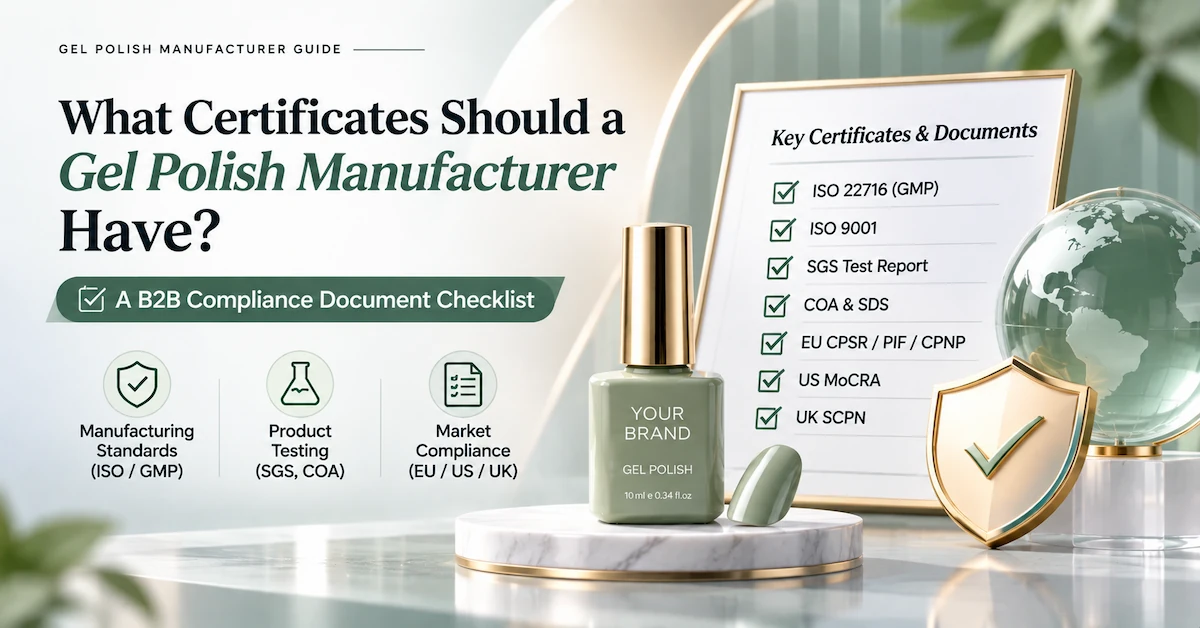
Which Gel Polish Manufacturer Certifications and Documents Matter Most?
Not every document described as a "certificate" serves the same purpose.
Some relate to a manufacturer's quality-management system. Others contain laboratory results for a specific product. Certain documents are required to support legal market placement, while others are voluntary supplier-assurance tools.
Gel Polish Certification and Documentation Comparison
| Certificate or Document | Main Purpose | Buyer Should Know |
|---|---|---|
| ISO 22716 / Cosmetic GMP Evidence | Demonstrates cosmetic manufacturing practices | GMP compliance is important; a third-party certificate is not universally mandatory |
| ISO 9001 Certificate | Quality-management system assurance | Voluntary, not cosmetic product approval |
| GMP / GMPC Audit Report | Documents manufacturing-system evaluation | Verify the audit standard, issuer, facility, and scope |
| SGS or Other Laboratory Report | Provides results of specified tests | A report covers particular samples and tests |
| Certificate of Analysis (COA) | Records agreed batch-quality results | Not a substitute for a safety assessment |
| Safety Data Sheet (SDS) | Communicates relevant hazard and handling information | Not proof of finished-product legal compliance |
| Ingredient / INCI Information | Supports ingredient review and labeling | Must match the actual formula |
| EU CPSR and PIF | Supports cosmetic safety and product documentation | Required under applicable EU cosmetic rules |
| EU CPNP Notification | Notifies relevant product information | Notification is not product approval |
| US MoCRA Registration / Listing | Meets applicable US cosmetic registration and listing obligations | FDA does not issue approval certificates for these submissions |
| UK SCPN Notification | Notifies cosmetic products supplied in Great Britain | Separate from EU CPNP |
The correct question is not "Does this factory have every certificate?" but "Does it have credible manufacturing evidence and can the relevant parties complete the required documentation for my product and destination market?"
Is ISO 22716 Certification Required for Gel Polish Manufacturers?
ISO 22716:2007, Cosmetics — Good Manufacturing Practices (GMP) — Guidelines on Good Manufacturing Practices, provides internationally recognized guidance for cosmetic production, control, storage, and shipment.
For professional gel polish manufacturing, these principles are relevant because product consistency depends on controlled materials, equipment, processes, personnel, and quality records.
What Should an ISO 22716-Based Quality System Cover?
Buyers should evaluate how the manufacturer manages:
-
Raw material identification and inspection.
-
Production-area hygiene and cleaning.
-
Personnel responsibilities and training.
-
Equipment maintenance and process controls.
-
Batch identification and traceability.
-
In-process and finished-product inspection.
-
Storage, complaints, and corrective actions.
Under EU cosmetic rules, manufacturing must follow appropriate GMP. ISO 22716 is the recognized reference, but compliance does not universally require a particular third-party ISO certificate.
A manufacturer may demonstrate compliance through documented procedures, manufacturing records, audits, and other suitable evidence.
How to Verify an ISO 22716 Certificate
If a manufacturer presents a third-party certificate, check its legal entity, production-site address, standard, scope, issuing body, certificate number, validity, and current status.
Where possible, verify the certificate directly with the issuing certification body.
A certificate covering one factory does not automatically cover every manufacturing site or outsourced process.
Is ISO 9001 Certification Important for a Nail Gel Factory?
ISO 9001 concerns quality-management systems across many industries.
Its requirements address areas such as process management, customer requirements, risk-based controls, corrective actions, and continual improvement.
For a gel polish buyer, an independently verified ISO 9001 certificate may provide useful additional evidence of organizational quality management.
However, ISO 9001 does not replace cosmetic GMP requirements, formula testing, product safety assessment, or market-specific regulatory obligations.
ISO itself does not issue company certifications. These are issued by independent certification bodies, which may be accredited.
When evaluating a supplier, request the actual certificate and verify its scope rather than relying solely on an ISO logo.
Are GMP, GMPC, and SGS Certificates the Same?
No. These terms refer to different types of standards, audits, organizations, or documentation.
GMP and GMPC
GMP stands for Good Manufacturing Practice.
GMPC is commonly used in the cosmetics industry to describe cosmetic GMP-related practices or audit programs. Buyers should determine the precise standard or scheme being referenced rather than assuming GMPC represents one universal government-issued certificate.
Ask which manufacturing activities were assessed, when the assessment occurred, and whether the document covers the production site responsible for your products.
SGS and Third-Party Testing
SGS is a testing, inspection, and certification company.
An SGS-issued report may document particular laboratory tests, while an SGS audit or certification document may relate to a different assessment.
The name of the testing organization alone does not establish that every gel polish formula is approved for all international markets.
For example, a report concerning a particular batch or ingredient does not necessarily apply to another color formulation with different components.
What Should a Test Report Include?
| Verification Item | What Buyers Should Check |
|---|---|
| Laboratory Identity | Name of the testing organization |
| Report Number | Traceable report identification |
| Product Identification | Correct product, sample, or formula code |
| Test Scope | Specific substances or properties examined |
| Testing Method | Relevant method and conditions |
| Results | Actual measured values or findings |
| Acceptance Criteria | Applicable limits or agreed standards |
| Report Date | Whether the evidence remains relevant |
| Formula Coverage | Whether the report applies to the ordered product |
Testing scope should be chosen according to the formula and destination-market requirements.
A laboratory report should be evaluated as evidence of the tests performed, not as an unrestricted compliance guarantee.
What Product Documents Should a Gel Polish Supplier Provide?
Besides manufacturing-system evidence, buyers need information connected to the actual products being purchased.
1. Ingredient Information
The supplier should provide sufficient ingredient information for appropriate safety assessment, regulatory review, and labeling.
Where relevant, ingredient documentation should identify the applicable formula or revision.
2. Certificate of Analysis (COA)
A COA may summarize agreed batch inspection results.
For gel polish, relevant characteristics could include appearance, viscosity, color references, or other formula-specific acceptance criteria.
The exact measurements and methods should be agreed upon between buyer and manufacturer.
3. Safety Data Sheet (SDS)
An SDS communicates relevant hazards and handling precautions where applicable.
However, an SDS is not the same as a Cosmetic Product Safety Report and does not automatically establish that a finished product can legally be marketed.
4. Technical and Performance Data
Depending on the product, buyers may request evidence addressing UV/LED curing performance, product stability, packaging compatibility, and consistency between production batches.
These requirements matter particularly for customized formulas and professional-use nail systems.
5. Approved Product Specifications
An approved specification should identify the formula, product type, finish, packaging, and agreed quality criteria.
This document helps connect manufacturing records and repeat orders to the product originally approved.
What Compliance Documents Are Required for Gel Polish in the EU?
For gel polish marketed as a cosmetic product in the European Union, Regulation (EC) No 1223/2009 establishes important product safety, documentation, manufacturing, and market-placement requirements.
A manufacturer holding ISO or GMP-related credentials does not automatically satisfy all obligations for a finished cosmetic product.
EU Cosmetic Compliance Checklist
| Requirement | Main Purpose | Key Responsibility |
|---|---|---|
| EU Responsible Person (RP) | Identifiable party responsible for compliance | Must be established in the EU |
| Cosmetic Product Safety Report (CPSR) | Documents the product's safety assessment | Qualified safety assessor and RP coordination |
| Product Information File (PIF) | Maintains product safety and technical information | Responsible Person |
| CPNP Notification | Notifies product information before market placement | Responsible Person, or distributor where applicable |
| GMP Compliance | Supports controlled cosmetic production | Manufacturer and relevant responsible parties |
| Ingredient and Label Review | Checks composition, restrictions, and required information | Responsible Person with relevant partners |
What Is a Cosmetic Product Safety Report?
A CPSR contains the product safety information and the safety assessor's evaluation.
The assessment must address the actual product and its intended conditions of use.
An ingredient list or general factory certificate does not substitute for a properly prepared CPSR.
What Is a Product Information File?
The PIF contains information including product identification, safety documentation, manufacturing and GMP information, and evidence supporting applicable product claims.
Under EU rules, it must be maintained for 10 years after the last batch has been placed on the market.
Is CPNP Notification an EU Certificate?
No.
The Cosmetic Products Notification Portal is an EU notification system. Notification does not constitute official product approval or independently verify that all legal obligations have been fulfilled.
Private label brands and importers should clarify who serves as the Responsible Person and who prepares, maintains, and submits the necessary product information.
Why Does TPO Matter for EU Gel Polish Sourcing?
The EU prohibition on TPO in cosmetic products took effect on September 1, 2025 under Commission Regulation (EU) 2025/877.
Buyers supplying the EU market must verify the actual formulation rather than relying on generic statements such as "EU compliant."
Product documentation should identify which formula is being supplied and support relevant ingredient claims.
A TPO-Free claim alone does not prove that all applicable cosmetic requirements are satisfied.
What Certificates Are Required for Gel Polish Sold in the United States?
The United States uses a different regulatory framework.
Under the Modernization of Cosmetics Regulation Act of 2022 (MoCRA), applicable cosmetic businesses have responsibilities involving facility registration, product listing, safety substantiation, and other regulatory requirements.
Certain small-business exemptions apply, subject to exclusions.
Is an FDA Certificate Required?
Ordinary cosmetic gel polish does not receive a general FDA premarket approval certificate.
The FDA generally does not approve cosmetic products before marketing, although color additives are subject to distinct approval requirements.
In a September 9, 2026 statement, FDA specifically clarified that it does not issue certificates, letters, or other verification documents establishing compliance with cosmetic facility registration or product listing.
A facility registration number or cosmetic product listing does not mean FDA has approved the factory or product.
What Should US Buyers Verify?
Buyers should determine:
-
Which MoCRA facility registration requirements apply.
-
Which cosmetic product listing obligations apply.
-
Who is the legally responsible person.
-
Whether appropriate safety substantiation records are maintained.
-
Whether product labels meet applicable requirements.
-
How ingredient, product, and adverse-event information is managed.
The applicable requirements should be assessed for the actual product and business arrangement.
Avoid describing an OEM manufacturer as "FDA certified" without a valid, specifically applicable basis for that statement.
What Documents Are Needed to Sell Gel Polish in the UK?
For Great Britain—England, Scotland, and Wales—cosmetic products are subject to a domestic regulatory framework.
Buyers should distinguish Great Britain requirements from EU requirements.
Great Britain Documentation Checklist
| Requirement | What Buyers Should Confirm |
|---|---|
| UK Responsible Person | Appropriate UK-established responsible party |
| Product Safety Assessment | Assessment performed by a qualified professional |
| Product Information File | Relevant safety, manufacturing, and product records |
| SCPN Notification | Notification through the UK service before making the product available |
| Ingredient and Label Information | Required details, warnings, and product identification |
| GMP Evidence | Appropriate manufacturing practice documentation |
The Submit Cosmetic Product Notifications (SCPN) service is administered by the Office for Product Safety and Standards.
It is a notification system, not a universal product quality certificate.
Northern Ireland has separate arrangements, so businesses should not assume that Great Britain's notification process is interchangeable with the EU system.
Brands selling into multiple markets should evaluate the requirements for each destination separately.
Do Gel Polish Products Need CE or RoHS Certification?
This is an important distinction for importers.
CE marking is not a general certification requirement for ordinary cosmetic gel polish. CE marking applies to product categories covered by specific EU legislation requiring it.
RoHS primarily concerns restrictions on certain hazardous substances in electrical and electronic equipment.
Therefore, a UV/LED nail lamp may have electrical-product compliance obligations that do not apply in the same way to the gel polish itself.
If a supplier presents CE or RoHS documents as proof of gel polish compliance, ask what product the documentation covers and why the scheme is legally relevant.
Manufacturing certificates and electrical equipment declarations should not be substituted for cosmetic safety records.
How Can Buyers Verify Gel Polish Manufacturer Certificates?
A practical verification process should follow the document from the claimed standard to the actual product being ordered.
Seven-Step Certificate Verification Process
-
Identify the document type. Determine whether it is a certification, audit report, laboratory result, safety assessment, registration record, or product specification.
-
Verify the issuing organization. Check the certification or testing body's identity and relevant accreditation where applicable.
-
Match the legal entity and facility. Confirm that the document covers the manufacturer and production site responsible for the order.
-
Check validity and scope. Review dates, standards, activities, product categories, and limitations.
-
Match the formula or sample. Confirm that product-specific evidence relates to the correct gel polish SKU, composition, or tested sample.
-
Check destination-market relevance. Determine whether additional safety, labeling, registration, or notification obligations apply.
-
Keep an approved document record. Record document versions and request updates when the formula, site, packaging, or regulatory requirements change.
Common Warning Signs
| Warning Sign | Why It Matters |
|---|---|
| Certificate without an identifiable issuer | Difficult to authenticate |
| Different factory address | May cover another facility |
| Expired or unverified certificate | Does not establish current certification |
| Laboratory report for a different formula | May not support the purchased SKU |
| "FDA Approved" claim for ordinary gel polish | May misrepresent US cosmetic regulation |
| CE mark presented as cosmetic certification | May use an inapplicable compliance scheme |
| No batch or formula identification | Weak product traceability |
| Refusal to clarify document scope | Prevents meaningful supplier due diligence |
An incomplete document is not automatically proof of a problem, but unresolved gaps should be addressed before commercial purchasing commitments.
How Does JOUS Support Gel Polish Certification and Documentation Needs?
Guangzhou JOUS Fine Chemical Co., Ltd. is a professional nail gel manufacturer offering formulation development, production, private label customization, and international B2B supply.
The JOUS About Us page references ISO, GMPC, and SGS-related credentials and describes a Class 100,000 clean-workshop manufacturing environment.
The JOUS OEM/ODM page also describes ISO/GMPC-aligned production practices, quality control, product information, and documentation assistance for international markets.
These are published company statements. Buyers should request current supporting documents and verify their legal entity, facility scope, issuing organization, and relevance to the products being ordered.
Product-Specific Documentation Support
JOUS provides multiple professional nail gel categories, including color gel polish, builder gel, base coats, top coats, and functional gels.
Different formulations may require different documentation and testing.
Buyers can review the JOUS Product Range before preparing a supplier-document request.
OEM/ODM and Private Label Projects
For custom formulas, colors, bottles, and labels, documentation should correspond to the final approved product rather than an earlier standard formula.
JOUS's OEM/ODM services provide a starting point for discussing product specifications, packaging, sample evaluation, and available documentation.
Bulk Gel Supply
Companies purchasing JOUS Bulk Gel for local filling should also clarify which party manages filling validation, finished-product quality control, labeling, and relevant regulatory responsibilities.
Contact JOUS to Request Certification Information and Formula-Specific Documents
What Should Buyers Include in a Certification Document Request?
An effective request identifies the exact information needed for the target market.
B2B Gel Polish Compliance RFQ Checklist
| Information to Provide | Document or Confirmation to Request |
|---|---|
| Target Country | Relevant market-specific documentation |
| Product Category | Formula and SKU identification |
| Manufacturing Site | Business and production-site information |
| Quality System | Applicable ISO/GMP certificate or evidence |
| Formula Composition | Relevant ingredient information |
| Product Testing | Available laboratory reports and test scope |
| Batch Quality | COA or agreed inspection records |
| Intended Use | Application, curing, and warning information |
| Packaging | Bottle compatibility and label details |
| EU Market | Information needed for CPSR, PIF, RP, and CPNP |
| US Market | Relevant MoCRA responsibilities and records |
| Great Britain | Information for safety assessment, PIF, RP, and SCPN |
| Order Quantity | MOQ and documentation-related project conditions |
Not every requested document will be applicable or immediately available for every product.
Before ordering, agree which records the manufacturer will supply, which tasks remain with the importer or brand owner, and which additional assessments may be required.
Buyers can submit their requirements through the JOUS Contact Us page.
Frequently Asked Questions About Gel Polish Manufacturer Certifications
1. What certificates should a gel polish manufacturer have?
A manufacturer should demonstrate appropriate cosmetic GMP and manufacturing-quality controls, provide credible product-specific records, and support relevant market requirements. ISO 22716 is an important GMP reference, while other certifications and documents depend on the product and destination.
2. Is ISO 22716 certification mandatory for every gel polish factory?
Not universally. Applicable markets may require cosmetic GMP compliance, but an independently issued ISO 22716 certificate is not always legally required. Buyers should verify the manufacturer's GMP evidence and any certification claims.
3. Is ISO 9001 enough to prove gel polish quality?
No. ISO 9001 concerns quality-management systems. It does not replace product safety assessments, formula verification, cosmetic GMP obligations, or regulatory documentation.
4. Does an SGS report mean gel polish is safe for every market?
No. SGS and other laboratories report on particular tests or assessments. Buyers must review the specific sample, method, results, and applicable requirements.
5. Does gel polish need FDA approval before being sold in the US?
Ordinary cosmetic gel polish generally does not require FDA premarket approval. Certain color additives are subject to separate approval requirements, and relevant cosmetic regulatory obligations still apply.
6. What is the difference between CPSR and PIF?
The CPSR documents the cosmetic product's safety assessment. The PIF is a broader product information record that includes the CPSR and other required information.
7. Is CPNP notification the same as an EU compliance certificate?
No. CPNP is a product notification mechanism. It does not constitute official approval and does not replace required product safety and documentation obligations.
8. Do TPO-Free and HEMA-Free products automatically qualify for EU sale?
No. Ingredient-exclusion claims must be supported for the actual formula, and all other applicable ingredient, safety, labeling, and notification requirements remain relevant.
9. Can a Chinese gel polish manufacturer provide documents for EU, US, and UK buyers?
A manufacturer may provide formula information, quality records, testing reports, and documentation assistance. However, the responsible legal parties must still ensure that the applicable destination-market requirements are completed.
10. How can I verify JOUS certifications before purchasing?
Request the relevant current certificates, issuing-body details, manufacturing scope, formula-specific test reports, and available product documentation. Provide your target market, selected products, and intended business model through the JOUS Contact Us page.
Conclusion
Understanding gel polish manufacturer certifications is essential for international nail brands, importers, distributors, and private label buyers seeking dependable manufacturing partners.
A trustworthy documentation package is not defined by the number of certification logos displayed on a supplier's website. It should provide verifiable manufacturing evidence, relevant product-quality records, and clear support for the actual legal requirements of the destination market.
ISO 22716 and cosmetic GMP are important manufacturing references. ISO 9001 may provide additional quality-management assurance. Laboratory reports, batch records, safety assessments, and market notifications each serve different purposes.
For EU, US, and UK sales, buyers should identify the responsible parties, verify the exact formulas being supplied, and confirm that the required regulatory work has been completed before products enter the market.
JOUS offers professional nail gel manufacturing, OEM/ODM customization, private label packaging, and documentation assistance for overseas B2B customers. Buyers can request project-specific information to assess available manufacturing evidence and supporting product records.
Explore JOUS OEM/ODM Manufacturing Services or Contact JOUS to Request Certification Details, Product Documentation, and a Manufacturing Quotation for your next gel polish sourcing project.