
Gel polish OEM production time depends on more than the number of days spent manufacturing nail gel. A complete project may involve formula selection, custom color development, sample approval, packaging preparation, mass production, quality inspection, and international shipping.
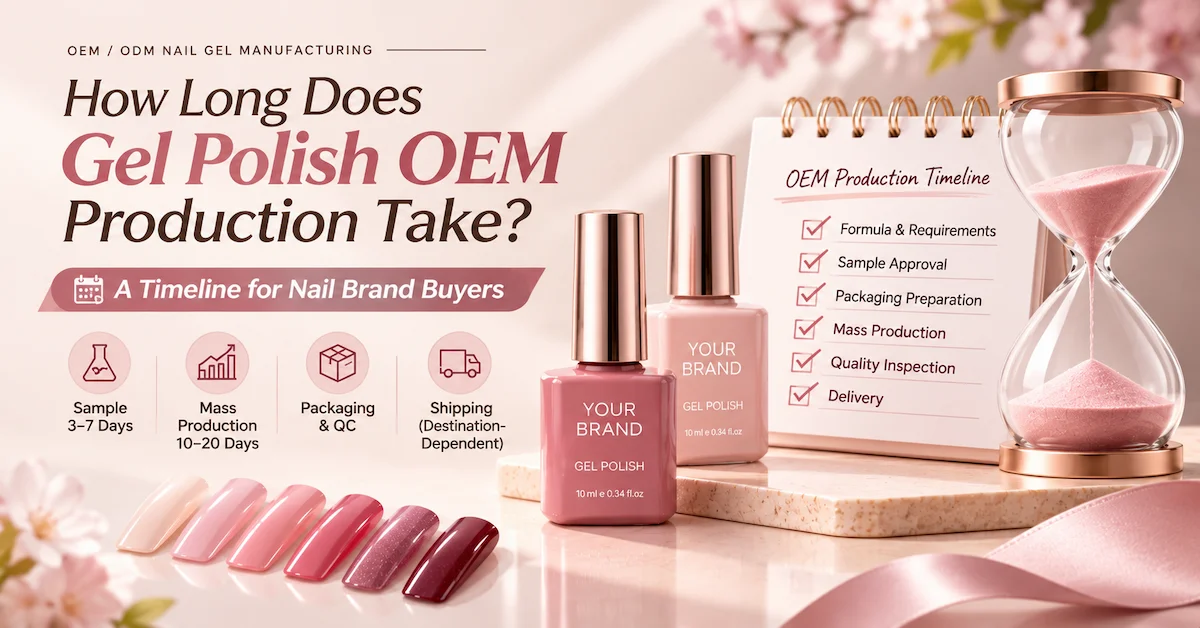
Quick Answer: JOUS publishes a reference of 3–7 days for sample preparation and 10–20 days for mass production in certain product FAQs, with mass production timed from sample confirmation and deposit payment. These figures are not guaranteed timelines for every OEM project and do not represent the complete time from initial inquiry to warehouse delivery.
For private label nail brands, beauty distributors, salon chains, and e-commerce businesses, the most reliable approach is to obtain a milestone-based production schedule before placing an order.
JOUS OEM/ODM Manufacturing supports formula customization, color development, private label packaging, and nail gel production for international B2B buyers.
This guide explains each production stage, identifies common delays, and shows how to plan a realistic manufacturing schedule.
How Long Does Gel Polish OEM Production Take?
There is no single production timeline that applies to every gel polish OEM order.
An existing formula using standard bottles and labels normally involves fewer development requirements than an exclusive color collection with customized formulations and new packaging components.
A useful distinction is between sample lead time, mass production lead time, and total order fulfillment time.
JOUS Published Lead-Time References
| Production Stage | Published Reference | Important Qualification |
|---|---|---|
| Sample Preparation | 3–7 days | Referenced in specific JOUS product FAQs after confirmation |
| Sample Testing and Approval | Project-dependent | Buyer evaluation and revisions may require additional time |
| Custom Color or Formula Development | Project-dependent | Depends on complexity and sample iterations |
| Packaging Artwork and Components | Project-dependent | Depends on design, approvals, and material availability |
| Mass Production | 10–20 days | Specific product FAQ reference after sample approval and deposit |
| Quality Inspection and Export Preparation | Confirm project scope | May be included in or separate from quoted production time |
| International Shipping | Destination-dependent | Depends on shipping method, customs, and logistics |
These periods should not be added together and treated as a guaranteed door-to-door delivery estimate.
The manufacturer must clarify which activities overlap, which steps occur sequentially, and what date triggers each quoted period.
For an accurate schedule, buyers should request written lead-time confirmation for their specific product and packaging requirements.
What Are the Main Stages of OEM Gel Polish Manufacturing?
A structured OEM project typically follows eight stages.
1. Product Requirements and Project Confirmation
The first stage establishes what the brand wants to manufacture.
The buyer should define product categories, target market, formula requirements, colors, packaging preferences, quantity, and intended launch date.
A clear specification helps the manufacturer determine whether an existing formulation is suitable or whether custom development is required.
2. Formula Selection or Development
The manufacturer evaluates the requested product characteristics.
These may include viscosity, application behavior, color, finish, curing requirements, or compatibility with other products.
An existing approved formula may require less development work than a new formulation.
3. Color Matching and Sample Preparation
The manufacturer prepares representative samples for evaluation.
For customized shades, the process may include adjustments to pigments, opacity, undertone, or visual effects.
Additional development cycles can extend the schedule.
Brands requiring unique colors can review the JOUS Color Gel Polish range before submitting customization requirements.
4. Sample Testing and Approval
The buyer evaluates the product against the agreed specification.
Approval should cover application, appearance, relevant curing performance, and compatibility with the intended product system.
The approved sample becomes the reference for commercial production.
5. Packaging Design and Component Preparation
This stage includes bottles, caps, brushes, logo artwork, labels, and outer boxes.
Existing components may simplify the project. Custom molds, printing processes, or specialty packaging can introduce additional manufacturing requirements.
Packaging design should begin early where possible, but final production must use approved specifications.
6. Raw Material Preparation and Mass Production
After the relevant approvals and commercial conditions are completed, the manufacturer prepares materials and schedules production.
Gel manufacturing may involve material preparation, mixing, dispersion, air removal, and in-process quality checks.
The manufacturing method depends on the formula and product category.
7. Filling, Packaging, and Quality Inspection
Finished gel is filled into approved containers and packaged according to the confirmed order.
Quality checks may include product identification, appearance, fill quantities, packaging condition, batch information, and agreed product tests.
8. Export Preparation and Shipping
Following the relevant release and shipment arrangements, the order proceeds through export preparation and international logistics.
The time required depends on transportation arrangements and the destination.
A complete OEM timeline must account for all eight stages, not only mass production.
How Does the Production Timeline Change by OEM Project Type?
Different purchasing models involve different preparation requirements.
OEM Production Model Comparison
| Project Type | Development Requirements | Packaging Requirements | Main Scheduling Risk |
|---|---|---|---|
| Existing Formula + Standard Packaging | Limited new formula development | Existing components | Production scheduling and stock availability |
| Existing Formula + Custom Logo | Formula selection and approval | Label or printing approval | Artwork and printing preparation |
| Custom Color Collection | Color matching and sample approval | Standard or customized bottles | Multiple shade revisions |
| Custom Formula + Custom Packaging | Formula development and technical validation | New or specialized components | Interdependent development and packaging tasks |
| Repeat Order of Approved Products | Verify approved specifications | Reuse approved components | Material availability and production capacity |
| Bulk Nail Gel Supply | Confirm bulk formula specifications | Bulk containers rather than retail filling | Bulk QC, shipment, and local filling arrangements |
This comparison describes relative complexity, not fixed production durations.
A private label brand using existing formulas may have a simpler approval process, while a company developing entirely new products should plan for more technical review.
For businesses with local filling capabilities, JOUS Bulk Gel Supply offers an alternative to purchasing finished branded bottles.
However, local filling introduces its own production and quality-control responsibilities.
What Determines Gel Polish OEM Production Time?
Several factors have a direct influence on the schedule.
Formula Complexity
Existing formulations typically require fewer development decisions than new formulas.
Requests involving specific viscosity, unusual finishes, or modified performance may require additional evaluation.
Number of Custom Colors
A collection with numerous exclusive shades can require more sampling, shade approval, and batch-control work than a smaller selection from an established color range.
Sample Revision Frequency
Every additional revision may require formulation work, sample preparation, shipment, and buyer evaluation.
Unclear feedback can cause repeated development cycles.
Packaging Availability
Standard bottles and existing packaging components may be easier to coordinate than newly manufactured bottles, specialized caps, or unique printed boxes.
Order Quantity and Production Capacity
Production scheduling depends on the project's volume, number of SKUs, manufacturing requirements, and available factory resources.
A larger quantity does not always mean a proportionally longer production period. Actual capacity and scheduling must be confirmed.
Documentation and Market Requirements
Destination-market documentation, ingredient verification, label review, and required testing can affect the project's readiness.
Shipping and Customs
International transport is separate from manufacturing.
Shipping terms define responsibilities and costs, while actual transit depends on the logistics arrangements and customs processes.
A supplier's production estimate should not be mistaken for the expected warehouse arrival date.
How Do Sample Approval and Packaging Affect Lead Time?
Sample approval and packaging preparation are often connected.
For example, a buyer may approve the bottle design while the final color formula remains under development. However, printing a complete retail carton may depend on confirmed product information.
The most effective way to manage these dependencies is to establish formal approval milestones.
Critical Approval Checklist
| Approval Item | Buyer Must Confirm | Next Stage Enabled |
|---|---|---|
| Product Specification | Formula, performance requirements, product category | Sample development |
| Color Reference | Shade code, undertone, finish | Color matching |
| Technical Sample | Application and curing test results | Formula approval |
| Bottle and Components | Size, cap, brush, compatibility | Packaging procurement |
| Artwork | Logo, labels, box files, required information | Printing preparation |
| Commercial Terms | MOQ, quantity, price, deposit conditions | Production release |
| Quality Criteria | Agreed inspection and acceptance requirements | Production QC |
| Delivery Arrangement | Destination, shipment terms, logistics requirements | Export planning |
A manufacturer should confirm which approvals are mandatory before mass production begins.
For buyers, the most important rule is simple:
Do not release an order into commercial production until the specifications needed for that production stage are approved and documented.
What Technical Tests Should Be Completed Before Production?
For professional nail gel products, technical approval should be treated as a manufacturing milestone.
A sample should not be approved solely because its color looks attractive.
Gel Polish Pre-Production Testing Checklist
| Test Item | Evaluation Focus | Potential Scheduling Impact |
|---|---|---|
| Viscosity | Application and flow characteristics | Formula adjustment may be needed |
| Color Matching | Match to approved reference | Additional shade development |
| Pigmentation | Coverage and uniformity | Pigment or formula revision |
| UV/LED Curing | Specified lamp and application conditions | Technical revalidation |
| Adhesion | Suitability for intended product system | Compatibility review |
| Base and Top Coat Compatibility | Performance across intended layers | System-level testing |
| Packaging Compatibility | Bottle, cap, brush, closure | Component changes |
| Stability | Product behavior under defined test conditions | Additional evaluation period |
| Documentation | Required product and batch information | Approval or shipment readiness |
The testing plan should reflect the intended product category and target market.
For example, builder gels may require different performance criteria from ordinary color gels, while magnetic cat eye products may need additional effect evaluation.
ISO 22716:2007 provides internationally recognized guidance for the production, control, storage, and shipment of cosmetics.
Manufacturers and buyers should use documented procedures and relevant quality records to support commercial production.
How Can Nail Brands Prevent OEM Production Delays?
The most effective scheduling improvements often come from better preparation rather than rushing manufacturing.
1. Prepare a Complete Product Brief
Include the target market, product types, formula requirements, number of shades, packaging direction, estimated quantity, and launch schedule.
2. Use Existing Components When Appropriate
Selecting established formulas and available packaging may reduce new development requirements.
This should not replace proper testing or packaging validation.
3. Consolidate Sample Feedback
Provide one coordinated approval response instead of sending multiple conflicting revisions.
Use shade codes, sample references, and specific requested changes.
4. Finalize Packaging Artwork Early
Confirm logo files, color references, label copy, box dimensions, and required product information before printing.
5. Establish a Single Approval Record
Maintain a record identifying the approved formula, shades, packaging components, artwork revisions, and agreed quality criteria.
6. Confirm Production Capacity Before Paying
Ask when the factory can schedule the order after the necessary approvals and commercial conditions are satisfied.
7. Build a Schedule Buffer
Allow time for sample revisions, unexpected material delays, inspection findings, shipping variability, and customs processing.
Never base a retail launch solely on the fastest advertised production estimate.
How to Plan Your Gel Polish Launch Date Backward
A reliable launch schedule begins with the required inventory arrival date rather than the day the factory starts manufacturing.
Work Backward from Your Target Delivery Date
Step 1: Define the warehouse arrival deadline.
Choose the date by which finished goods must be available for labeling checks, distribution, or retail fulfillment.
Step 2: Obtain a realistic shipping plan.
Ask the logistics provider for an estimate based on the shipment method, route, destination, customs requirements, and agreed delivery terms.
Step 3: Confirm production and quality-release milestones.
Determine when mass production must be complete and when the goods will be ready for dispatch.
Step 4: Establish the production-release date.
Confirm the latest acceptable dates for sample approval, artwork approval, materials readiness, and payment conditions.
Step 5: Add contingency time.
Build an appropriate buffer for unexpected delays.
A Simple Launch Scheduling Formula
Required Project Start Date = Target Warehouse Arrival Date − Estimated Critical-Path Duration − Contingency Allowance
The critical path is the sequence of dependent activities that determines the earliest possible completion date.
For example, label artwork can sometimes be developed while gel samples are being evaluated. These activities may overlap.
However, commercial printing may still require final approved product information.
Similarly, mass production cannot responsibly proceed if mandatory formula approvals remain incomplete.
The project schedule should therefore identify both parallel tasks and unavoidable dependencies.
What Are the Business Risks of Rushing OEM Production?
Faster production is valuable only when the finished product meets the agreed requirements.
Rushing an OEM order can create additional commercial costs.
| Risk | Possible Consequence | Better Approach |
|---|---|---|
| Incomplete Sample Approval | Unsatisfactory product performance | Complete defined tests before release |
| Unapproved Artwork | Incorrect labels or boxes | Approve final artwork files |
| Packaging Procurement Delays | Manufacturing cannot finish on time | Confirm component availability |
| Incomplete Quality Checks | Higher risk of nonconforming goods | Preserve required inspection steps |
| Unclear Delivery Terms | Unexpected logistics expenses | Define shipment responsibilities |
| No Reorder Planning | Future stock interruptions | Forecast demand and agree replenishment milestones |
An urgent project may justify additional scheduling discussions, but buyers should not assume every delay can be solved by paying a rush fee.
A better purchasing decision considers total cost, production reliability, and finished-product readiness.
How JOUS Supports OEM Gel Polish Production Planning
Guangzhou JOUS Fine Chemical Co., Ltd. provides professional nail gel manufacturing and OEM/ODM solutions for international nail brands, beauty distributors, and other B2B buyers.
Its manufacturing services include formula development, color matching, bottle customization, private label packaging, and production support.
Through its OEM/ODM Manufacturing Service, JOUS describes support for product development, samples, quality control, and scalable manufacturing.
Formula and Color Development
JOUS supports existing and customized nail gel formulations, including color matching and product performance adjustments.
Packaging Customization
Customers can discuss bottle sizes, caps, labels, and outer packaging.
Manufacturing and Quality Control
JOUS describes a controlled manufacturing environment and a production process involving material preparation, mixing, testing, filling, and packaging.
Sample and Production Scheduling
JOUS publishes reference sample and mass-production lead times in certain product FAQs, but the precise timing for custom projects must be confirmed separately.
For a meaningful schedule, buyers should clarify:
-
Whether samples require new development.
-
Whether packaging components are already available.
-
Which approvals must be completed before production.
-
When the factory can reserve the production order.
-
What quality checks apply before shipment.
-
Which delivery terms and logistics arrangements are proposed.
Contact JOUS to Confirm Your OEM Production Schedule
What Should You Include in an OEM Gel Polish Production Inquiry?
A detailed inquiry helps the manufacturer estimate the required development work and manufacturing schedule.
OEM Gel Polish Scheduling RFQ Checklist
| Information | What to Provide |
|---|---|
| Business Type | Nail brand, distributor, salon chain, or retailer |
| Target Market | Destination country and intended users |
| Product Categories | Color gel, base, top, builder, cat eye, etc. |
| Formula Direction | Existing formula or custom development |
| Colors and SKUs | Number of shades and product variations |
| Packaging | Bottle size, logo, label, cap, and box |
| Sample Requirements | Existing or customized samples |
| Initial Order Quantity | Units per SKU and total volume |
| Quality Requirements | Testing and product documentation |
| Approval Status | Which samples and artwork are already approved |
| Launch Deadline | Required warehouse arrival date |
| Logistics | Destination and preferred shipping arrangement |
| Reorder Forecast | Expected future quantities |
Ask JOUS to identify the estimated duration of each stage, the responsible party, and the events that may change the schedule.
You can review the JOUS Product Catalog before preparing the product shortlist.
Request OEM Gel Polish Samples, Lead-Time Confirmation, and a Manufacturing Quote
Frequently Asked Questions About Gel Polish OEM Production Time
1. How long does gel polish OEM production take?
JOUS provides a 10–20-day mass-production reference in certain product FAQs after sample confirmation and deposit payment. This is not a universal estimate for every OEM project. Custom development, packaging preparation, inspection, and shipping may add time.
2. How long does JOUS take to prepare gel polish samples?
Certain JOUS product FAQs mention 3–7 days after confirmation. Samples requiring exclusive shades, formulation development, or additional technical evaluation may follow different schedules.
3. Does OEM lead time include international shipping?
Not automatically. Manufacturing lead time and international delivery time are separate. Buyers should confirm exactly what the quoted period includes and which shipping terms apply.
4. Does custom color development increase production time?
It can. Color matching may require formulation adjustment, physical samples, buyer evaluation, and additional revisions before commercial approval.
5. Do custom bottles and packaging affect the schedule?
Yes. New bottle designs, printing, molds, labels, or specialty boxes may involve preparation and approval requirements that differ from stock packaging.
6. When does the mass-production lead-time clock start?
The trigger must be defined in the quotation or order agreement. A JOUS product FAQ references sample confirmation and deposit payment, but other project conditions, such as artwork or material approval, may also need to be satisfied.
7. Can gel polish OEM manufacturing be accelerated?
Some projects may have opportunities to simplify development or coordinate tasks in parallel. Availability depends on the approved product configuration, materials, production capacity, and quality requirements. Buyers should request a realistic schedule rather than assume expedited production is guaranteed.
8. Does quality inspection add time to an OEM order?
Quality inspection requires appropriate resources and scheduling. Some checks occur during production, while others are performed before product release. Buyers should confirm whether inspection is included in the quoted manufacturing period.
9. Are repeat gel polish orders faster than first orders?
Repeat orders can involve fewer development decisions when formulas, colors, and packaging are unchanged and approved. However, actual timing still depends on materials, capacity, quantity, and other production conditions.
10. How can I confirm gel polish OEM production time with JOUS?
Prepare your product categories, formula requirements, colors, quantities, packaging specifications, target market, and required delivery date. Submit the details through the JOUS Contact Us page to request a project-specific production schedule.
Conclusion
Understanding gel polish OEM production time is essential for nail brands planning new collections, private label launches, and repeat manufacturing orders.
The time spent producing gel polish is only one part of the full project. Formula selection, sample development, approval cycles, packaging preparation, quality control, and international logistics must all be considered.
JOUS publishes sample and mass-production lead-time references for certain products, but buyers should confirm the full schedule for their specific formulas, colors, packaging, and quantities.
A well-prepared product brief, clear approval milestones, documented specifications, and realistic delivery planning can help reduce avoidable delays and improve coordination with the manufacturer.
JOUS supports international B2B customers with professional nail gel manufacturing, custom formulation, color development, OEM/ODM packaging, and bulk gel supply.
Explore JOUS OEM/ODM Manufacturing Solutions or Contact JOUS for a Customized Production Timeline and Quotation to plan your next gel polish manufacturing project.