
Yes, you can customize gel polish colors for your brand by selecting existing shades, modifying color formulas, or working with an OEM/ODM manufacturer to develop exclusive collections. However, successful color customization requires more than sending a photograph and asking a factory to reproduce it.
For private label nail brands, salon chains, beauty distributors, and professional nail product retailers, the real challenge is developing custom gel polish colors that match the intended appearance, perform correctly under UV/LED curing conditions, and remain consistent during future production.
A custom shade should be evaluated for undertone, opacity, finish, pigment distribution, application behavior, curing compatibility, and batch repeatability.
JOUS offers professional nail gel manufacturing, color matching, custom formulation, and OEM/ODM services for international nail brands.
This guide explains how to develop a brand-specific gel polish palette, approve samples, minimize color differences, and prepare a commercially viable manufacturing order.
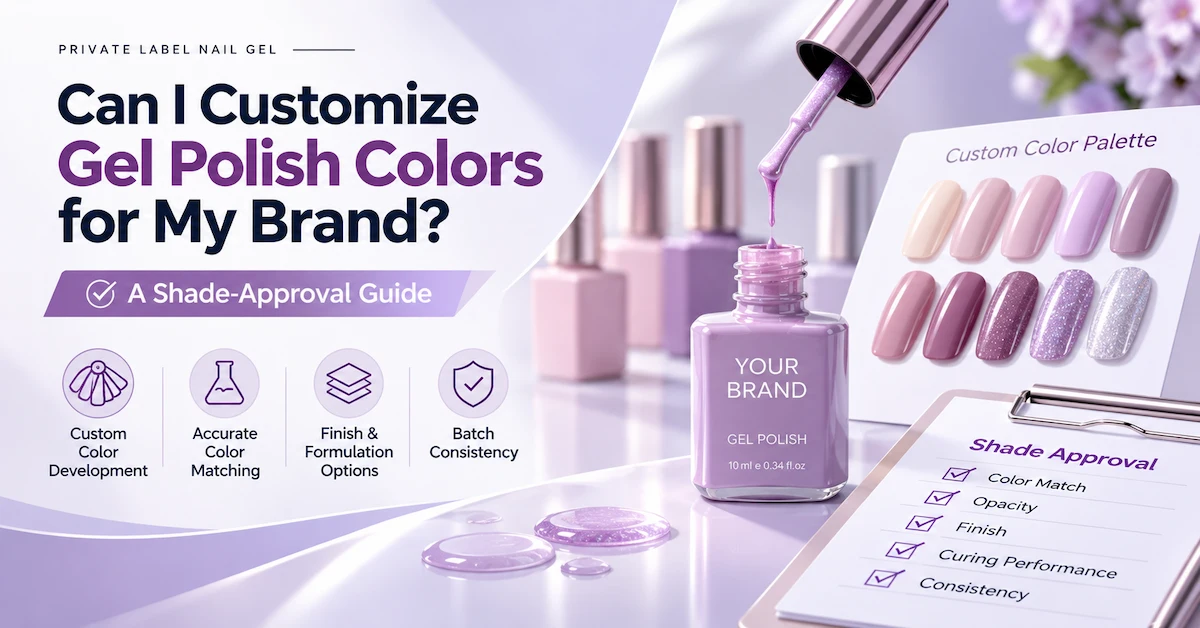
Can I Customize Gel Polish Colors for My Brand?
Yes. Professional OEM/ODM gel polish manufacturers can develop brand-specific colors using existing formula platforms, physical color references, adjusted pigment systems, or new formulation development.
The available customization depends on the manufacturer's formulation capabilities, the desired finish, the product's performance requirements, and the order quantity.
Common customization requests include:
-
Matching a specific nude, pink, red, or other target shade.
-
Developing a coordinated seasonal color collection.
-
Adjusting opacity, undertones, or color intensity.
-
Creating shimmer, glitter, or magnetic cat eye effects.
-
Developing signature shades for a professional nail brand.
-
Selecting formulations compatible with an established base and top coat system.
JOUS provides color development and trend-shade matching through its OEM/ODM manufacturing services.
Before requesting a quotation, buyers should decide whether they need an existing shade with their logo, a modified color, or a newly developed formula.
These options have different technical and commercial requirements.
Which Gel Polish Color Customization Method Is Best?
Not every nail brand needs a completely new formulation.
Selecting the appropriate development route can reduce unnecessary sampling, testing, and production complexity.
Compare Four Color Development Options
| Customization Method | Main Characteristics | Advantages | Best For |
|---|---|---|---|
| Existing Color Selection | Choose shades from an established product range | Less new development | Startup brands and distributors |
| Existing Formula with Color Adjustment | Modify pigment balance or undertones | Greater brand differentiation | Growing private label brands |
| Exclusive Shade Development | Develop a defined brand-specific color target | Distinctive collection identity | Established nail brands |
| Custom Effect and Formula Development | Adjust color, finish, and potentially formula performance | Specialized product positioning | Premium and professional nail product lines |
An existing formula with color modification may offer a useful balance between customization and manufacturing complexity.
However, an exclusive shade request does not automatically establish contractual exclusivity or ownership of a formulation. These matters should be clarified in writing.
Buyers can explore JOUS's Color Gel Polish Collection to identify possible color directions before starting a development project.
How Does Custom Gel Polish Color Matching Work?
A professional color-matching project should follow a structured approval process.
The objective is to turn a visual concept into a reproducible product specification.
Step 1: Define Your Brand's Color Direction
Begin by identifying the customers and applications your collection will serve.
A professional salon brand may prioritize versatile nude shades, consistent coverage, and repeatable application.
An e-commerce nail brand may emphasize visually distinctive colors and seasonal collections.
A beauty distributor may require a wider assortment designed for different customer segments.
Consider whether your collection focuses on:
-
Natural nude and French manicure shades.
-
Classic professional salon colors.
-
Seasonal and fashion-inspired palettes.
-
Glitter or reflective finishes.
-
Magnetic cat eye effects.
-
Sheer and milky gel polish.
The clearer the collection concept, the easier it becomes to create a coherent product range.
Step 2: Provide Accurate Color References
A manufacturer needs a clear target for color matching.
Useful references include physical color swatches, existing approved samples, material samples, or detailed color specifications.
Digital photographs and screenshots can communicate a general direction, but they should not be the sole final color standard.
Screen calibration, lighting, photography, and image processing can change how a shade appears.
Pantone or similar color references may be useful starting points, but a printed color standard does not guarantee an identical appearance in a translucent, glossy, or UV-curable nail gel.
For commercial approval, a physical cured gel polish sample is generally more useful than a digital image alone.
Step 3: Specify the Desired Finish and Coverage
Two gel polishes can have similar colors but produce very different visual results.
For example, a sheer nude gel and an opaque nude gel may look similar inside the bottle but appear different when applied.
Define:
-
Opacity or transparency.
-
Warm, cool, or neutral undertone.
-
Glossy, matte, shimmer, or glitter finish.
-
Desired appearance at a specified number of coats.
-
Intended base and top coat combinations.
These details should be agreed upon before final sample approval.
Step 4: Develop and Review Samples
After reviewing the color reference and product requirements, the manufacturer can evaluate an appropriate existing formula or develop a revised sample.
Color adjustment may involve pigment selection, dispersion, and formula-specific compatibility considerations.
For each sample, record its formulation or product reference and revision number.
If a shade requires several adjustments, ensure that every revision is identified separately.
Step 5: Evaluate the Cured Color
Apply the sample using controlled conditions.
Use consistent application thickness, substrate, curing equipment, and lighting.
Compare the intended appearance after the product has been applied and cured, not only while it is inside the bottle.
Evaluate color, undertone, opacity, surface finish, and relevant application characteristics.
Step 6: Approve a Master Reference
Once the desired shade is achieved, approve an identifiable physical reference.
The approval record should include the shade code, sample revision, formula reference, finish, application conditions, and approval date.
Retain the reference for manufacturing and future orders.
Step 7: Confirm Commercial Production
Before a full production run, confirm how the approved shade will be reproduced, inspected, packaged, and identified.
A reliable color development process should connect the approved sample to a defined commercial product specification.
What Technical Specifications Are Needed for Custom Gel Polish Colors?
A professional color customization request should include more than a shade name.
The following specifications help the manufacturer understand the complete product requirements.
Custom Color Gel Polish Specification Checklist
| Specification | What Buyers Should Define | Why It Matters |
|---|---|---|
| Target Shade | Physical reference or approved sample | Establishes color target |
| Color Undertone | Warm, cool, neutral, or specified reference | Reduces visual mismatch |
| Opacity | Sheer, semi-transparent, or opaque | Determines intended coverage |
| Surface Finish | Glossy, matte, glitter, shimmer, cat eye | Defines final appearance |
| Viscosity | Desired application behavior | Affects brush control and leveling |
| Pigment Distribution | Uniformity expectations | Helps avoid streaks or uneven color |
| UV/LED Curing | Validated lamp and application conditions | Supports correct product performance |
| Base/Top Compatibility | Intended accompanying products | Supports full-system evaluation |
| Bottle Size | Preferred retail volume | Affects packaging and product presentation |
| Target Market | Country and intended users | Determines relevant product documentation |
The values and acceptance criteria should be confirmed for the selected formula.
These are recommended procurement specifications, not universal technical values that apply to every JOUS product.
Why Do Some Custom Gel Polish Colors Look Different After Curing?
Color development is not simply a process of adding pigments until the liquid looks correct.
The final appearance depends on several interacting factors.
Pigment Concentration and Dispersion
Pigment selection and dispersion can affect color intensity, coverage, uniformity, and the final appearance.
Uneven distribution may cause streaking or variation during application.
Layer Thickness and Opacity
A thin coat of semi-transparent gel may appear lighter than a thicker application.
The number of coats can also affect the perceived shade.
For consistent evaluation, specify the intended application thickness or method and the number of coats.
Base and Top Coat Interaction
A colored gel can appear different over clear, milky, nude, or colored bases.
The top coat may also affect the final visual finish.
Professional buyers should evaluate their custom shade using the actual product system intended for sale.
UV/LED Curing Requirements
Highly pigmented formulations can present different curing considerations from transparent gels.
The formulation should be evaluated using suitable lamp conditions and application thickness.
A visual color match does not establish that curing performance is acceptable.
Special Effect Pigments
Glitter, pearlescent, and magnetic pigments create effects that depend on lighting, particle distribution, orientation, and application technique.
These products may require additional visual references or specialized testing beyond simple solid-color matching.
The best custom gel polish colors must satisfy both the visual target and the agreed product performance requirements.
How Do Manufacturers Control Color Differences Between Batches?
Color consistency is particularly important for brands that expect repeat orders.
If the same shade changes significantly between shipments, customers may lose confidence in the brand.
A repeatable manufacturing program should establish an approved reference and a method for assessing future production.
Recommended Color Quality-Control Framework
| QC Stage | Recommended Control | Buyer Benefit |
|---|---|---|
| Raw Material Review | Confirm relevant pigment and formula materials | Supports material consistency |
| Formula Identification | Maintain approved formula reference | Reduces unintended changes |
| Mixing and Dispersion | Control agreed processing requirements | Supports uniform product appearance |
| In-Process Inspection | Compare against approved specifications | Detects variation before filling |
| Finished Sample Testing | Evaluate cured color and finish | Confirms intended appearance |
| Batch Documentation | Record product and lot identification | Supports traceability |
| Repeat-Order Approval | Compare with retained master sample | Helps maintain shade continuity |
Should Buyers Use Color Difference Measurements?
Instrumental color measurements, including CIELAB-based color difference evaluation, can sometimes support comparisons between solid-color samples.
However, measurement results depend on the equipment, sample preparation, viewing geometry, surface characteristics, and agreed method.
A single color difference number may not adequately describe shimmer, glitter, or magnetic effects.
For these products, controlled visual assessment and appropriate effect-specific evaluation remain important.
Buyers should agree on acceptance criteria with their manufacturer rather than assuming a universal tolerance applies to every gel polish shade.
Common Color Customization Problems and How to Avoid Them
| Common Problem | Possible Reason | Recommended Solution |
|---|---|---|
| Sample differs from online reference | Screen or lighting differences | Approve a physical cured sample |
| Color looks too transparent | Different pigmentation or application thickness | Define opacity and coat conditions |
| Shade changes between samples | Different reference or formula revisions | Maintain numbered sample approvals |
| Final color appears different under top coat | Product-system interaction | Test the intended base/color/top combination |
| Glitter appearance is inconsistent | Particle distribution or application differences | Establish effect-specific inspection standards |
| Cat eye effect differs from expectation | Pigment, magnet, or application variables | Approve an effect sample under defined conditions |
| Repeat-order color variation | Process or material changes | Use approved references and batch traceability |
| Delayed color approval | Incomplete brand requirements | Provide a detailed technical brief |
Resolving these issues during development is generally preferable to discovering them after a large order has been manufactured.
Can I Customize Nude, Glitter, and Cat Eye Gel Polish Colors?
Yes, these product categories can be considered for customization, although their technical requirements differ.
Nude and Solid Color Gel Polish
Nude and solid shades are useful for cohesive salon collections.
Undertone and opacity are particularly important.
A slight difference in warm or cool undertone can significantly affect how a nude shade appears on different backgrounds.
Sheer and Milky Gel Polish
These products require careful evaluation of transparency and layer buildup.
The approved sample should define the intended appearance after a specified application procedure.
Glitter and Shimmer Gel Polish
Visual effects depend on pigment or particle characteristics and their distribution.
A brand should provide both color references and finish references.
Magnetic Cat Eye Gel Polish
Magnetic gel requires evaluation of both the underlying shade and the visual effect created during application.
JOUS offers Cat Eye Gel products and describes customized color development through its OEM/ODM services.
The availability of a specific magnetic effect or exclusive formulation requires project confirmation.
How Much Does Custom Gel Polish Color Development Cost?
There is no universal price for developing a custom shade.
The cost depends on the extent of development, the number of shades, testing requirements, packaging choices, and manufacturing quantities.
Cost Factors to Confirm
| Cost Factor | Potential Impact |
|---|---|
| Existing vs. New Formula | Changes development complexity |
| Number of Custom Shades | Affects sampling and production planning |
| Pigment or Effect Requirements | May affect formulation and testing |
| Sample Revisions | Can increase development work |
| Individual Color MOQ | Determines inventory commitment |
| Custom Bottles and Labels | Adds packaging requirements |
| Quality and Market Documentation | May create additional project costs |
| Repeat-Order Requirements | Influences production planning |
For a new brand, selecting colors from an established formulation platform may be a practical starting point.
For an established brand, a carefully developed signature palette may justify greater development investment.
Is There a Minimum Order Quantity Per Custom Color?
MOQ can differ by formula, shade, bottle, decoration, and packaging.
JOUS advertises flexible MOQ options, but does not establish one universally applicable minimum for all custom colors.
Before confirming an order, ask whether MOQ applies per shade, per formula, or to the entire collection.
Also clarify sample fees, color development charges, and repeat-order conditions.
How JOUS Supports Custom Gel Polish Color Development
Guangzhou JOUS Fine Chemical Co., Ltd. is a professional nail gel manufacturer offering formulation development, color selection, OEM/ODM customization, and private label manufacturing.
JOUS's OEM/ODM service specifically describes color matching, trend-inspired shade development, exclusive palettes, and formula adjustments.
Its website also features a broad Color Gel Polish product category.
The product category is labeled “6,000+ Colors,” while the OEM/ODM service page separately mentions more than 1,600 custom color development options. Buyers should confirm which shades and development services are currently available for their intended project rather than assuming that these figures refer to identical offerings.
Color Development and Formula Customization
JOUS describes R&D support for custom shade selection and formulation-related requirements.
Brands can discuss desired colors, finish types, viscosity, curing behavior, and other project needs.
Private Label Packaging
JOUS also supports branding through bottles, caps, labels, and outer packaging.
Explore JOUS Private Label Manufacturing for potential product and packaging customization.
Production and Quality-Control Support
JOUS describes controlled manufacturing procedures and quality checks intended to support product consistency.
For a custom color program, buyers should request the actual sample approval criteria, batch documentation, and production specifications relevant to their selected shades.
Bulk Gel Supply for Local Fillers
Brands operating their own filling or packaging facilities can also discuss JOUS Bulk Gel Supply.
This route requires appropriate local filling capability, packaging compatibility, and quality control.
Contact JOUS to Discuss Custom Gel Polish Color Development
What Should I Send a Manufacturer to Request Custom Colors?
A detailed request allows the manufacturer to assess the technical and commercial scope.
Custom Gel Polish Color RFQ Checklist
| Project Information | What to Provide |
|---|---|
| Brand Positioning | Professional salon, distributor, or retail brand |
| Target Market | Countries and intended users |
| Product Category | Solid, nude, sheer, glitter, cat eye, or other gel |
| Number of Colors | Planned shade count |
| Color References | Physical samples, swatches, or reference images |
| Opacity and Finish | Coverage, undertone, and surface effect |
| Formula Requirements | Existing formula or custom development |
| Application Requirements | Intended base/top system and curing conditions |
| Packaging | Bottle size, logo, label, and box preferences |
| Order Quantity | Expected units per shade |
| Documentation | Product and target-market requirements |
| Project Schedule | Desired sampling and launch dates |
| Reorder Requirements | Expected future quantities and shade consistency needs |
Also ask the manufacturer how revisions are approved, whether physical master samples are retained, and how repeat orders are linked to the original approved shade.
For buyers developing brand-owned colors, clarify exclusivity, intellectual property, and permitted use of the developed shades in a written commercial agreement.
Request Custom Color Samples and an OEM Gel Polish Quotation
Frequently Asked Questions About Custom Gel Polish Colors
1. Can I create my own gel polish colors for a private label brand?
Yes. Manufacturers with OEM/ODM capabilities may support color selection, shade matching, and custom development. The project should begin with color references, a defined finish, and an agreed sample approval process.
2. Can a manufacturer match a gel polish color from a photo?
A photograph can be used as an initial reference, but it may not accurately represent the target color. Physical cured samples are preferable for final approval because lighting, cameras, and screens can distort appearance.
3. Can JOUS develop exclusive gel polish colors?
JOUS states that it supports exclusive palette development and color matching. Whether a color or formula is contractually exclusive to one brand should be agreed upon separately.
4. How many custom colors can I order?
The number depends on the selected formula, available color development options, individual shade MOQ, packaging, and commercial requirements. Request a project-specific assessment rather than relying on a universal minimum.
5. Can I customize both gel polish color and texture?
JOUS describes color and formulation customization, including viscosity and finish-related adjustments. The feasibility of combining particular requirements must be confirmed through technical development and testing.
6. How long does custom gel polish color matching take?
Timing depends on the color reference, formulation complexity, required sample revisions, approval process, and production arrangements. Buyers should obtain a project-specific development schedule from JOUS.
7. Can the same custom shade be reordered later?
That should be an objective of the manufacturing agreement. Maintain approved formula references, shade codes, physical master samples, and batch records to support repeat-order consistency.
8. Can I customize magnetic cat eye gel polish colors?
Yes, customized magnetic gel projects may be possible. Buyers should approve both the target shade and the intended magnetic effect under specified application conditions.
9. Does customizing the color affect UV/LED curing?
It can. Pigment type, concentration, opacity, and formulation changes may affect light penetration and curing performance. Customized shades should be evaluated using suitable product-specific curing conditions.
10. How can I get custom gel polish color samples from JOUS?
Prepare your preferred shades, color references, finish requirements, target market, expected quantities, and packaging preferences. Submit these details through the JOUS Contact Us page to discuss color development, samples, and a project-specific quotation.
Conclusion
Developing custom gel polish colors for your brand is an effective way to establish a distinctive nail product collection, but successful customization requires more than choosing attractive shades.
Professional buyers should define their color references, evaluate physical samples, confirm UV/LED curing and formula compatibility, and establish clear requirements for batch-to-batch consistency.
A structured shade approval process reduces ambiguity between the brand and manufacturer and helps maintain more reliable results during future orders.
JOUS supports international nail brands with professional gel polish manufacturing, custom shade development, private label packaging, OEM/ODM services, and bulk nail gel supply.
Whether you are developing a signature nude collection, trend-inspired color range, or specialty cat eye series, clear technical specifications and approved reference samples are the foundation of a successful manufacturing project.
Explore JOUS Custom Gel Polish Manufacturing or Contact JOUS for Custom Color Samples and a Manufacturing Quotation to discuss your brand's shade development requirements.