
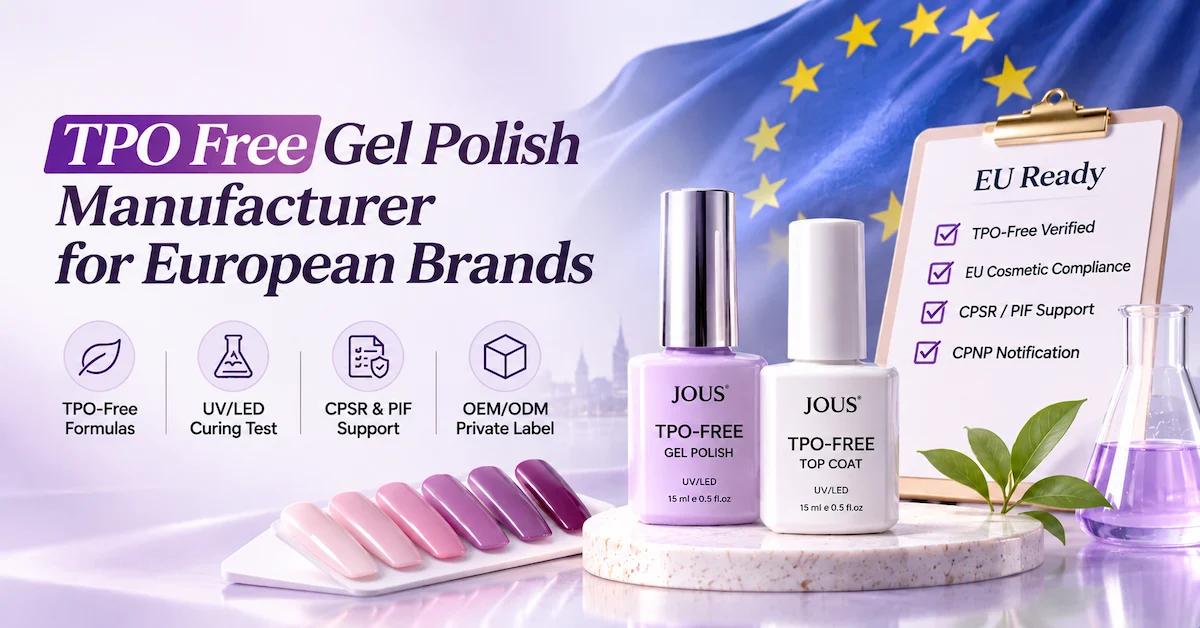
Finding a reliable TPO free gel polish manufacturer is an important sourcing decision for European nail brands, professional beauty distributors, salon chains, and private label businesses.
Since September 1, 2025, the European Union has prohibited Trimethylbenzoyl Diphenylphosphine Oxide (TPO) in cosmetic products under Commission Regulation (EU) 2025/877. This means nail brands must evaluate ingredient composition, product safety documentation, and formula performance before introducing or replenishing gel polish collections for the EU market.
Quick Answer: European brands should choose a TPO-free manufacturer that can identify the exact formulation, support ingredient verification, demonstrate appropriate UV/LED curing performance, provide relevant manufacturing records, and supply information needed for EU cosmetic safety assessment and notification.
JOUS provides professional nail gel manufacturing, TPO-free product options, formula customization, and OEM/ODM services for international nail brands.
This guide explains how to qualify TPO-free gel polish formulas, review EU documentation, and establish a more reliable private label manufacturing program.
Why Do European Nail Brands Need TPO-Free Gel Polish?
TPO, whose INCI name is Trimethylbenzoyl Diphenylphosphine Oxide (CAS 75980-60-8), was used as a photoinitiator in certain UV/LED-curable nail products.
Photoinitiators help initiate the polymerization process when compatible formulations are exposed to suitable light.
However, TPO was classified as a category 1B reproductive toxicant under EU chemicals legislation. Commission Regulation (EU) 2025/877 subsequently added it to the prohibited substances list under the EU Cosmetics Regulation.
What Changed on September 1, 2025?
The prohibition affects both new products and products previously supplied to the market.
| Business Activity | EU Position Since September 1, 2025 |
|---|---|
| Importing new TPO-containing cosmetic gel polish | Prohibited for EU market placement |
| Selling TPO-containing cosmetic gel polish | Prohibited |
| Distributing existing TPO-containing stock | Prohibited |
| Supplying TPO-containing products free of charge commercially | Prohibited |
| Using TPO-containing nail products on salon clients | Prohibited |
| Continuing to sell stock purchased before the restriction | Not permitted under a sell-through exemption |
The European Commission clarified that there is no general sell-through or use-up period for existing TPO-containing cosmetic products.
For European brands, this makes formulation verification essential when choosing replacement products or developing new collections.
It also means buyers should review existing inventory, supplier records, and product documentation rather than relying on previous purchasing approvals.
Does TPO-Free Mean a Gel Polish Is Fully EU Compliant?
No. TPO-free is an ingredient-exclusion claim, not proof of complete compliance with EU cosmetic requirements.
A product may be formulated without TPO but still require ingredient review, a cosmetic safety assessment, suitable labeling, relevant manufacturing evidence, and regulatory notification.
European brands should distinguish among three different claims.
| Claim | What It Means | What It Does Not Prove |
|---|---|---|
| TPO-Free | The identified formulation is claimed not to contain TPO | Complete EU cosmetic compliance |
| HEMA-Free | The identified formulation is claimed not to contain HEMA | Absence of all sensitizing ingredients |
| EU Cosmetic Compliance | The actual product meets relevant applicable requirements | That every formula from the same manufacturer is compliant |
TPO and HEMA Have Different EU Regulatory Status
TPO is prohibited in EU cosmetic products.
HEMA and Di-HEMA Trimethylhexyl Dicarbamate are subject to different restrictions under Commission Regulation (EU) 2020/1682, including professional-use conditions and specific warnings for applicable nail products.
Therefore, buyers should not treat TPO-Free, HEMA-Free, and TMPTA-Free as interchangeable claims.
A manufacturer should identify which substances are excluded from each specific formula and provide appropriate supporting information.
How to Verify a TPO-Free Gel Polish Formula Before Ordering
A reliable supplier should connect its ingredient claims to an identifiable, approved product formulation.
Step 1: Confirm the Exact Formula and SKU
Request the product name, formula reference, version, and intended use.
A general statement that a manufacturer offers TPO-free products does not establish that every color gel, base coat, or builder gel uses a TPO-free formula.
Step 2: Review Ingredient Documentation
Request appropriate ingredient information and a written declaration addressing the exact substance being excluded.
The declaration should be traceable to the formula under evaluation.
Where necessary, coordinate with the supplier and responsible safety assessor to determine whether additional evidence or testing is appropriate.
Step 3: Evaluate the Replacement Photoinitiator System
Removing TPO can require changes to the photoinitiator system or other formulation components.
Manufacturers should evaluate how the resulting formulation responds to the intended curing equipment.
A replacement ingredient is not automatically suitable simply because it serves a similar function.
Its applicable regulatory status, concentration, compatibility, and product safety must be evaluated.
Step 4: Test the Finished Formula
The finished gel polish should be tested under defined application and curing conditions.
Testing should consider viscosity, color, opacity, curing characteristics, and compatibility with the intended base and top coats.
Step 5: Establish Batch and Change Control
Once the formula is approved, confirm how future production batches will be linked to the approved version.
If the photoinitiator system, pigments, or other relevant components change, the buyer should be informed and determine whether renewed testing or safety-document updates are required.
The objective is not merely to purchase a TPO-free label, but to approve a reproducible formulation supported by appropriate evidence.
Technical Specifications for TPO-Free Gel Polish Manufacturing
European buyers should request a product specification that connects the formula's intended performance with its quality-control requirements.
TPO-Free Gel Polish Technical Checklist
| Technical Parameter | What Buyers Should Verify | Procurement Importance |
|---|---|---|
| Formula Identification | Approved formula code and revision | Prevents product confusion |
| TPO Exclusion | Formula-specific ingredient evidence | Supports the ingredient claim |
| Photoinitiator System | Appropriate technical and regulatory review | Supports curing and safety assessment |
| UV/LED Compatibility | Tested lamp characteristics and exposure conditions | Helps ensure appropriate curing |
| Viscosity | Measurement method and agreed range | Affects application control |
| Color and Pigmentation | Approved reference and opacity | Supports consistent appearance |
| Curing Performance | Product-specific evaluation criteria | Supports intended product use |
| Base/Top Compatibility | Approved product combinations | Supports complete nail gel systems |
| Stability | Relevant storage and stability evaluation | Supports product quality |
| Batch Traceability | Lot identification and formula records | Supports repeat purchases |
| Packaging Compatibility | Bottle, cap, brush, and light protection | Helps maintain product integrity |
These are recommended specification fields. Actual acceptance limits must be determined for each formulation rather than assumed to apply universally.
Does Removing TPO Affect UV/LED Curing Performance?
Changing the photoinitiator system can affect how a UV/LED gel responds to curing conditions.
The extent of any change depends on the complete formulation rather than the absence of TPO alone.
Important variables include:
-
Photoinitiator absorption characteristics.
-
Lamp emission spectrum and irradiance.
-
Exposure time.
-
Gel layer thickness.
-
Pigment type and concentration.
-
Transparency or opacity.
-
Interactions with other formulation components.
Why European Buyers Should Test Complete Nail Gel Systems
A TPO-free color gel may perform differently when combined with different base and top coats.
Therefore, the product should be evaluated using the actual intended manicure system.
A controlled test program should establish application conditions, curing instructions, and relevant acceptance criteria.
Where appropriate, qualified laboratories may use suitable analytical methods to evaluate curing or polymerization characteristics.
A hard-looking or touch-dry surface alone does not establish adequate curing.
What About Highly Pigmented and Cat Eye Gels?
Opaque colors, glitter products, and magnetic cat eye gels may require additional product-specific evaluation.
Pigmentation and effect materials can influence light interaction and visual appearance.
Brands developing multiple product categories should not assume that one curing instruction has been validated for every formula.
Which TPO-Free Nail Gel Products Can European Brands Source?
JOUS lists a dedicated TPO & HEMA & TMPTA Free Gel Polish product category.
The category includes listings described as TPO-free across color gel, extension gel, base-related products, and selected functional gels.
However, each listed product must be evaluated separately before making a final ingredient or regulatory claim.
Product Selection Matrix
| Product Type | Potential Brand Application | Main Evaluation Requirement |
|---|---|---|
| TPO-Free Color Gel | Professional shade collections | Color, curing, opacity and batch consistency |
| TPO-Free Base Gel | Foundation for nail gel systems | Adhesion, application and compatibility |
| TPO-Free Top Gel | Glossy or other finishing effects | Surface finish and curing performance |
| TPO-Free Builder Gel | Professional overlays and structural applications | Viscosity, flexibility and structural suitability |
| TPO-Free Extension Gel | Nail extension applications | Working properties and curing behavior |
| TPO-Free Cat Eye Gel | Magnetic nail art collections | Pigment effect, color and curing evaluation |
Product availability and TPO-free status must be confirmed for the exact selected formula. This table describes potential sourcing categories rather than a guarantee that every listed JOUS product is available in every configuration.
A complete brand collection may require multiple formula types to be assessed together.
For brands seeking customized color systems, JOUS also offers OEM/ODM nail gel development.
What EU Compliance Documents Should a TPO-Free Gel Polish Manufacturer Support?
For cosmetic products placed on the EU market, Regulation (EC) No 1223/2009 establishes requirements relating to safety, manufacturing, labeling, responsible persons, and product information.
A Chinese OEM manufacturer may provide essential technical information and documentation assistance.
However, responsibility for completing the applicable EU regulatory obligations must be clearly assigned.
EU Cosmetic Documentation Checklist
| Document or Requirement | Purpose | Responsible Party or Verification |
|---|---|---|
| Ingredient / INCI Information | Identifies ingredients for relevant assessments and labeling | Manufacturer supplies accurate supporting data |
| TPO-Free Formula Declaration | Supports the specified ingredient exclusion | Supplier and brand verify formula scope |
| Cosmetic Product Safety Report (CPSR) | Provides product-specific safety assessment | Qualified safety assessor; EU Responsible Person ensures compliance |
| Product Information File (PIF) | Maintains required product information | EU Responsible Person |
| CPNP Notification | Electronic product notification before EU market placement | EU Responsible Person, with distributor obligations where applicable |
| GMP Evidence | Supports appropriate manufacturing practice | Manufacturer supplies relevant records |
| Label and Warning Review | Confirms required product information | EU Responsible Person with relevant partners |
| Batch Quality Documentation | Supports quality and traceability | Manufacturer and supply-chain participants |
| Stability / Compatibility Data | Supports assessment of the finished product | Relevant testing and technical parties |
EU Responsible Person
A cosmetic product must have an appropriate EU-established Responsible Person before it is placed on the EU market.
For imported cosmetics, the importer generally takes this role unless another EU-established person has been designated according to the Regulation.
The parties should confirm these responsibilities in writing.
CPSR and PIF
A CPSR evaluates the safety of the actual cosmetic product.
The PIF contains required product documentation, including the CPSR, manufacturing information, and other relevant records.
A manufacturer can assist with technical information, but providing an ingredient list does not automatically complete the CPSR or PIF.
CPNP Notification
The Cosmetic Products Notification Portal is used to submit required information about cosmetic products.
CPNP notification is not an EU product approval certificate.
Brands should complete the relevant processes before placing products on the market.
What About Brands Selling Outside the EU?
The United Kingdom, Switzerland, and other European markets have their own applicable requirements.
An EU-compliant product should not automatically be described as approved for every European country.
The intended destinations should be specified during the supplier qualification process.
How to Compare Standard and Customized TPO-Free Formulations
A European brand may not need a completely new formula for every product.
Choosing the correct development model can reduce avoidable complexity.
| Sourcing Option | Main Advantages | Buyer Must Confirm | Suitable Buyer |
|---|---|---|---|
| Existing TPO-Free Formula | Established product starting point | Ingredient evidence, performance and EU readiness | New private label brands |
| Existing TPO-Free Formula + Custom Colors | Brand-specific color collection | Shade approval, curing and repeatability | Growing nail brands |
| Custom TPO-Free Formulation | Greater control over defined requirements | Development scope, technical testing and safety assessment | Established professional brands |
| Bulk TPO-Free Gel + Local Filling | Regional filling and packaging flexibility | Formula verification, filling quality and legal responsibilities | Qualified filling businesses |
TPO-free sourcing does not eliminate the need to approve packaging, colors, labels, and finished-product performance.
For companies with suitable local filling facilities, JOUS Bulk Gel Supply may provide another sourcing approach.
Bulk gel availability and formula-specific documentation should be confirmed before selecting this option.
How to Evaluate a TPO-Free Gel Polish Manufacturer for European Brands
A supplier should demonstrate both manufacturing capability and the ability to support informed regulatory review.
Consider the following evaluation criteria.
1. Formula Transparency
Can the manufacturer identify the exact formula and provide suitable ingredient information?
2. Technical Development Capability
Can it explain the requirements for replacing TPO and validating the resulting product?
3. Testing and Quality Control
Are relevant curing, color, viscosity, and batch-control procedures available?
4. EU Documentation Support
Can the manufacturer provide the records needed by the brand and its EU Responsible Person or qualified assessor?
5. OEM/ODM Capability
Can the supplier support customized colors, packaging, labels, and professional nail gel systems?
6. Commercial Reliability
Are MOQ, sample requirements, lead times, and formula-change procedures clearly explained?
Common Supplier Warning Signs
| Warning Sign | Potential Risk |
|---|---|
| All products described as TPO-free without formula identification | Claims may not be traceable to individual SKUs |
| No information about curing conditions | Product performance may be insufficiently documented |
| Supplier claims TPO-free means completely safe | Misleading safety positioning |
| Supplier claims universal EU approval | Regulatory responsibilities may be misunderstood |
| No documentation for formula changes | Inconsistent future production |
| No identifiable sample approval process | Commercial batch may differ from approved sample |
| Unclear MOQ or packaging specifications | Unexpected commercial commitments |
An evidence-based supplier evaluation helps reduce risks before production begins.
How JOUS Supports TPO-Free Gel Polish OEM Manufacturing
Guangzhou JOUS Fine Chemical Co., Ltd. provides professional nail gel formulation, manufacturing, color development, and private label services for international brands.
JOUS has a dedicated product category for certain TPO, HEMA, and TMPTA-Free Nail Gel formulations.
Its OEM/ODM Manufacturing Service describes support for formula development, viscosity and curing-performance adjustments, color matching, bottles, labels, and outer packaging.
Formula and Product Selection
European buyers can review the available TPO-free product options and discuss formulation requirements for their intended market.
Custom Colors and Private Label Packaging
JOUS supports branded collections with custom shades, bottle options, labels, and packaging design.
Manufacturing and Quality Control
The company describes a controlled production environment and quality-control processes intended to support consistent product manufacturing.
Buyers should request the specific evidence and available technical records relevant to their selected formulations.
Documentation and Project Coordination
JOUS describes documentation assistance for international customers.
For EU-bound orders, buyers should identify the information required by the responsible regulatory parties and confirm what JOUS can provide for each SKU.
Contact JOUS for TPO-Free Gel Polish Samples and OEM Manufacturing
How to Request a TPO-Free Gel Polish Quotation
An effective inquiry should describe the intended EU market and the exact products required.
European Brand RFQ Checklist
| Buyer Information | What to Specify |
|---|---|
| Target Market | EU Member States and any additional countries |
| Business Model | Nail brand, salon chain, importer, distributor or local filler |
| Product Categories | Color gel, base, top, builder, extension or cat eye |
| Ingredient Requirements | TPO-free and any additional specific exclusions |
| Formula Requirements | Existing or customized formulation |
| Performance Requirements | Viscosity, finish, application and UV/LED curing |
| Color Selection | Existing shades or custom color references |
| Packaging | Bottle size, logo, label and outer box |
| Documentation | Ingredient information and relevant EU safety-file support |
| EU Responsible Person | Identified party or planned arrangement |
| Initial Quantity | Expected units per shade or formula |
| Reorder Forecast | Potential future purchasing requirements |
| Launch Schedule | Sample approval and commercial delivery targets |
For custom development, request the manufacturer to identify the proposed sample process, approved formula reference, quality criteria, and conditions affecting MOQ or lead time.
A written quotation should clearly separate product specifications from regulatory and commercial assumptions.
Request a Project-Specific TPO-Free Gel Polish Quotation from JOUS
Frequently Asked Questions About TPO-Free Gel Polish Manufacturing
1. Is TPO-free gel polish required for the EU market?
Cosmetic gel polish placed or made available on the EU market must not contain prohibited TPO. The prohibition has applied since September 1, 2025, including commercial supply and professional use of existing stock.
2. What should I look for in a TPO free gel polish manufacturer?
Look for formula-specific ingredient evidence, suitable UV/LED curing information, manufacturing quality controls, relevant documentation support, sample approval procedures, and consistent repeat-order specifications.
3. Is TPO-free gel polish automatically safe for everyone?
No. Removing TPO does not eliminate every potential product hazard or sensitivity concern. The complete formulation must be evaluated for its intended use, and appropriate application instructions and safety measures remain important.
4. Can JOUS manufacture TPO-free gel polish for private label brands?
JOUS lists TPO-free product options and offers OEM/ODM formulation and private label services. Buyers should confirm the availability, composition, and applicable documentation for their exact products.
5. Is TPO-free the same as HEMA-free?
No. These claims refer to different substances. EU cosmetic legislation prohibits TPO, while HEMA and Di-HEMA Trimethylhexyl Dicarbamate are subject to separate restrictions and professional-use warnings.
6. Does removing TPO change gel polish curing time?
It may affect curing behavior depending on the complete formulation and photoinitiator system. The final product should be tested under suitable UV/LED conditions rather than relying on curing instructions for an older formula.
7. Does TPO-free gel polish need a CPSR?
Cosmetic gel polish marketed in the EU requires an appropriate safety assessment, including the relevant CPSR. Being TPO-free does not remove this obligation.
8. Can a Chinese manufacturer complete CPNP notification for an EU brand?
The required notification and legal responsibilities are associated with the applicable EU Responsible Person and other relevant parties. A Chinese manufacturer may provide supporting technical information or assistance, but the commercial agreement must clarify legal responsibilities.
9. Can I order TPO-free builder gel, base coat, and top coat?
These product categories can be evaluated for TPO-free sourcing. JOUS lists certain relevant product types in its special-formula category, but availability and ingredient-exclusion claims must be confirmed for each specific formula.
10. How do I request TPO-free gel polish samples from JOUS?
Prepare the target market, product types, ingredient requirements, color references, curing expectations, packaging specifications, estimated quantities, and documentation needs. Submit the information through the JOUS Contact Us page to discuss available formulas, samples, and OEM manufacturing terms.
Conclusion
Choosing a TPO free gel polish manufacturer is an important part of developing or maintaining professional nail gel collections for the European market.
Since the EU prohibition took effect on September 1, 2025, European nail brands must verify actual formulations rather than rely solely on general supplier descriptions or ingredient-free marketing claims.
Successful sourcing requires a combination of formula verification, appropriate UV/LED curing assessment, manufacturing quality control, relevant EU safety documentation, and consistent repeat-order specifications.
TPO-free status is one necessary consideration for applicable EU cosmetic products, but it does not replace the responsibilities associated with the complete finished formulation.
JOUS supports international nail brands through professional gel polish manufacturing, TPO-free product options, formula development, OEM/ODM customization, and private label packaging.
Whether your business is replacing an existing gel polish line or developing a new European private label collection, begin with confirmed technical requirements, traceable samples, and clear documentation responsibilities.
Explore JOUS TPO-Free Nail Gel Products or Contact JOUS for TPO-Free Formula Samples and an OEM Manufacturing Quotation to discuss your European sourcing project.