
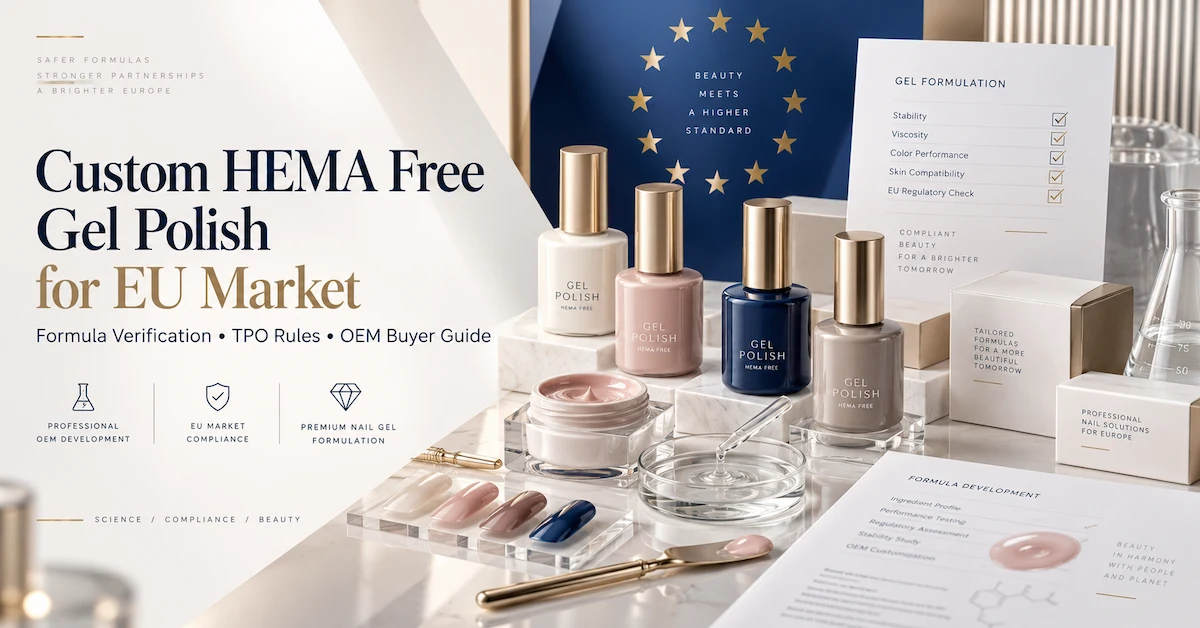
Custom HEMA Free Gel Polish for EU Market: What Buyers Must Verify First
To source custom HEMA free gel polish for EU market distribution, a nail brand should specify the exact ingredient exclusions, confirm the complete formula against current EU cosmetic restrictions, evaluate how the gel cures and performs, and establish who will handle the EU safety assessment, product file, labeling, and notification. Only then should the buyer approve commercial packaging, minimum order quantities, and production.
The distinction is important: “HEMA-free” describes the absence of a particular ingredient, not the safety or legal status of an entire nail gel system. A formulation that excludes HEMA can still contain other acrylates or methacrylates with sensitization potential. It must also meet EU requirements affecting other ingredients, notably the prohibition on TPO in cosmetics from September 1, 2025. Likewise, a supplier's ingredient list or factory certificate does not replace the obligations of the EU responsible person.
For European salon brands, private-label businesses, distributors, and importers, the practical goal is an evidence-backed product that technicians can use according to validated instructions and buyers can reorder to the same approved specification. This guide focuses on that EU-specific sourcing process rather than repeating a generic manufacturer-selection checklist.
HEMA-Free, DI-HEMA-Free and TPO-Free: Three Different Questions
HEMA stands for 2-Hydroxyethyl Methacrylate (CAS 868-77-9). It is a distinct substance from DI-HEMA TRIMETHYLHEXYL DICARBAMATE, frequently abbreviated DI-HEMA TMHDC. Buyers should not assume that a claim about one automatically answers whether the other is present. Request the precise INCI names, the version-controlled composition supplied to the appropriate safety assessor, and the supplier's definition of any exclusion claim.
The EU has not imposed a blanket ban on HEMA in nail products. Commission Regulation (EU) 2020/1682 placed HEMA and DI-HEMA TMHDC under specified nail-product restrictions, including professional-use limitations and package warnings. By contrast, Commission Regulation (EU) 2025/877 prohibited Trimethylbenzoyl Diphenylphosphine Oxide (TPO) in cosmetic products beginning September 1, 2025. Those legal statuses should never be blended into a single marketing phrase.
| Substance / claim | What it actually addresses | EU buyer action |
|---|---|---|
| HEMA-free | Exclusion of HEMA from the specified formula | Obtain formula-specific confirmation; do not infer absence of other sensitizers |
| DI-HEMA TMHDC | A different named ingredient restricted in nail products | Check separately when setting an ingredient exclusion policy |
| TPO | A photoinitiator prohibited in EU cosmetics from September 1, 2025 | Screen the full formula and ensure no TPO-containing cosmetic stock enters EU commercial supply |
| TMPTA-free | Another ingredient-exclusion request sometimes offered by suppliers | Define the exact substance and ask for evidence; assess the rest of the formulation independently |
| “Allergy-free” or “non-toxic” | Broad statements about finished-product safety | Do not infer or use such claims from a single exclusion; require appropriate substantiation and legal review |
A particularly costly mistake is treating TPO-free as an exceptional EU marketing benefit. Since EU cosmetics cannot lawfully contain TPO, compliance with that prohibition is a baseline requirement. EU cosmetic-claims rules also caution against presenting compliance with minimum legal requirements as a special product advantage. TPO exclusion belongs in the technical specification; any consumer-facing marketing wording should be reviewed under the applicable cosmetic-claims criteria.
Who Should Source a Custom EU-Oriented HEMA-Free Gel System?
This procurement route is most useful to buyers who need control over more than a logo. Professional nail brands may require a documented color, base, and top-coat system for trained technicians. EU importers and distributors need repeatable product identification, traceability, labels suited to their destination countries, and documentation for the responsible person. Salon chains may prioritize familiar application behavior and consistent replenishment. Established e-commerce brands may need careful separation of professional-use items from products intended for consumers.
A customized formula is not always necessary. If an existing supplier formulation can meet the verified ingredient brief, usage requirements, product-safety review, and brand positioning, private labeling it may involve fewer development variables. Substantial adjustments to rheology, opacity, photoinitiator systems, or builder-gel performance are more likely to require structured OEM/ODM work and additional testing.
This approach is not suitable for a buyer who intends to avoid professional regulatory responsibilities simply by printing “HEMA-free” on the bottle, nor for a business seeking a guarantee that no customer can experience irritation or allergy. The product, its intended use, and its market obligations must be assessed together.
Step 1: Set the EU Market and Product Brief Before Formulation
“EU market” is not a complete technical brief. State the EU Member States where the product will be available, the intended user, and whether it will be sold through professional distributors, salons, or consumer-facing retail. Member States may specify language requirements for particular label information. The UK should be treated as a separate regulatory market rather than automatically grouped with the EU.
A useful written brief should include:
-
Product category: color gel polish, base gel, rubber base, builder gel, top coat, cat-eye gel, or functional nail-art gel.
-
Ingredient policy: exclusion of HEMA, and any separate requirements concerning DI-HEMA TMHDC or other named substances; confirmation of current EU restrictions across the complete composition.
-
Intended user: professional technician or another intended user supported by the product's assessment and labeling.
-
Application system: surface preparation, complementary layers, lamp conditions, intended coating thickness, and removal approach.
-
Brand format: stock or custom bottle, shade count, net quantity, labels, outer packaging, and target country languages.
-
Evidence required: formula and ingredient information, sample ID, manufacturing records, technical tests, and material needed for the EU safety file.
-
Commercial parameters: initial quantities, reorder frequency, target shipment date, and the party acting as EU importer and responsible person.
Avoid requesting performance in purely promotional terms such as “cures in any lamp” or “lasts a month on everyone.” Ask instead for a validated application method and the tests supporting the supplier's product-specific claims. This makes your RFQ more accurate and reduces the risk of extensive sample revisions.
Step 2: Select Products as a Complete Nail Gel System
A custom HEMA-free color gel is only one component of a commercial manicure range. When creating an EU-oriented collection, review the base, color, top, and any builder or extension products as a system. A product can be individually acceptable yet perform poorly with a different brand's uncured layer, removal method, or lamp protocol. Test combinations intentionally rather than assuming universal compatibility.
| Product family | Why EU brands may include it | Main specifications to compare |
|---|---|---|
| Solid color gel polish | Core shades for professional salons and distributors | Ingredient exclusions, pigment dispersion, opacity, shade consistency, cure instructions |
| Rubber or standard base | Supports the intended nail coating system | Application, compatibility, adhesion, flexibility, removal |
| No-wipe or gloss top | Final finish and service workflow | Surface cure, gloss, staining behavior, abrasion observations |
| Builder or builder base | Structural services for qualified technicians | Viscosity, leveling, suitable structure, layer limits, removal |
| Cat-eye or decorative gel | Distinctive collections and seasonal launches | Magnetic effect, opacity, suspension stability, curing |
| Functional adhesive or nail-art gel | Technique-specific professional products | Use instructions, purpose-specific adhesion or modeling, system compatibility |
JOUS publicly lists a TPO, HEMA and TMPTA free gel polish product category, including listings for color, base, extension, and other specialist gels. Those listings establish advertised product directions, not independent verification of each SKU's ingredients or permission to sell it in the EU. Request the exact proposed formula, current composition, intended use, and supporting records for each selected item.
The first collection need not cover every family. A carefully tested professional color range and its supporting base and top may be more manageable than a large catalog containing many unverified combinations.
Step 3: Evaluate Formula Chemistry and UV/LED Curing Together
Removing or replacing one ingredient can change how a nail gel behaves. The relevant question is not whether a sample looks similar in the bottle, but whether the finished and properly applied system meets its defined performance and safety objectives. This matters especially when changes affect reactive ingredients or the photoinitiator system.
Cure response and the light source
UV/LED gel systems depend on photoinitiator chemistry and exposure to suitable light. Lamp wavelength and irradiance, exposure duration, layer thickness, pigment loading, and other formulation properties can influence the cure. After a photoinitiator change, the manufacturer should not simply copy curing claims from an older product or assert that every commercial lamp produces equivalent results.
Ask which lamp specifications, use conditions, layer thickness, and performance criteria were used for the relevant sample. Review the finished base–color–top combination, not just a clear test gel. Highly pigmented or dark shades should be included in the assessment because they may behave differently from translucent samples.
Flow, self-leveling and brush control
Viscosity measures resistance to flow; rheology covers the broader way material flows under different conditions. A self-leveling product must balance smooth surface formation with control near the sidewalls and cuticle. Builder gels may require a different flow profile from thin color gels. A supplier should describe the intended application, not market every formula as equally thin, thick, and self-leveling.
Adhesion, flexibility and removal
The target coating system influences adhesion and mechanical performance. A rubber base for natural nails may need a different flexibility profile from a structural extension gel. Ask about appropriate removal instructions—such as soak-off or file-off where relevant—and avoid treating easy removal and high structural strength as automatically interchangeable benefits.
Ingredient evidence is not a cure test
A document saying “HEMA not added” does not establish successful cure, minimal residual reactive substances, or a safe finished product. Likewise, a gel that feels hard after curing is not proof of complete chemical conversion. Ask what validation or assessor-relevant evidence is available for the actual formula and application method. Specialist testing methods and acceptance criteria depend on product type and should not be invented in a marketing article.
Step 4: Build a Sample Approval Plan for EU Buyers
An OEM sample must be tied to a formula revision, color or finish specification, and intended packaging. This becomes particularly important when developing custom HEMA free gel polish for EU market requirements: after any formula adjustment, the supplier and EU responsible person need to know exactly which version is being evaluated and documented.
| Sample checkpoint | Evidence to retain | Why buyers need it |
|---|---|---|
| Formula identification | Formula code, revision, date, ingredient declaration supplied through the agreed process | Prevents undocumented substitutions |
| Shade and appearance | Approved physical reference and controlled visual evaluation | Supports future batch color matching |
| Viscosity / application | Test method or observation record with conditions | Confirms expected technician handling |
| UV/LED curing | Defined lamp and exposure parameters, layer thickness, performance findings | Prevents unsupported universal cure claims |
| Multi-layer compatibility | Tested base–color–top combination | Avoids assuming all systems are interchangeable |
| Wear and removal | Documented, suitable product-specific assessment | Supports appropriate instructions and claims |
| Packaging compatibility | Filled-bottle observations, light protection and closure behavior | Reduces leakage and stability concerns |
| Final approval | Signed golden sample or equivalent reference and specification | Connects development to production QC |
Technician feedback is useful, but it should be distinguished from formal laboratory findings and regulatory safety assessment. Record both positive observations and failure modes: streaking, sidewall flooding, unexpected lifting, gloss change, bottle leakage, or inconsistent cure with defined equipment. Where samples change, update the sample record and determine whether any existing safety or stability conclusions need revisiting.
JOUS describes OEM/ODM formula customization and color matching, plus an approval-to-production workflow. For an EU project, request a written sample plan showing which tests the manufacturer can perform and which must be commissioned separately.
Step 5: Map EU Cosmetic Responsibilities—CPSR, PIF, RP and CPNP
A supplier may help assemble product information, but EU legal compliance is a defined responsibility, not a document bundle with an impressive name. Regulation (EC) No 1223/2009 sets requirements relating to product safety, the EU responsible person, good manufacturing practice, safety assessment, the Product Information File, notification, and labeling. Identify the appropriate responsible person and regulatory workflow before releasing artwork or commercial production.
| Requirement | What it means for the project | Practical owner question |
|---|---|---|
| EU Responsible Person (RP) | An EU-established person or entity must be designated in accordance with the regulation | Who is the RP for this particular imported product, and what is documented? |
| Cosmetic Product Safety Report (CPSR) | Qualified safety assessment based on the actual product and its intended conditions of use | Who commissions and reviews the report, and for which formula versions? |
| Product Information File (PIF) | Product-specific records including the CPSR, manufacturing/GMP details, and relevant claims substantiation | Who maintains it and where is it accessible to the authorities? |
| CPNP | Electronic cosmetic product notification under the applicable requirements before market placement | Who submits and updates it? |
| Good Manufacturing Practice | Production under appropriate GMP requirements | Which manufacturing records and certificates substantiate the specific claim? |
| Article 19 labeling | Product identity, responsible-person details and other required information | Who signs off the final country-language labels? |
| Claims substantiation | Evidence for declared product benefits or ingredient-exclusion claims | Where is the evidence and who approves marketing copy? |
CPSR is not an optional certificate that can be swapped for an SDS. An SDS may be useful for workplace handling or transport assessment, but it is not itself the EU finished-cosmetic safety report. Similarly, CPNP is a notification system, not a premarket product approval or an EU-issued endorsement of performance. The European Commission describes CPNP as a free online notification portal.
The PIF must be maintained as required by the regulation, including the prescribed retention period after the last batch is placed on the market. Its technical information should remain aligned with the formula actually manufactured, the intended uses, and any changes. For multiple shades, ask the qualified assessor whether and how variants may be covered; do not assume one assessment automatically covers an unlimited palette.
The European importer or brand may have responsibilities beyond obtaining supplier reports. The exact arrangement depends on the parties and the legal structure, and changes should be agreed in writing. A China-based manufacturer's offer of export documentation assistance is valuable, but it is not a substitute for the EU-established responsible person's legal obligations.
Step 6: Handle HEMA Restrictions and the TPO Ban Correctly
Commission Regulation (EU) 2020/1682 provides a precise rule relevant to this market: nail products containing HEMA or DI-HEMA TMHDC under the specified Annex III entries are limited to professional use and require the warnings “For professional use only” and “Can cause an allergic reaction.” The regulation does not turn the phrase “HEMA-free” into a blanket requirement for all nail gel products.
Regulation (EU) 2025/877 is different. It placed TPO on the EU prohibited-substances list for cosmetics with effect from September 1, 2025. The European Commission's subsequent Q&A clarified that TPO-containing cosmetics cannot continue to be supplied in the EU, including old commercial stock, and professional nail salons cannot use that stock on clients after the cut-off date. This is not simply a recommendation to change future batches.
For a 2026 sourcing project, ask the manufacturer to document a TPO-free formula and confirm that the exact finished product intended for import has been reviewed against the current EU restrictions. Do not equate being TPO-free with automatically being EU-compliant. Any replacement photoinitiator or other ingredient still requires independent consideration in the complete safety assessment and performance evaluation.
Importers should also establish a regulatory change-control procedure. If a supplier changes a photoinitiator, oligomer, pigment system, or other component, require notification, a revised composition record, and a determination from the responsible person or relevant specialists about needed testing and document updates. The cheapest substitution is not acceptable if it invalidates the approved formulation or its evidence.
Step 7: Design EU-Ready Labels Without Unsupported Marketing Claims
A product's label is the final expression of its verified formulation, intended user, claims, and responsible-person arrangement. EU labeling needs cannot be solved by copying the front panel of a popular competitor. The exact information and language requirements depend on the product, packaging, and destination Member State.
Article 19 of Regulation (EC) No 1223/2009 covers key labeling matters, including responsible-person information, nominal content where applicable, relevant durability information, precautions, batch or identification data, product function when not clear, and ingredient naming. Small packaging may have specific presentation arrangements; these need case-by-case review.
Claims an EU brand should scrutinize
-
“HEMA-free”: confirm the exact formula and the scope of the exclusion. It should not imply that the product has no allergy potential.
-
“DI-HEMA-free”: assess separately if requested; do not treat the presence or absence of HEMA as conclusive for this substance.
-
“TPO-free”: use TPO exclusion as a procurement and compliance condition, while avoiding promotional claims that present ordinary legal compliance as a special EU benefit.
-
“Hypoallergenic” or “allergy-safe”: do not infer these from an ingredient exclusion; they require strong, appropriate evidence and careful claims review.
-
“Non-toxic,” “zero-risk,” or “safe for everyone”: overly broad statements are difficult to support and can mislead users.
-
“30-second cure” or “three-week wear”: only claim a performance outcome that has been properly substantiated for the exact product under relevant conditions.
EU cosmetic claims are governed by Article 20 of the Cosmetics Regulation and the common criteria in Commission Regulation (EU) No 655/2013. These address legal compliance, truthfulness, evidential support, honesty, fairness, and informed decision-making. Product safety and marketing accuracy are related but separate obligations.
Step 8: Choose an OEM Supply Model and Packaging Strategy
The most practical supply model depends on your team, quantity, and ability to oversee product filling. EU private-label buyers without filling infrastructure often start with finished bottles, whereas established companies with controlled local filling operations may evaluate bulk nail gel. Custom formulation development is possible under either arrangement, but the project responsibilities are different.
| Supply option | Suitable buyer | What to clarify before ordering |
|---|---|---|
| Existing HEMA-free formula + private label | Small EU salon brand or new product line | Verified composition, available bottle, label approval, MOQ per shade |
| Customized OEM/ODM formula | Brand with specific rheology, color or application targets | Development plan, formula ownership, new tests, approval and change control |
| Finished bottled OEM gel | Importer or distributor without filling equipment | Final label, RP details, packed-goods QC, shipping and traceability |
| Bulk HEMA-free gel | Qualified local filler or established industrial buyer | Filling controls, container compatibility, batch records, responsibilities after filling |
JOUS offers private-label and OEM/ODM manufacturing as well as bulk gel supply. Its website identifies 8 ml, 10 ml and 15 ml options for finished bottled products and says MOQ varies with formula and color complexity. These are product-service descriptions, not a promise that every HEMA-free formula is available at every size or minimum. Check the precise combination in the quotation.
A low per-bottle price can conceal high minimums on pigment shades, custom cap finishes, printed cartons, or individual formula variants. Request a breakdown by formula, shade, bottle, cap, label and box, then calculate the total quantity and cash exposure. For EU imports, include product assessment, label localization, samples, inspection, logistics, duties, and any responsibilities incurred by the EU business. Do not present hypothetical cost numbers as actual JOUS quotations.
Step 9: Evaluate Manufacturing QC and Repeat-Order Control
Once a formula has been selected and evaluated, the next commercial risk is whether the manufacturer can consistently make the same approved product. That includes more than a similar bottle appearance. A repeat production order should align with the agreed formulation, shade reference, application properties, fill, package, and identification records.
Request written answers to these quality questions:
-
How are incoming ingredients and pigment lots identified and reviewed?
-
How is the approved formula version controlled during production?
-
Which viscosity, shade, appearance, curing, or performance checks are appropriate for this product?
-
Are testing conditions consistent with the approved application method?
-
How are bottles, brushes, closures, labels and filling quantities inspected?
-
Are retained samples and batch identifiers available for complaint investigations?
-
What happens if a raw material, photoinitiator, colorant, or packaging component must change?
-
How are defective shipments, deviations and repeat-order discrepancies addressed?
JOUS describes a production workflow involving raw-material checks, mixing, defoaming, color verification, semi-finished testing, filling, labeling and finished packaging. It also refers to its clean-workshop environment and export documentation support. These are company-published manufacturing capabilities; buyers should request any specific certificate, quality plan, test record, and acceptance limit required for their own products rather than assuming that a marketing description proves a particular test result.
A useful contractual control is to retain a golden sample and approved specification. State how disagreements will be resolved and whether changes to the composition can occur only after written approval. In a market with ingredient restrictions, unannounced substitution is especially problematic because it can invalidate the existing safety file or claims.
Step 10: Request a Quote That Supports EU Product Approval
An effective RFQ for custom HEMA free gel polish for EU market supply should not ask only for “price per bottle.” It should enable the manufacturer to evaluate the exact product and enable your EU regulatory partners to determine which supporting records are needed.
EU-focused OEM request checklist
| Include in the RFQ | Example of a useful request |
|---|---|
| Target geography | EU Member States where the products will be distributed |
| Intended user | Professional salon technicians, or another clearly supported user group |
| Product list | Color gel, base, top, builder, cat-eye or selected functional gels |
| Named ingredient exclusions | No HEMA; separate DI-HEMA requirement if needed; current EU TPO prohibition acknowledged |
| Compliance workflow | EU RP and assessor involved; list of documents required from the manufacturer |
| Application parameters | Intended lamp, layer thickness, finish, removal and compatible product system |
| Sampling | Samples with formula codes, test plan, revisions and golden-sample approval |
| Packaging | 8/10/15 ml preference where applicable; bottle, cap, brush, label and languages |
| Initial quantities | Forecast by formula and shade, plus likely reorder scenarios |
| Commercial request | MOQ breakdown, development cost, tests, delivery terms, timing, payment and change control |
Ask the supplier to distinguish available stock formulas from newly developed formulas, and to identify any information or tests it cannot supply. Transparency is more valuable than a promise that every document is automatically included. You can review JOUS's relevant product categories before sending a brief to its OEM/ODM project team.
Common EU sourcing mistakes to avoid
Mistake: “HEMA-free” means consumer-safe. It does not. Intended use and the complete product must be assessed, and other ingredients may present risks.
Mistake: HEMA and DI-HEMA are the same label check. They are separately named substances; define the precise exclusions you want.
Mistake: TPO restrictions are only for new manufacturing. EU commercial supply and professional use of TPO-containing cosmetics are prohibited under the applicable rule, including relevant older stock.
Mistake: CPNP is an EU approval certificate. It is notification, not authorization or a safety guarantee.
Mistake: One SDS replaces a CPSR and PIF. These are different documents with different purposes and legal roles.
Mistake: A cleanroom or ISO statement proves SKU compliance. Facility systems support manufacturing control but do not validate every ingredient, shade, claim or safety assessment.
Mistake: Every shade behaves like the clear sample. Pigment loading and product use conditions can affect cure; evaluate representative variants appropriately.
Mistake: An approved sample means future formulas may be substituted. Require revision identification and formal change approval.
Why JOUS Is Relevant to Custom EU Nail Gel Projects
JOUS describes itself as a professional nail gel manufacturer offering formula matching, color development, packaging customization and finished or bulk supply for international brands and distributors. For European buyers, those services create potential routes to source a complete product line through one manufacturing partner, subject to individual product suitability and technical verification.
Its public HEMA/TPO/TMPTA-free product category can help buyers identify formulations to investigate. Its OEM/ODM service describes formula and packaging customization, while the bulk gel program addresses buyers with filling requirements. The website does not provide enough open technical data to establish each listed formula's complete INCI composition, final EU safety report, specific cure validation or regulatory status; those should be requested and assessed for the proposed SKU.
A commercially useful first conversation should therefore cover which formula is proposed, which exclusions are documented, which tests support the intended use, which packaging combinations are available, and which EU compliance files will be handled by which party. This turns supplier outreach into a genuine product-development project instead of a generic price inquiry.
Frequently Asked Questions About HEMA-Free Gel Polish for the EU
1. Is HEMA banned in EU gel polish?
No. HEMA is not universally banned in EU nail cosmetics. Under Commission Regulation (EU) 2020/1682, nail products containing HEMA under the relevant restriction are limited to professional use and must carry specified warnings. An EU brand should verify the substance, formulation and applicable labeling rather than interpreting “HEMA-free” as a statutory requirement for all gels.
2. Does HEMA-free mean DI-HEMA-free?
No. HEMA and DI-HEMA TRIMETHYLHEXYL DICARBAMATE are different ingredient names. If the buyer wants both excluded, they must specify both and obtain formula-specific verification. A marketing title that only states HEMA-free cannot settle the separate DI-HEMA question.
3. Can an EU nail salon still use an older gel product containing TPO?
The European Commission's guidance explains that, from September 1, 2025, the EU TPO prohibition prevents commercial supply of affected cosmetic products and professional use on clients, including relevant older stock. Salons and distributors should address remaining TPO-containing stock in accordance with applicable requirements rather than assuming a use-up period exists.
4. Does a HEMA-free nail gel need a CPSR and PIF?
Being HEMA-free does not remove EU cosmetic safety and product-information obligations. Under the Cosmetics Regulation, the responsible person must ensure the applicable safety assessment, Product Information File and other requirements are completed for the finished product. An ingredient declaration alone is not a substitute.
5. Is CPNP registration the same as EU product approval?
No. CPNP is the Cosmetic Products Notification Portal used for required electronic notification. It does not certify that a gel is safe, validate an OEM factory, or replace the responsible person's obligations. Buyers should be cautious of misleading “CPNP approved” marketing statements.
6. Can HEMA-free gel polish cause an allergic reaction?
Yes, it may. Excluding HEMA does not eliminate other potential sensitizers, nor does it establish that skin contact with uncured material is harmless. Follow verified product instructions, prevent avoidable skin exposure, and assess safety and claims for the finished formula and intended use.
7. Must a HEMA-free formula also be TPO-free for the EU?
EU cosmetic products must comply with the current EU TPO prohibition irrespective of whether they contain HEMA. Request the complete formula and ensure the photoinitiator system and all other ingredients receive appropriate regulatory and technical review. TPO exclusion by itself is not enough to establish full EU compliance.
8. Can JOUS customize HEMA-free colors and packaging?
JOUS advertises OEM/ODM formula, color and packaging support and lists HEMA/TPO/TMPTA-free product options. The exact achievable color, formula, bottle, MOQ and supporting evidence must be confirmed for each proposed project. Review its OEM/ODM capabilities and request samples before production.
9. What should I test when replacing a photoinitiator?
Review cure performance with the intended lamp and layer thickness, including relevant pigmented shades, along with application properties, stability, package compatibility and other product-specific requirements. Work with qualified technical and safety specialists to determine appropriate test methods and whether documents need updating.
10. What information should I send for an EU OEM quote?
Specify the destination EU countries, target users, formula and ingredient requirements, color and product categories, intended application conditions, packaging preferences, trial and order quantities, regulatory document needs, and launch timeline. Use JOUS's contact page to request a project-specific sample plan, MOQ details and quotation.
Conclusion
Sourcing custom HEMA free gel polish for EU market buyers requires coordinated ingredient verification, product-specific curing and quality evidence, and a clear EU compliance workflow—not simply a “free-from” label. Separate HEMA restrictions from the TPO prohibition, define the responsible person's role, and approve the complete formula, packaging and repeat-order controls before launch. To discuss suitable OEM/ODM formulas, documented sample development and an EU-focused quotation, contact JOUS with your product brief.