
A professional nail gel supplier should help your business source more than individual bottles of gel polish. For nail brands, importers, wholesale distributors, and salon chains, the real purchasing challenge is finding a supplier that can deliver compatible product systems, consistent quality, appropriate documentation, and dependable support for future orders.
A good initial sample is only one part of that evaluation. The base gel must work with the color or builder system. The recommended UV/LED lamp must be capable of curing the product under specified conditions. Packaging must preserve the formula during storage, and approved colors should remain consistent when production moves from samples to commercial quantities.
The short answer: Choose a professional nail gel supplier by evaluating six areas: product-system compatibility, technical performance, manufacturing and quality controls, market-specific documentation, customization capability, and repeat-order management. Confirm these requirements through product samples and written specifications before placing a bulk order.
This guide explains how to make those assessments, with practical selection criteria for professional nail gel brands, beauty distributors, salon operators, and businesses planning OEM/ODM manufacturing or local filling.
1. What Should a Professional Nail Gel Supplier Actually Provide?
The term nail gel supplier can describe several different businesses.
Some companies distribute finished nail products manufactured elsewhere. Others specialize in packaging and private labeling. A direct manufacturer may handle formulation, production, filling, and customization, although the exact scope varies considerably between factories.
There is no single supply model that fits every buyer.
A distributor purchasing several unrelated beauty categories may prefer a trading partner capable of consolidating products from different sources. A private-label brand developing an integrated gel system may benefit from direct communication with a manufacturer that can discuss formulation, curing behavior, and packaging compatibility.
The distinction becomes important when a technical problem appears. If customers report that a particular top coat does not perform as expected over a builder gel, who investigates the compatibility issue? If a color shifts between shipments, who maintains the approved color reference? If regulations change in the destination market, who can provide the necessary formulation information?
A supplier's ability to answer these questions matters more than the number of shades displayed in a catalog.
The four supply models B2B buyers should understand
|
Supply model |
Typical services |
Suitable buyers |
Main consideration |
|---|---|---|---|
|
Finished product wholesale |
Existing nail gels in standard packaging |
Distributors, retailers, salon suppliers |
Product selection, pricing, stock and replenishment |
|
Private label / OEM |
Existing or specified products with branded packaging |
New and established nail brands |
Formula choice, artwork, packaging MOQ and approval |
|
ODM development |
Customized formulation, product effects or performance requirements |
Brands seeking differentiated products |
Development scope, testing and ownership terms |
|
Bulk gel supply |
Nail gel supplied for subsequent filling or packaging |
Local fillers, manufacturers, larger distributors |
Bulk specifications, transport, filling and batch controls |
Before contacting suppliers, identify which of these models your business actually needs. Requesting a generic wholesale price when your project requires an exclusive formula usually produces a quotation that cannot be used for realistic cost planning.
A supplier should also distinguish between its own manufacturing operations and any outsourced activities. Bottle molding, printing, packaging components, and certain laboratory tests may involve external partners. That arrangement is not necessarily a weakness, provided responsibilities, documentation, and quality controls are clear.
2. Build Your Product Range Around Complete Gel Systems
One of the most expensive assortment mistakes is purchasing attractive individual products without confirming how they work together.
Professional nail services commonly involve several layers or functions: preparation, base application, color or structure creation, and finishing. Specialty techniques may require additional decorative gels or adhesives.
A brand offering all these products should evaluate the complete system rather than treating each bottle as an unrelated SKU.
Compare the main professional nail gel categories
|
Product category |
Main function |
Technical priorities |
Typical commercial application |
|---|---|---|---|
|
Color Gel Polish |
Provides color and decorative finish |
Pigmentation, viscosity, curing and shade consistency |
Salon color collections and retail kits |
|
Base Gel / Rubber Base |
Provides a foundation for compatible gel systems |
Adhesion, flexibility, leveling and removal requirements |
Professional salon systems |
|
Top Gel / Top Coat |
Creates the final surface finish |
Gloss, surface curing, scratch behavior and compatibility |
Salon finishing products |
|
Builder Gel |
Creates additional nail structure |
Viscosity, self-leveling, structural behavior and curing |
Nail overlays and extensions |
|
Extension Gel / Poly Gel |
Supports artificial nail extension and sculpting |
Workability, shape retention, cure depth and finishing |
Nail extension studios |
|
Cat Eye Gel |
Creates magnetic decorative effects |
Pigment distribution, magnetic response and curing |
Specialty color collections |
|
Nail Art Gel |
Supports drawing, blooming, transfers or decoration |
Flow control, effect consistency and application precision |
Nail art and professional design |
|
Press-on Nail Gel |
Supports certain artificial nail attachment systems |
Adhesive behavior, geometry, cure accessibility and instructions |
Press-on nail products |
These are functional distinctions, not universal performance specifications. Two products called “builder gel” may behave differently, and a rubber base is not interchangeable with every hard builder formula.
Color gel polish: assortment depth versus usable colors
A large color range can be commercially useful, especially for distributors and established salon brands. Yet a catalog containing hundreds or thousands of colors does not automatically produce a well-designed assortment.
For a wholesale launch, consider organizing colors by how customers will purchase and use them:
-
Core salon colors with broad everyday appeal.
-
Sheer and neutral shades for natural-looking finishes.
-
Seasonal collections that can be rotated without replacing the entire assortment.
-
Specialty finishes such as cat eye, glitter, or other decorative effects.
-
Coordinated shades selected for specific customer groups or sales channels.
Every additional shade creates its own inventory, labeling, sample approval, and reorder requirements. A tightly selected collection may be easier to manage than a much larger catalog with limited demand information.
JOUS provides a dedicated Color Gel Polish collection as well as a Cat Eye Gel category. These are useful starting points for discussing different types of branded nail color collections.
When sourcing magnetic products, request physical swatches showing the finish both before and after magnetic manipulation. A single promotional photograph cannot adequately demonstrate every possible visual result.
Base and top products: compatibility comes first
A base gel helps establish the intended relationship between the prepared nail surface and subsequent gel layers. A top coat provides the final surface finish. Their performance depends on the formula, application, curing conditions, and the rest of the system.
A buyer should ask whether the supplier recommends a particular base for its color gels or builder products.
Do not assume that a no-wipe top coat is universally appropriate for every application. The preferred product may depend on whether the customer needs a glossy finish, a specialty decorative surface, or compatibility with a particular color or builder system.
The JOUS Top Gel category and Builder Base Gel range can help buyers identify which product directions require further sample testing.
Builder and extension products: define the technique
Builder gel purchasing requires a different evaluation process from ordinary color gel purchasing.
A nail technician may need a self-leveling product for overlays, a more controlled texture for structural work, or a gel intended for extensions. These needs cannot be reduced to a single claim such as “high strength.”
A builder gel that levels quickly may feel efficient in one working technique but difficult to control in another. A highly structured gel may offer greater placement control yet require more finishing work.
Start with the intended technique, then determine the suitable viscosity, leveling behavior, removal procedure, and curing protocol.
JOUS lists both Self-Leveling Gel and Extension Gel among its product categories. Buyers should request specific formula information before treating products in those categories as substitutes.
3. Why Gel System Compatibility Matters More Than Individual Product Claims
A supplier may offer an excellent color gel, an attractive top coat, and a builder formula with appealing handling characteristics. That does not necessarily mean those three products have been validated as one complete system.
Professional nail gels are formulated to cure through specific photochemical processes. Their performance can be affected by the chemistry of neighboring layers, pigment loading, application thickness, curing conditions, and surface preparation.
Incompatible combinations may create difficulties with application, interlayer adhesion, finish, or removal. Some problems only become visible during wear, making compatibility testing particularly important for brands that intend to sell a coordinated professional system.
Ask suppliers to identify recommended product combinations
For each proposed collection, request a compatibility matrix.
|
Product system |
Products to evaluate together |
Main questions |
|---|---|---|
|
Standard salon color system |
Base + Color Gel + Top |
Are application, curing and removal instructions compatible? |
|
Flexible base system |
Rubber Base + Color + Top |
Does the system suit the intended professional technique? |
|
Structured overlay system |
Builder Gel + compatible finishing products |
Can the intended structure and finish be achieved reliably? |
|
Nail extension system |
Extension product + compatible layers |
Are shaping, curing and finishing procedures validated? |
|
Specialty art system |
Base + Effect Gel + Top |
Does the decorative effect survive the required finishing process? |
|
Press-on system |
Nail tip + appropriate adhesive or gel |
Can the attachment system cure or set correctly under the intended conditions? |
A compatibility recommendation should specify the tested product references rather than referring vaguely to “all gel polishes.”
Buyers also need to distinguish between products requiring soaking and products that typically require filing or a more complex removal procedure. Applying an unsuitable removal method can create product complaints and professional-use risks even when the original application appears successful.
Consider the equipment used by your customers
A professional nail gel supplier should be able to discuss the curing equipment associated with its products.
This matters when a brand distributes gel products without controlling which lamps its customers use. Lamp specifications, wavelength output, irradiance, condition, and exposure time can differ. An instruction such as “cure for 60 seconds” is incomplete unless it is connected to a suitable lamp and application method.
Buyers should request the manufacturer's validated curing instructions and decide how those requirements will be communicated to salon customers.
Selling a compatible gel system with clear technical instructions is generally more useful than selling individual products with broad claims of universal compatibility.
4. Technical Specifications Every Nail Gel Buyer Should Verify
Color appearance is easy to evaluate visually. Technical consistency requires a more structured approach.
A professional buyer does not necessarily need to know every confidential ingredient percentage, but the supplier should be able to provide enough product-specific information to support safe use, quality evaluation, and procurement decisions.
The following checklist can guide discussions with potential manufacturing partners.
|
Quality parameter |
What buyers should verify |
Why it affects purchasing |
|---|---|---|
|
Viscosity |
Defined measurement conditions and acceptable range |
Influences application and filling behavior |
|
Self-leveling |
Flow and leveling under the intended technique |
Affects working control and finishing effort |
|
Pigmentation |
Coverage at a defined number of coats and thickness |
Influences color consistency and application |
|
Color matching |
Approved master swatch and viewing conditions |
Reduces variation between shipments |
|
UV/LED curing |
Compatible lamp conditions and recommended application thickness |
Helps avoid inadequate curing |
|
Adhesion |
Evaluation on appropriately prepared substrates |
Supports intended application performance |
|
Surface finish |
Gloss, tack, hardness or decorative appearance as applicable |
Determines the finished product's intended use |
|
Storage stability |
Separation, settling, color change and viscosity stability |
Supports storage and shelf-life decisions |
|
Packaging compatibility |
Bottle, cap, seal, brush and light protection |
Helps prevent leakage, degradation or dispensing problems |
|
Batch traceability |
Product code, batch reference and retained sample system |
Supports investigations and reorders |
These are evaluation categories, not published performance figures for JOUS products. Acceptance ranges must be agreed for each specific formula.
Viscosity: the same number can describe different behavior
Viscosity is particularly important for builder gels, rubber bases, bulk products, and formulas intended for automated filling.
However, gel products may be non-Newtonian: their apparent viscosity changes with shear, temperature, or measurement conditions. Two materials can produce similar readings under one method while behaving differently during brush application.
When evaluating viscosity, ask the supplier to identify the measurement temperature, instrument, measuring geometry or spindle, test speed, and any relevant preconditioning.
Buyers should also perform practical application tests.
A builder gel that appears stable in its container may spread more quickly during brushing. A gel that remains controlled on a nail tip may behave differently when applied over a warmer surface or worked for an extended period.
For purchasing purposes, the useful question is not simply, “How thick is this gel?”
It is, “Does this gel provide the intended working control under our application conditions, and can the manufacturer reproduce that behavior?”
UV/LED curing: distinguish visible hardness from adequate cure
Most UV/LED nail gels rely on photoinitiators that respond to suitable light and initiate polymerization. The formula, lamp output, pigment characteristics, and applied layer all influence the result.
A surface that feels hard is not, by itself, conclusive proof of adequate polymerization throughout the coating.
Opaque colors, thick builder applications, and certain heavily pigmented products deserve particular attention because light transmission can be affected by the formula and application.
Before approving a product, establish the specific curing method that will be used during evaluation.
That includes the lamp model or relevant technical specifications, application thickness, exposure conditions, and intended finishing procedure.
Do not assume that a gel will cure adequately in every device marketed as a UV/LED nail lamp.
Color consistency: use physical standards, not screenshots
A digital color image can help buyers shortlist shades, but it is not a dependable production reference.
Lighting, display calibration, camera processing, substrate color, and coating thickness influence appearance.
A better color-approval process uses a physical master swatch prepared under defined conditions. The buyer and supplier should agree on the base substrate, number of coats, curing method, and viewing environment.
For critical shades, instrumental color measurements may supplement visual assessment. If a color-difference tolerance is used, it should be defined for the relevant product and measurement method rather than applying an arbitrary number to every formula.
Keep the final approved swatch and product reference available for future production.
This is particularly important for distributors replenishing popular shades across multiple seasons.
5. How to Test Samples Before Approving Wholesale Nail Gel Orders
Samples should answer a defined list of purchasing questions. They should not function merely as attractive sales demonstrations.
A structured sample program reduces the risk of approving one product version and accidentally ordering another.
Step 1: Identify the sample correctly
Each sample should be recorded with an identifiable product or formula reference, shade number, development version, intended package, and date received.
If the supplier adjusts a formula after feedback, treat the revision as a new sample.
For example, changing the viscosity may improve working control but could also affect the application characteristics that were accepted previously. A revised sample should therefore be reviewed against the agreed requirements rather than approved automatically.
Step 2: Use a repeatable evaluation procedure
Prepare the testing environment before comparing suppliers.
For color products, keep the substrate and application method consistent. For builder gels, use the same intended sculpting or overlay technique. For products requiring a lamp, follow the validated lamp and curing requirements.
A useful evaluation program includes both controlled comparative observations and professional-use assessment.
|
Test stage |
Suggested evaluation |
Record |
|---|---|---|
|
Initial condition |
Packaging integrity, appearance and any separation |
Sample and condition notes |
|
Application |
Flow, brush control, leveling and coverage |
Application observations |
|
Color or effect |
Appearance under defined lighting and application conditions |
Reference swatches and images |
|
Curing |
Performance under the specified lamp and application conditions |
Product, lamp and procedure details |
|
Finishing |
Gloss, surface behavior, filing or decorative effect where relevant |
Finished sample observations |
|
Compatibility |
Performance with the intended companion products |
System and product references |
|
Removal |
Approved removal process and practical observations |
Removal instructions and findings |
|
Packaging |
Closure, dispensing, brush and storage behavior |
Packaging evaluation record |
Testing should be performed by appropriately trained personnel, with safe handling of uncured materials and suitable precautions for potential skin sensitization. Do not use informal human wear trials as a substitute for required safety assessment or validated curing evaluation.
Step 3: Evaluate the complete product system
A new color collection may look excellent over a particular demonstration base coat. If your brand intends to sell another base and top combination, test that combination as well.
For structured nail systems, examine the complete application process rather than judging the builder formula in isolation.
Some suppliers can provide suggested product combinations and corresponding application instructions. Ask whether these recommendations are supported by internal compatibility evaluations and whether the supplier can share appropriate evidence.
Step 4: Separate approval criteria from preferences
Not every observation has the same importance.
Color preference and visual effect can involve subjective brand decisions. Packaging integrity, product identity, compliance requirements, and the agreed technical specification should be treated as defined acceptance matters.
If the sample meets the original functional requirements but the marketing team wants a different shade, record that as a new development request rather than a quality failure.
This distinction keeps the manufacturer and buyer aligned.
Step 5: Retain the final approved reference
Once the sample is accepted, confirm its reference and revision in writing.
The purchase order should correspond to the approved formula, color, packaging, and relevant instructions. Retaining reference samples can help resolve later questions about product differences.
A buyer should not approve a large order solely because one sample looks acceptable on arrival.
Planning your first professional gel collection? Contact JOUS to discuss product samples, intended gel systems, and technical requirements before finalizing your purchasing specifications.
6. How to Evaluate a Nail Gel Manufacturer's Production and Quality Controls
A supplier's product catalog tells you what it offers. Its manufacturing and quality-control system helps indicate whether it can reproduce an approved product consistently.
When visiting or remotely evaluating a factory, ask how the company controls production from incoming materials through final release.
Raw material identification and incoming inspection
Gel manufacturing depends on consistent incoming materials, which may include oligomers, reactive diluents, pigments, photoinitiators, and other formulation components.
The exact ingredients depend on the product.
A buyer should confirm whether the manufacturer uses approved raw material specifications, checks incoming batches, and maintains traceability between raw materials and finished production.
The purpose is not to demand public disclosure of a proprietary recipe. It is to understand whether material changes can be detected and managed.
Mixing, dispersion and deaeration
Uniform mixing and appropriate pigment dispersion affect product appearance and consistency.
Certain formulations may also require controlled deaeration or other processing to reduce entrained air.
For highly pigmented color gels, poor dispersion can produce visible specks, inconsistent shade appearance, or settling behavior.
For transparent products, bubbles or suspended particles may be more noticeable.
A factory evaluation should therefore go beyond photographs of mixing equipment. Ask what in-process properties are checked and how the manufacturer decides whether a batch may proceed to filling.
Filling, labeling and final inspection
Finished-bottle production introduces another set of risks.
A correct gel formula can still become a commercial problem if the fill quantity is wrong, bottles leak, labels identify the wrong shade, or cartons use obsolete artwork.
Check whether the supplier has defined controls for fill quantity, packaging components, closure integrity, label verification, and finished-product identification.
JOUS describes a production sequence that includes raw material inspection, stirring, deaeration, color testing, semi-finished product checks, filling, labeling, and packaging. Its website also identifies viscosity, curing, adhesion, and durability as areas considered during production testing. These are company-published descriptions; buyers should request project-specific evidence and acceptance criteria.
Document control and corrective action
Manufacturing quality is not only about preventing errors. It also concerns how errors are investigated.
Useful questions include whether the supplier maintains batch production records, how deviations are handled, whether approved formulations are version-controlled, and how customer complaints are investigated.
For long-term partners, ask whether corrective actions are documented and reviewed before the next production run.
A manufacturer that can explain these procedures clearly is easier to assess than one that relies entirely on general claims of strict quality control.
7. Supplier Qualification: Which Documents and Capabilities Matter?
International buyers should assess documents according to their purpose.
A management-system certificate is not the same as a test report. A cosmetic product ingredient list is not a safety assessment. A marketing claim about being suitable for a particular market does not establish the legal status of every SKU.
A practical supplier qualification checklist
|
Document or evidence |
What it helps establish |
What buyers should verify |
|---|---|---|
|
Business and manufacturing information |
Supplier identity and business model |
Legal entity, facility and production responsibilities |
|
ISO or GMP-related certificate |
Claimed management or manufacturing standards |
Issuer, validity, site and certification scope |
|
Product specification |
Agreed commercial and technical requirements |
Product identity, version, test conditions and limits |
|
Ingredient information / INCI |
Ingredients relevant to labeling and assessment |
Formula-specific accuracy and currency |
|
SDS, where applicable |
Hazard and handling information |
Correct product, jurisdiction and revision |
|
COA or batch test record |
Evidence of defined batch checks |
Lot identity, measured results and acceptance criteria |
|
Stability or compatibility data |
Support for storage and package decisions |
Test conditions and relevance to final packaging |
|
Label artwork |
Market-facing product information |
Language, warnings, identity and responsible party |
|
Batch traceability records |
Reorder and complaint investigation |
Traceable references and records management |
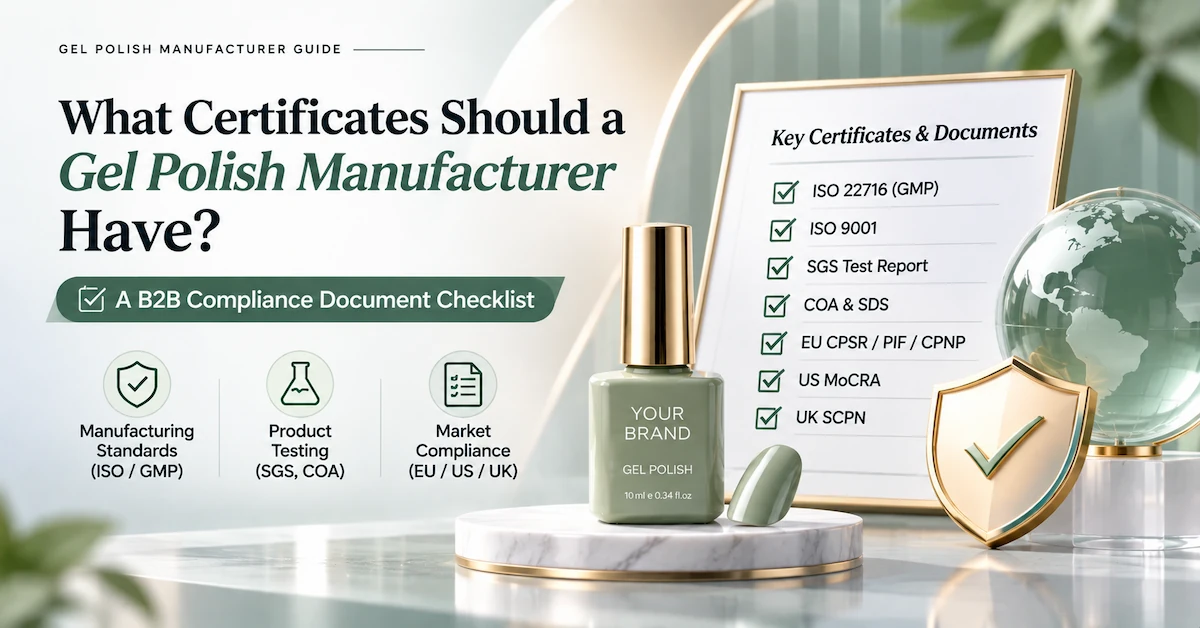
Not every document applies identically to every product or market. Ask suppliers which records they can provide for the actual formula and destination.
A certificate displayed on a factory website may also have a narrower scope than the buyer assumes. Request the complete certificate where appropriate.
Factory or trading partner: which is preferable?
Manufacturing relationships are useful when a buyer requires technical customization and ongoing formula control.
A trading company may offer convenient consolidation and access to several production sources.
Neither business model should be accepted or rejected based solely on its name. Evaluate which organization owns the technical specifications, manages production changes, and is responsible for resolving quality concerns.
If a supplier uses subcontractors, ask how those subcontractors are qualified and what controls prevent unapproved substitutions.
8. EU and US Compliance: What International Nail Gel Buyers Should Know
Compliance requirements depend on the destination country, product formulation, claims, intended use, and responsible business entity.
A supplier's general statement that its products are export-ready should begin a documentation discussion, not end one.
European Union: cosmetic safety and responsible-person requirements
In the EU, cosmetic products are governed by Regulation (EC) No 1223/2009 and applicable amendments.
Among the important obligations are a responsible person, safety assessment, Cosmetic Product Safety Report (CPSR), Product Information File (PIF), appropriate labeling, and notification through the Cosmetic Products Notification Portal (CPNP), as applicable.
CPNP notification is a regulatory notification process. It does not itself constitute an independent product-safety approval.
Buyers should establish who is responsible for preparing, maintaining, and submitting the required information. A manufacturer may provide supporting records, but those services should not be confused with the legal obligations of the relevant responsible person.
TPO-free and HEMA-free formulations
Ingredient restrictions require particular attention when sourcing professional nail gels for the European market.
Under Commission Regulation (EU) 2025/877, Trimethylbenzoyl Diphenylphosphine Oxide, commonly known as TPO, is prohibited in EU cosmetic products from September 1, 2025. The European Commission's published guidance explains that this prohibition also affects commercial supply and professional use of existing stock after that date.
HEMA has a different regulatory position.
Regulation (EU) 2020/1682 restricts nail products containing HEMA and Di-HEMA Trimethylhexyl Dicarbamate to professional use, with specified warning requirements. These restrictions should not be described as an unconditional prohibition of every HEMA-containing professional nail product.
When requesting a HEMA-free or TPO-free product, specify the ingredients that must be excluded and request supporting formula information.
An ingredient-exclusion claim does not mean the finished formula is automatically free of all potential sensitizers or suitable for every user.
A buyer should also avoid assuming that a formula marketed for the EU can be imported without the other applicable documentation and safety-assessment steps.
United States: MoCRA and product responsibilities
In the United States, the Modernization of Cosmetics Regulation Act of 2022 (MoCRA) introduced additional requirements affecting cosmetic facility registration, product listing, safety substantiation, and other regulatory responsibilities, subject to applicable exemptions and implementation details.
Importers and brands should determine which obligations apply to their legal entities and products.
The FDA has explicitly clarified that cosmetic facility registration and product listing do not constitute FDA product approval. The agency does not issue certificates proving compliance with those registration or listing requirements.
This distinction matters when assessing suppliers that advertise “FDA-certified” or “MoCRA-approved” nail gels.
Ask what the manufacturer actually provides: ingredient records, labeling assistance, product information, test documentation, or other support relevant to your market.
JOUS advertises OEM/ODM support that includes documentation and labeling assistance for international customers. The precise documents available for a particular formulation should be confirmed during project discussions.
Build compliance review into the sourcing schedule
Regulatory review should begin before final packaging approval.
A formula change can affect ingredient declarations and safety documentation. Packaging changes can affect labeling obligations. Different product claims may also require substantiation.
Leaving these issues until the shipment is ready can create avoidable delays, rejected artwork, or a need to revise the product.
For compliance-sensitive markets, involve the appropriate regulatory specialist before approving commercial production.
9. OEM/ODM Nail Gel Manufacturing: From Product Idea to Approved Formula
Professional nail gel sourcing often develops into a long-term brand project.
An importer may begin with standard color gels and later request custom packaging. A salon chain might want products designed around its application workflow. An established manufacturer may seek bulk formulations for local filling.
Each project needs a different level of customization.
OEM, private label and ODM are not identical
Private labeling commonly involves selecting an existing product platform and adapting the branding or packaging.
OEM projects may use an established or buyer-defined specification, while ODM projects often involve more extensive product design or formulation development.
These terms are not used consistently by every supplier, so the commercial agreement should describe the actual work rather than rely on a label.
For example, distinguish among selecting an existing shade, adjusting a color, changing viscosity, developing a new effect, modifying a formula, and designing custom bottles.
Each activity can require different approvals, costs, and minimum quantities.
Define the custom product before requesting development
A useful nail gel development brief should specify the expected application.
Instead of asking for “a premium self-leveling builder gel,” describe the target users, preferred working behavior, intended curing equipment, application technique, expected appearance, and any formulation restrictions.
For a cat eye collection, provide physical or visual effect references and specify which features matter most.
For a private-label color range, define the shade palette, finish, retail bottle format, brush expectations, and planned sales market.
The more clearly these requirements are described, the easier it becomes to evaluate whether the supplier's sample meets them.
A practical OEM/ODM project sequence
-
Requirement definition: Establish buyer type, product range, target market, and commercial objectives.
-
Formula and product selection: Decide which products can use existing formulations and which need development.
-
Quotation review: Confirm development charges, sample terms, component minimums, and other assumptions.
-
Sample preparation: Evaluate formulas, colors, application and compatibility.
-
Packaging approval: Check the bottle, brush, cap, decoration, labels, and secondary packaging.
-
Regulatory review: Verify applicable formula, documentation and labeling requirements.
-
Production authorization: Approve the exact product versions and written specifications.
-
Production and inspection: Apply agreed quality controls and shipment acceptance procedures.
-
Reorder management: Preserve approved references and manage subsequent changes.
For exclusive formulations, discuss ownership, confidentiality, permitted use, and what happens if the buyer changes suppliers. These terms should be covered in the commercial agreement where relevant.
JOUS offers OEM/ODM nail gel manufacturing services, including formula development, color matching, viscosity-related customization, and private-label bottles, caps, labels, and outer packaging.
Developing a branded nail gel collection? Discuss your OEM/ODM requirements with JOUS and provide your product brief, target market, packaging concept, and expected purchasing volume.
10. Bulk Nail Gel or Finished Bottles: Which Purchasing Model Makes Sense?
A buyer planning professional gel distribution must decide where filling and packaging will occur.
This decision changes purchasing costs, operating responsibilities, documentation requirements, and quality-control arrangements.
Finished bottles: simpler downstream operations
Finished-bottle purchasing generally places more filling and packaging activities with the upstream manufacturer.
It can suit importers, new private-label brands, e-commerce businesses, and distributors without established local filling equipment.
The buyer still needs to approve the formula and packaging, but does not normally need to operate a separate gel-filling process.
This approach can simplify initial operations, although custom printed bottles, caps, and boxes may create minimum-quantity commitments.
Bulk gel: more control, more responsibility
Bulk supply can be useful for businesses with established filling lines or local packaging partners.
It may allow a company to control its regional bottle formats, manage several brands from an approved product base, or coordinate local packaging availability.
However, the bulk material must remain suitable for the downstream filling process.
Buyers should verify storage conditions, bulk container compatibility, filling equipment suitability, handling precautions, product identification, and the division of responsibilities for final product quality.
A bulk purchase is not automatically cheaper once local processing costs are included.
|
Purchasing factor |
Finished bottles |
Bulk gel |
|---|---|---|
|
Filling process |
Normally performed upstream |
Managed by the buyer or filling partner |
|
Retail packaging |
Supplied as agreed |
Arranged locally |
|
Equipment requirement |
Limited downstream equipment |
Suitable filling and handling equipment |
|
Quality responsibilities |
Focus on finished-product acceptance |
Include downstream filling and packaging |
|
Inventory planning |
Finished SKUs and cartons |
Bulk batches plus packaging components |
|
Customization options |
Manufacturer-dependent |
Local packaging flexibility |
|
Main commercial risk |
Packaging MOQ and finished inventory |
Equipment, handling, filling and combined costs |
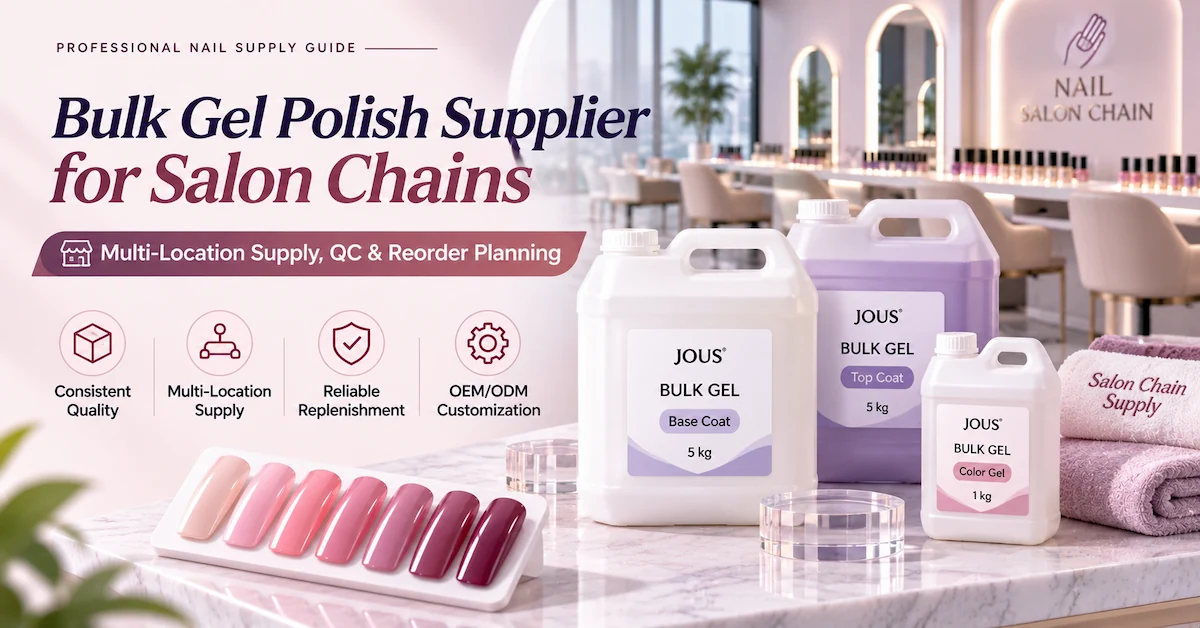
JOUS has a dedicated Bulk Gel Supply service for brands, fillers, and distributors. Its website describes formula selection, specification confirmation, sample approval, bulk production, and reorder support.
Packaging size also influences channel strategy
JOUS lists 8ml, 10ml, and 15ml as standard finished-bottle options on its Bulk Gel page.
These serve different commercial needs.
An 8ml bottle can suit compact collections or trial sets. A 10ml format can be considered for routine retail use. A 15ml bottle may be appropriate for higher-use professional products and larger-capacity ranges.
The appropriate choice depends on brand positioning, consumption patterns, packaging costs, and customer expectations. The presence of a bottle option on the website does not establish availability for every formula or project.
Some JOUS product listings also reference larger packaging formats, such as the solid press-on nail gel listing with 15ml and 1kg options. Buyers should confirm which sizes are offered for the specific product under consideration.
Operating a local filling business or planning larger-volume supply? Ask JOUS about bulk gel specifications and quotation requirements before comparing bulk and finished-bottle costs.
11. MOQ, Pricing and Lead Time: How to Compare Supplier Quotations
Price comparisons become unreliable when suppliers quote different products or packaging assumptions.
A lower unit price may reflect a standard formula, shared packaging, fewer colors, or a larger minimum order.
A higher quotation may include development, custom components, special packaging, or additional documentation.
Neither quotation is meaningful until the scope is aligned.
Understand the different types of MOQ
For OEM/ODM projects, several minimum quantities may apply:
-
Formula MOQ, which depends on production requirements.
-
Color MOQ, which may differ for existing and custom shades.
-
Bottle MOQ, particularly for custom molded or decorated components.
-
Printing MOQ for labels, bottle decoration, or branded caps.
-
Outer-box MOQ for individually printed retail packaging.
-
Bulk packaging MOQ for different container types and production arrangements.
A supplier might offer a relatively manageable product MOQ while a specialized packaging component requires a larger purchase commitment.
That difference should appear in the quotation before the buyer approves artwork.
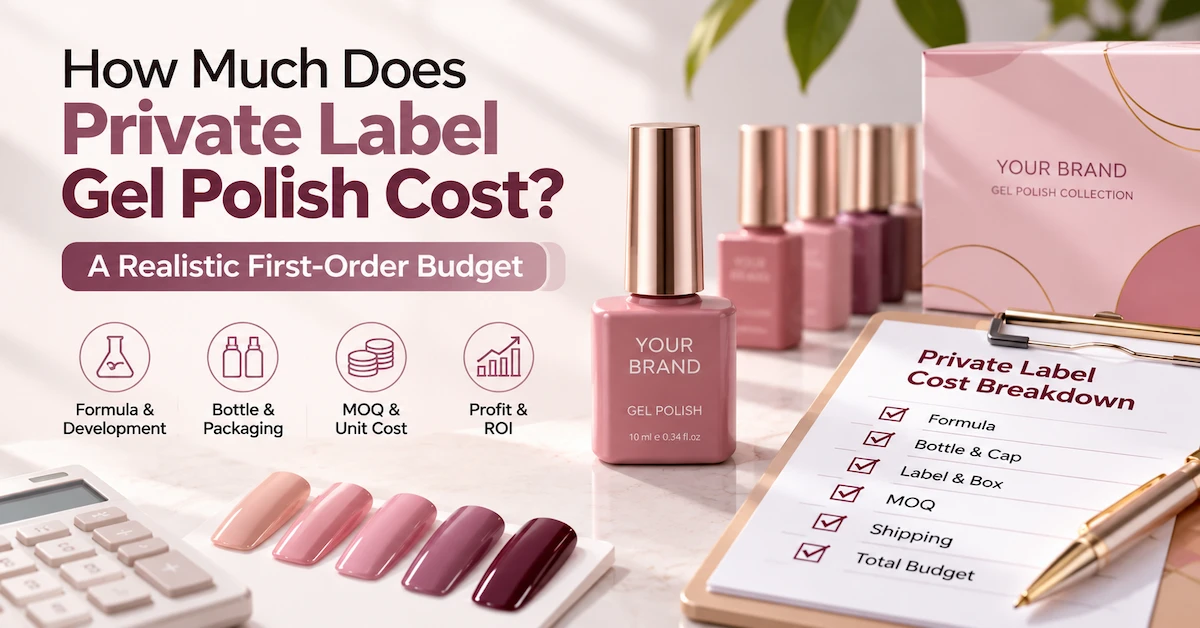
Calculate the full landed cost
The purchase price is only one part of the cost structure.
Depending on the project, buyers may need to account for product manufacturing, decoration, sampling, development, quality verification, transport, duties, insurance, local handling, and regulatory work.
For a bulk program, the calculation may also include filling labor, packaging loss, equipment, local QC, and warehousing.
A useful comparison is:
Estimated landed cost per saleable unit = Total relevant sourcing, logistics, compliance, and processing costs ÷ Expected saleable units.
This is a planning formula, not a substitute for an accounting or customs valuation method.
Calculate the cost using realistic order quantities and expected losses. A quotation per kilogram should not be directly compared with a quotation per retail bottle without adjusting for actual fill quantities and all downstream costs.
Confirm what the lead time includes
A statement such as “production takes two weeks” may exclude formula development, packaging manufacturing, regulatory review, or shipping.
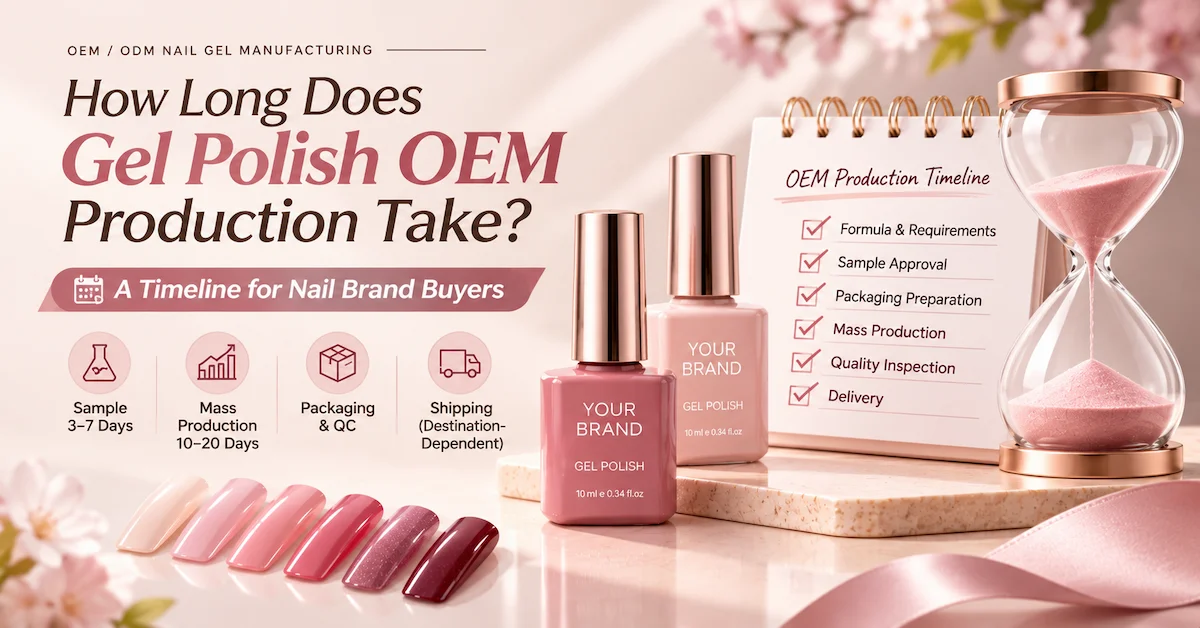
Break the schedule into stages: requirements confirmation, sample development, sample approval, packaging production, material procurement, manufacturing, inspection, and dispatch.
Ask what triggers the production clock. Is it the initial deposit, artwork approval, receipt of materials, or written approval of all product specifications?
A reliable supplier should be willing to define that milestone.
JOUS promotes flexible MOQ options, but the website does not publish a universal minimum quantity for every product and package. Buyers should therefore request project-specific terms rather than assuming one minimum applies across the entire catalog.
12. Compare Suppliers Using a Structured Purchasing Scorecard
Personal impressions can help during supplier discussions, but a written scorecard makes decisions easier to justify.
The following model is an illustrative purchasing tool, not an industry-certified rating method.
|
Evaluation area |
Suggested weight |
Questions to answer |
|---|---|---|
|
Product and system suitability |
25% |
Does the range meet the intended application and compatibility requirements? |
|
Sample performance |
20% |
Did samples meet the agreed evaluation criteria? |
|
Manufacturing and QC |
20% |
Are processes, records and batch controls clear? |
|
Compliance readiness |
15% |
Can the required documentation and regulatory roles be established? |
|
Commercial terms |
10% |
Are MOQ, prices, packaging and timing workable? |
|
Communication and change control |
10% |
Are revisions, responsibilities and reorders managed clearly? |
|
Total |
100% |
Overall supplier assessment |
Different companies should adjust the weights.
An EU importer selling compliance-sensitive professional products may assign greater importance to documentation. A salon chain introducing a specialized builder system may place more weight on sample performance and application consistency.
Legal compliance and critical safety requirements should be mandatory pass/fail gates, not issues that can be offset by a high score for price or communication.
After excluding suppliers that fail those requirements, use the weighted score to compare the remaining candidates.
The scorecard becomes particularly useful when procurement, product development, marketing, and regulatory teams are involved in the same decision.
13. Common Mistakes When Sourcing Professional Nail Gels
Several recurring purchasing mistakes create avoidable disputes.
Choosing products from photographs alone
High-quality images are useful for initial screening, especially for decorative effects. They cannot establish viscosity, curing behavior, adhesion, storage stability, or system compatibility.
Request representative samples before approving production.
Comparing prices without specifying the formula
Two quotes for “15ml builder gel” may refer to different types of products.
Define the intended formula, performance requirements, packaging, and testing scope before treating the quotations as comparable.
Treating HEMA-free or TPO-free as complete safety claims
Ingredient exclusion is relevant but does not replace full formulation assessment, labeling review, and appropriate use instructions.
Check the actual composition and applicable requirements for the destination market.
Expanding the assortment too quickly
More shades and specialized gels mean more references to approve, stock, label, and reorder.
Begin with a product range that supports your target customers and operational capacity.
Neglecting batch and packaging version control
A successful launch can be followed by difficult reorders if the buyer does not retain approved specifications.
Preserve references for formulas, shades, bottles, brushes, labels, and finished-product configurations.
Assuming every problem can be solved by changing suppliers
A product complaint may result from formulation, application technique, inappropriate curing equipment, incompatible product combinations, or incorrect storage.
An effective investigation identifies the cause before making a manufacturing change.
14. What to Include in a Professional Nail Gel Supplier RFQ
An RFQ, or request for quotation, should give suppliers enough information to propose an appropriate product and commercial arrangement.
The goal is not to write the longest possible inquiry. It is to remove uncertainty about what is being purchased.
Recommended nail gel RFQ checklist
|
RFQ field |
Information to provide |
|---|---|
|
Company and market |
Brand or company name, destination country, intended channel |
|
Product categories |
Color, builder, base, top, extension, cat eye or other products |
|
Application |
Salon use, professional distribution, press-on manufacturing or local filling |
|
Formula requirements |
Existing formula or development, intended finish and performance |
|
Ingredient requirements |
Specific excluded ingredients and applicable market restrictions |
|
Color plan |
Shade references, number of colors, requested custom matching |
|
Packaging |
Finished bottle size, brush, cap, label, box or bulk container |
|
Estimated quantity |
First order by product and approximate reorder forecast |
|
Testing |
Sample requirements, curing evaluation, acceptance criteria |
|
Documentation |
Relevant product, regulatory or batch information |
|
Commercial terms |
Target shipment timing, delivery arrangement, quotation currency |
|
Development terms |
Formula ownership, exclusivity or confidentiality where applicable |
A well-defined RFQ helps suppliers identify which aspects are standard and which require custom development.
Where information is not yet available, state that it is open for discussion. For example, a brand may know its target retail size and application but need advice on whether a rubber base or builder base suits the product line.
Questions worth asking before approving a purchase order
Ask which product versions the quotation covers, how changes are approved, who owns the final packaging artwork, which acceptance tests will be applied, and how batch references will appear in the shipment documents.
Also clarify the process for dealing with nonconforming goods.
A quotation becomes a dependable purchasing document only when its product, quantity, packaging, delivery, and quality assumptions are understood by both parties.
15. How JOUS Supports Professional Nail Gel Sourcing
Guangzhou JOUS Fine Chemical Co., Ltd. presents itself as a nail gel manufacturer established in 2014, combining product development, manufacturing, and international OEM/ODM services.
Its About Us page describes in-house R&D, formula design, and manufacturing facilities. These are manufacturer-published details that buyers can evaluate through direct discussion and supporting evidence.
JOUS's product catalog and category pages cover color gels, bases, tops, builder products, extension gels, cat eye products, press-on nail gels, and functional nail art products.
This product breadth may be relevant to buyers seeking several related categories from one manufacturing partner.
However, the actual decision should still depend on the suitability of the specific products, testing results, applicable documentation, and agreed commercial terms.
Match JOUS services to different purchasing projects
|
Buyer profile |
Potential JOUS service |
First item to confirm |
|---|---|---|
|
New private-label brand |
Existing formulas with customized branding |
Initial product plan, MOQ and packaging |
|
Established professional brand |
Formula, color and packaging development |
Technical brief and approval process |
|
Beauty distributor |
Multiple professional gel categories |
Product assortment and repeat supply |
|
Salon chain |
Base, color, top and builder product systems |
Application and curing compatibility |
|
Press-on nail business |
Relevant nail gel and attachment products |
Intended materials, technique and product suitability |
|
Local filling business |
Bulk nail gel formulations |
Bulk specifications and filling requirements |
A buyer seeking custom formulas can review JOUS's OEM/ODM capabilities. A company with its own filling operations can explore the separate bulk supply model.
Neither route should be selected solely from the website description. Sample approval and a specific quotation remain essential.
For an initial inquiry, it is helpful to identify the target market, product types, required packaging, approximate quantity, and any formulation or documentation restrictions.
This allows the supplier to respond to a defined project rather than a general request for its entire product range.
16. Frequently Asked Questions About Professional Nail Gel Suppliers
1. How do I choose a reliable professional nail gel supplier?
Start by matching the supplier's product range to your business needs. Then evaluate product samples, compatible gel systems, manufacturing controls, documentation, commercial terms, and repeat-order procedures.
For OEM or private-label projects, verify whether the supplier can manage formula specifications, color approval, packaging changes, and quality records. Do not select a partner based only on its advertised color range or lowest quotation.
2. What products should a professional nail gel supplier offer?
The appropriate product range depends on your sales channel.
A salon-focused brand may need base gels, color gels, top coats, builder products, and selected decorative gels. A press-on nail business may require different adhesive and application systems. A distributor may prioritize a broader assortment, while a specialist builder-gel brand may prefer fewer, more technically differentiated products.
The best portfolio is one that supports the buyer's actual customers and operating model.
3. How can buyers verify nail gel curing performance?
Ask for product-specific curing instructions, including compatible lamp conditions and recommended application thickness.
Evaluate samples under the defined conditions, with appropriate technical methods and professional handling precautions. A hard-feeling surface alone does not establish complete cure, particularly for thicker or heavily pigmented products.
Avoid assuming that one curing time or lamp works for every formulation.
4. Can I order professional nail gels with my own brand and packaging?
Yes, many manufacturers provide private-label or OEM options.
Depending on the project, customization may include labels, bottles, caps, brushes, boxes, color matching, and formula development.
JOUS advertises these types of services through its OEM/ODM program. Specific availability, charges, minimum quantities, and development terms should be confirmed for the selected products.
5. What factors affect the MOQ for private-label nail gel?
MOQ can depend on the formula, shade selection, production batch requirements, packaging components, printing methods, and degree of customization.
An order using an established formula and stock bottle may have different requirements from one involving an exclusive color, custom mold, or special packaging.
Request separate clarification for product quantities and packaging-component minimums. Do not assume a single published MOQ applies to every SKU.
6. What should I test before placing a bulk nail gel order?
Check the approved formula and shade, viscosity behavior, curing requirements, storage and bulk-container suitability, batch identification, and filling compatibility.
If the material will be packaged locally, evaluate the actual filling process and final retail container.
Agree on acceptance criteria and documentation before authorizing commercial quantities. Bulk supply also requires clearly allocated responsibilities for downstream filling and finished-product controls.
7. What documents should an international nail gel supplier provide?
The required information depends on the product and market, but may include product specifications, ingredient information, appropriate safety documentation, batch quality records, manufacturing or certification information, and packaging or labeling support.
For EU sales, the responsible person must address the relevant safety assessment, PIF, notification, and other legal obligations. For US sales, determine the applicable MoCRA and cosmetic regulatory responsibilities.
Do not treat a registration number or supplier certificate as proof that every finished product is legally compliant.
8. How should buyers compare two nail gel suppliers offering similar prices?
Compare quotations using identical product, quantity, formula, packaging, testing, and delivery assumptions.
Then assess the quality of approved samples, manufacturing records, system compatibility, compliance support, and the supplier's ability to manage reorders.
A slightly lower purchase price may not be beneficial if the order introduces additional packaging inventory, unsuitable products, or unresolved quality responsibilities.
17. Conclusion
Selecting a professional nail gel supplier is a product-system and supply-chain decision, not simply a search for attractive colors or low bottle prices.
For nail brands building a complete professional collection, compatibility between base, color, builder, and top products should be a central evaluation point. Distributors need a manageable assortment and reliable replenishment. Private-label businesses should prioritize clearly defined customization, sample approval, and packaging requirements. Companies sourcing bulk nail gels must also consider their own filling equipment, handling procedures, and quality responsibilities.
Across these purchasing models, the same principle applies: approve specific products under defined conditions, document the agreed specifications, and verify the supplier's ability to reproduce them in commercial production.
A useful supplier evaluation combines technical testing with manufacturing review, regulatory planning, cost analysis, and clear communication. These steps reduce uncertainty before the first shipment and make future replenishment easier to manage.
JOUS provides professional nail gel product categories, OEM/ODM customization, private-label packaging, and bulk gel supply options for international B2B customers.
If you are developing a new product range or reviewing an existing supply arrangement, begin with your intended applications, target market, product categories, and purchasing requirements.