
Finding a reliable gel polish manufacturer requires more than comparing product catalogs, factory photographs, and wholesale prices. For international nail brands, private label companies, distributors, and salon chains, manufacturing reliability directly affects product performance, regulatory documentation, delivery schedules, and customer satisfaction.
The most effective approach is to verify the manufacturer's actual production capabilities, evaluate gel polish samples under controlled conditions, review quality records, and confirm how approved formulas are reproduced during future orders.
A manufacturer that offers attractive samples but cannot explain its quality controls, formula identification, or production process may expose buyers to unnecessary sourcing risks.
This guide provides 12 practical verification checks, a technical sample-testing checklist, and a 100-point supplier evaluation framework to help B2B buyers compare manufacturers before placing commercial orders.
JOUS is a China-based professional nail gel manufacturer offering formula development, OEM/ODM customization, private label production, and bulk nail gel supply. Buyers can use the following criteria when evaluating JOUS or other potential manufacturing partners.
Why Is Choosing a Reliable Gel Polish Manufacturer Important?
Gel polish manufacturing involves formulation chemistry, color development, UV/LED curing performance, production controls, filling, packaging, and batch consistency.
A supplier's ability to produce an attractive sample does not automatically establish its ability to manufacture the same product repeatedly at commercial scale.
Poor manufacturing control can create several business problems:
-
Differences in color or viscosity between production batches.
-
Inconsistent curing behavior under specified application conditions.
-
Packaging leakage or incorrect product labeling.
-
Incomplete product documentation.
-
Unexpected formula or ingredient changes.
-
Production delays and uncertain replenishment schedules.
-
Increased complaints, replacements, and inventory losses.
For a private label brand, these issues can damage consumer confidence. For distributors, they may interrupt supply to multiple customers. For professional salon chains, inconsistent products can affect standardized service procedures.
A reliable manufacturer should therefore be evaluated through documented evidence and reproducible performance, rather than marketing claims alone.
Who Should Use This Gel Polish Manufacturer Verification Checklist?
This framework is particularly relevant to:
| B2B Buyer | Main Purchasing Concern | Verification Priority |
|---|---|---|
| Private Label Nail Brands | Developing consistent branded products | Formula approval and packaging controls |
| Beauty Importers | Sourcing products for specific markets | Ingredient and regulatory documentation |
| Gel Polish Wholesalers | Maintaining dependable stock | Batch consistency and replenishment |
| Professional Salon Chains | Standardizing products across locations | Curing, application, and system compatibility |
| E-Commerce Nail Brands | Controlling complaints and launch risks | Product testing and packaging reliability |
| Bulk Nail Gel Fillers | Filling products in local facilities | Bulk specifications and traceability |
Businesses that only need small quantities of existing retail products may prefer a distributor. Buyers requiring exclusive formulas, substantial customization, or long-term private label production typically need more direct manufacturing involvement.
12 Checks for Finding a Reliable Gel Polish Manufacturer
The following checks form a practical pre-order factory audit.
1. Verify the Manufacturer's Business Identity
Start by establishing who will actually manufacture the products.
Request the company's registered name, business registration details, production-site information, and the name of the entity responsible for your purchase agreement.
Confirm whether the supplier is:
-
A direct manufacturer with production capabilities.
-
A trading company purchasing from factories.
-
A distributor supplying existing products.
-
A business combining manufacturing with outside production partners.
A trading company is not automatically unsuitable, but its business model should be transparent.
Evidence to request: Business registration, manufacturing location, company profile, and a clear explanation of production responsibilities.
JOUS identifies its business as Guangzhou JOUS Fine Chemical Co., Ltd., founded in 2014, and describes its research and manufacturing activities on the JOUS About Us page.
2. Examine the Actual Production Facility
Professional gel polish manufacturing requires suitable production environments, equipment, material handling, and process controls.
Factory photographs can provide useful context, but they should not replace verification.
Where practical, arrange an on-site visit or a live remote walkthrough.
Ask to see:
-
Raw material receiving and storage areas.
-
Formula mixing and dispersion equipment.
-
Defoaming or applicable air-removal processes.
-
Intermediate inspection points.
-
Filling and packaging operations.
-
Finished-product inspection areas.
-
Batch identification and storage procedures.
JOUS states that it operates a Class 100,000 constant-temperature clean workshop. Buyers should request current supporting evidence and clarify the scope of the facility's environmental controls.
Red flag: A supplier repeatedly avoids reasonable requests to clarify where manufacturing takes place.
3. Evaluate Formulation and R&D Capabilities
A manufacturer should understand how different nail gel formulations perform and which characteristics can be adjusted.
For UV/LED gel polish, important technical variables include:
-
Viscosity and flow behavior.
-
Pigment dispersion and color stability.
-
Photoinitiator system and curing requirements.
-
Adhesion and flexibility.
-
Surface finish and leveling.
-
Compatibility between product layers.
-
Storage and packaging stability.
Ask whether the manufacturer provides established formulas, custom development, or both.
More importantly, determine how formula modifications are evaluated and documented.
For private label projects, a reliable gel polish manufacturer should distinguish between selecting an existing shade and developing a modified formulation.
JOUS describes custom formulation, viscosity matching, color development, and product customization through its OEM/ODM services.
4. Check Raw Material Control and Traceability
Gel polish commonly contains polymer-forming ingredients, reactive components, photoinitiators, pigments, and other formulation-specific materials.
Their quality and consistency affect the finished product.
Ask how the manufacturer identifies incoming materials, verifies specifications, manages storage, and handles substitutions.
A useful traceability system should allow the manufacturer to connect a finished production lot to its relevant raw material records.
Buyers do not necessarily need access to confidential proprietary formulations. However, they should receive sufficient information to evaluate the product's suitability and applicable market requirements.
Evidence to request: Raw material specifications, incoming inspection procedures, batch identification methods, and ingredient information appropriate to the transaction.
5. Review the Gel Polish Quality-Control System
Manufacturing quality should be managed throughout production—not assessed only after bottles have been packed.
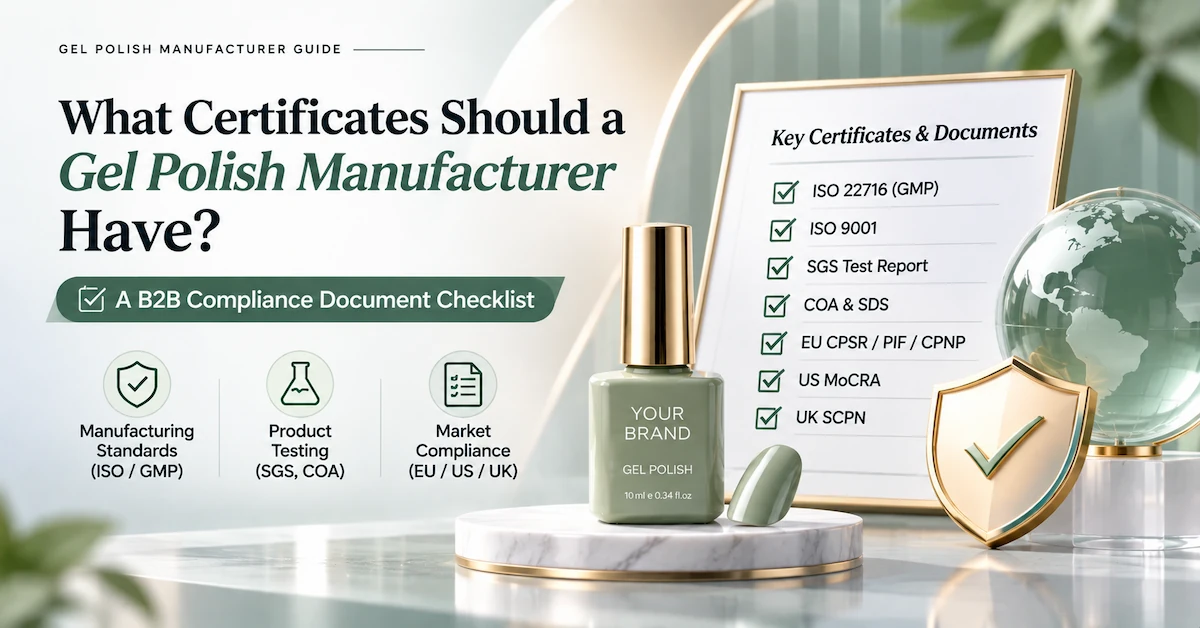
ISO 22716:2007, Cosmetics — Good Manufacturing Practices (GMP), provides internationally recognized guidance for cosmetic production, control, storage, and shipment.
When evaluating suppliers, ask how these activities are managed and documented.
A manufacturer claiming ISO or GMP compliance should be able to identify the applicable standard, demonstrate relevant procedures, and provide current evidence supporting any certification claims.
Do not treat an ISO logo on a website as sufficient proof of certification.
Evidence to request: Applicable certificates with their scopes and validity, quality procedures, inspection criteria, and relevant product records.
6. Test UV/LED Curing Performance
Curing performance is one of the most important technical considerations in gel polish procurement.
UV/LED-curable formulations respond to light under specific conditions. The lamp, emitted wavelength range, irradiance, exposure time, layer thickness, pigmentation, and formula chemistry can affect curing.
A supplier should provide appropriate product-specific application and curing instructions.
Buyers should evaluate samples using a controlled test procedure and suitable equipment.
Avoid relying on statements such as "works with every LED lamp" unless the manufacturer can substantiate the claim.
Evidence to request: Recommended curing conditions, sample test procedures, and relevant performance results.
7. Verify Color, Viscosity, and Application Consistency
Color appearance and application characteristics are essential for customer satisfaction and repeat purchases.
Evaluate multiple samples using the same conditions.
For colored gel polish, document:
-
Product or formula reference.
-
Shade identification.
-
Base color and substrate.
-
Number of applied coats.
-
Viewing and lighting conditions.
-
Coverage and pigmentation.
-
Brush application and leveling.
-
Final appearance after validated curing.
Where viscosity is part of the purchase specification, agree on the testing method, measurement temperature, and acceptable range.
A visually attractive product sample should become an identifiable, approved reference for subsequent manufacturing.
8. Confirm Batch-to-Batch Repeatability
An excellent first sample does not guarantee consistent future production.
Ask the manufacturer how it links production orders to approved formulas, color references, and product specifications.
A robust process should include controlled formula versions, approved samples, relevant QC records, and procedures for managing changes.
For example, if a particular pink gel polish is approved, the next order should not silently use a different pigment system, bottle component, or formula version.
Buyers should clarify which changes require advance notification and renewed approval.
Red flag: The manufacturer cannot identify which formula or approved sample will be used for the commercial order.
9. Check Ingredient Documentation and Market Requirements
International nail product buyers must evaluate the actual formulation against destination-market requirements.
Different markets have different obligations regarding cosmetic ingredients, labeling, product documentation, responsible parties, and product claims.
For example, the European Commission confirms that cosmetics containing TPO are prohibited from being placed or made available on the EU market from September 1, 2025.
For the United States, the Modernization of Cosmetics Regulation Act of 2022 (MoCRA) establishes relevant facility registration, product listing, and other obligations, subject to applicable exemptions.
The FDA does not issue certificates verifying cosmetic facility registration or product listing compliance, and such registration or listing is not FDA product approval.
Depending on the project, buyers may need:
-
Ingredient information and applicable product safety documentation.
-
Batch-specific quality documents.
-
Appropriate labeling information.
-
Documentation supporting ingredient-exclusion claims.
-
Product identification and traceability.
-
Destination-market regulatory review.
Important: HEMA-Free or TPO-Free claims should be checked against the specific product formulation. They are not universal safety guarantees.
10. Verify OEM/ODM and Packaging Control
If your business requires private label gel polish, evaluate the manufacturer's packaging capability separately from formula manufacturing.
Relevant components may include bottles, caps, brushes, printed labels, individual boxes, and shipping cartons.
Confirm which elements are standard and which require customized production.
Request physical packaging samples when necessary, and check:
-
Bottle and formula compatibility.
-
Cap fit and leakage resistance.
-
Label accuracy and durability.
-
Artwork approval procedures.
-
Batch identification.
-
Packaging protection during shipping.
JOUS describes bottle, label, color, and packaging customization through its Private Label OEM/ODM program.
11. Confirm MOQ, Production Lead Times, and Commercial Terms
A reliable manufacturer should explain the commercial requirements of the proposed project.
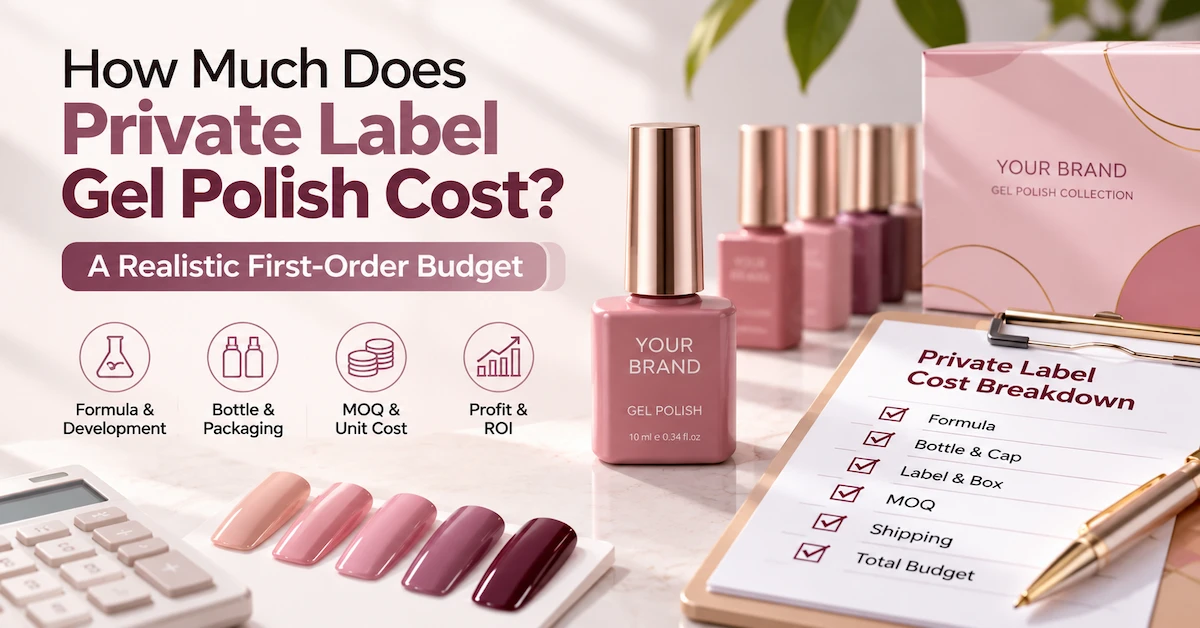
Request separate minimum order quantities for formulas, individual colors, bottle customization, labeling, and outer packaging where applicable.
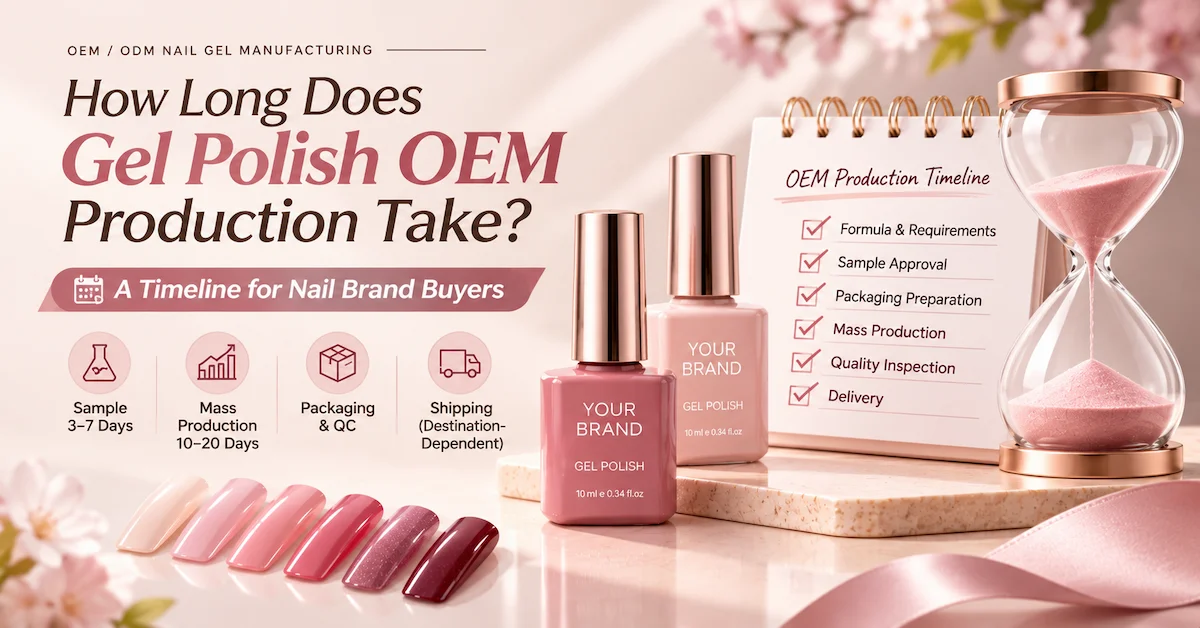
Production schedules should distinguish sample development, artwork approval, material preparation, manufacturing, inspection, and shipment.
Ask whether the quoted lead time begins after sample approval, payment, packaging approval, or another agreed milestone.
Do not assume that one advertised MOQ or production schedule applies to every gel polish formulation.
Evidence to request: A written quotation with quantities, specifications, lead-time assumptions, payment conditions, and agreed delivery responsibilities.
12. Evaluate Communication, Trial Orders, and After-Sales Support
The final verification step is whether the manufacturer can turn approved requirements into a controlled production order.
For an initial project, consider a commercially appropriate trial order before committing to a larger supply program.
Define the acceptance criteria in advance.
Evaluate the supplier's responsiveness when technical questions arise, samples require revision, or documentation needs clarification.
Also agree on procedures for reporting nonconforming products, investigating quality concerns, managing corrective actions, and planning future replenishment.
A dependable manufacturing relationship should remain manageable after the first shipment.
Gel Polish Sample Testing Checklist for Professional Buyers
A good supplier evaluation involves more than visual inspection.
The following technical checklist can help buyers organize sample testing.
| Test Area | Evaluation Method | Acceptance Basis |
|---|---|---|
| Product Identification | Check SKU, formula code, sample revision | Matches approved project |
| Appearance | Inspect under controlled conditions | Agreed visual reference |
| Viscosity | Measure using a defined method and temperature | Approved specification |
| Color Accuracy | Compare with physical shade reference | Agreed shade tolerance |
| Application | Evaluate brushing and leveling | Intended use requirements |
| UV/LED Curing | Test specified lamp and application conditions | Agreed curing criteria |
| Layer Compatibility | Test base, color, and top coat system | Product-system approval |
| Adhesion / Flexibility | Use relevant documented methods | Agreed performance requirements |
| Packaging Compatibility | Test actual bottle and closure | Agreed package specifications |
| Storage Stability | Evaluate under a documented test plan | Approved stability criteria |
| Batch Traceability | Review product and lot identification | Records can be matched |
The test plan should be adjusted to the product category. For example, builder gels may require additional structural performance checks, while cat eye gels may require magnetic-effect evaluation.
Actual acceptance limits should be established with the manufacturer rather than invented from generic supplier claims.
A 100-Point Gel Polish Manufacturer Evaluation Scorecard
When comparing manufacturers, use a consistent scoring method instead of relying on sales presentations.
The following framework is a suggested procurement evaluation tool, not a certification, laboratory standard, or official industry rating.
| Evaluation Category | Maximum Score | Evidence to Review |
|---|---|---|
| Manufacturing Identity and Capability | 15 | Business records, facility verification, equipment |
| Formula and Technical Competence | 20 | Technical responses, formula references, sample performance |
| Quality Control and Traceability | 20 | QC procedures, batch identification, change control |
| Documentation and Market Readiness | 15 | Applicable records, ingredient information, certificate verification |
| OEM/ODM and Packaging Capability | 10 | Packaging samples, customization scope |
| MOQ, Lead Time, and Supply Planning | 10 | Written commercial terms and scheduling |
| Communication and Trial-Order Support | 10 | Responsiveness, technical clarification, issue handling |
| Total | 100 | Evidence-based supplier comparison |
Use the same criteria for every shortlisted manufacturer.
A supplier scoring well overall should still be excluded if it cannot satisfy a mandatory safety, legal, or product requirement.
The score helps organize commercial decisions; it does not replace independent verification or qualified regulatory assessment.
Manufacturer vs. Trading Supplier: Which Should You Choose?
Different sourcing models have different strengths.
| Sourcing Model | Potential Advantage | Key Verification Requirement |
|---|---|---|
| Direct Gel Polish Manufacturer | More direct formula and production coordination | Verify actual manufacturing and QC capabilities |
| Trading Company | Product consolidation and sourcing flexibility | Identify production responsibility and accountability |
| Distributor | Convenient access to existing products | Confirm product origins, documentation, and stock continuity |
| OEM/ODM Manufacturing Partner | Formula, branding, and packaging support | Verify development scope, approval process, and repeatability |
| Bulk Gel Supplier | Suitable for companies with their own filling operations | Confirm bulk specifications and local filling compatibility |
For businesses building differentiated product lines, direct manufacturing or OEM/ODM support can be valuable.
For companies operating local packaging lines, JOUS Bulk Gel Supply provides another potential sourcing route.
The right model depends on the buyer's technical requirements, operational capabilities, and commercial objectives.
Common Red Flags When Evaluating a Gel Polish Factory
Several warning signs deserve closer attention during supplier screening.
Unverifiable manufacturing claims: The supplier cannot explain its production role or provide reasonable information about its facility.
Unclear certification claims: Certificates are expired, unrelated to the manufacturing entity, or cannot be matched to the claimed scope.
No controlled sample reference: The supplier cannot identify the approved formula or explain how it will be reproduced.
Inconsistent technical answers: Different representatives provide conflicting curing instructions or product specifications.
Unexplained formula changes: Ingredients, colors, or product characteristics are modified without an agreed approval process.
Vague pricing or MOQ: The quotation fails to distinguish formula, bottle, color, or printing requirements.
Unrealistic promises: The supplier guarantees universal curing compatibility, zero allergy risk, or unrestricted regulatory compliance without supporting evidence.
These warning signs do not automatically prove that a supplier is unreliable. They indicate areas requiring clarification before money is committed.
How JOUS Supports Professional Gel Polish Manufacturing
Guangzhou JOUS Fine Chemical Co., Ltd. presents its business as a professional nail gel manufacturer integrating formulation development, product manufacturing, global sales, and customer support.
Founded in 2014, JOUS offers product categories including color gel polish, base and top coats, builder gels, cat eye gels, and functional nail gels.
Buyers can review the JOUS product portfolio to identify potential products for their target market.
Formula and Product Development
JOUS describes support for custom formulas, viscosity adjustments, color matching, and professional nail gel applications.
OEM/ODM and Private Label Manufacturing
JOUS offers private label support involving formula selection, product development, bottles, labels, and packaging.
Production and Quality Control
The company describes a controlled clean-workshop environment and quality-control procedures involving manufacturing, product testing, filling, and packaging.
As with any supplier, buyers should verify relevant documents and agree on actual project specifications before commercial production.
Bulk Nail Gel Supply
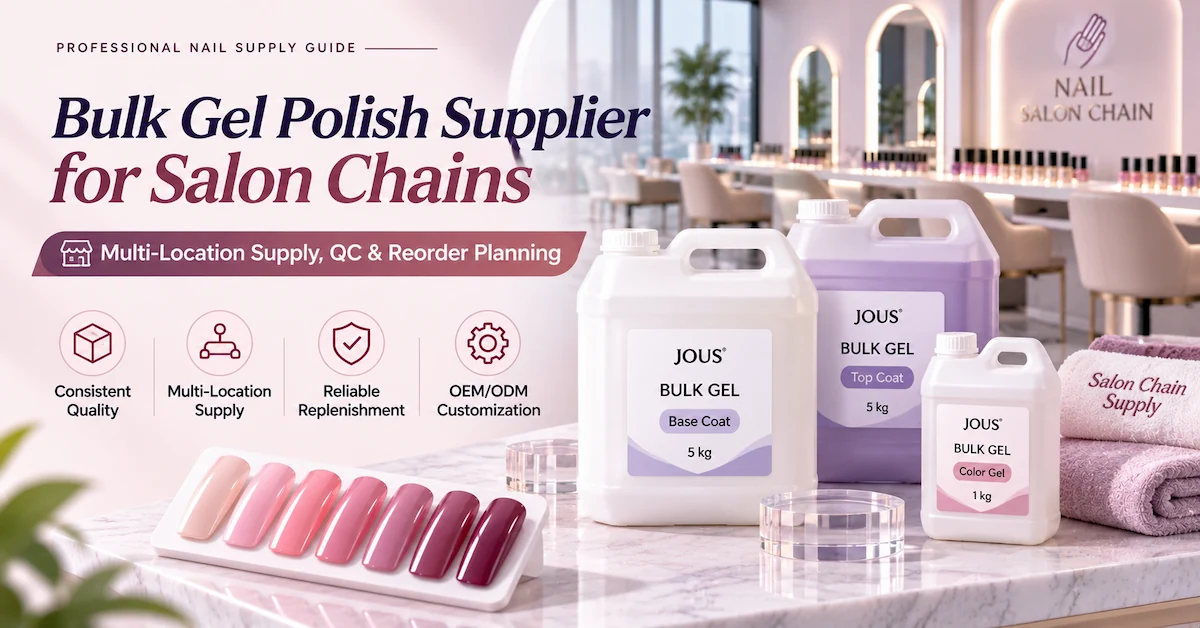
For businesses with their own filling equipment, JOUS provides Bulk Gel solutions covering different professional gel categories.
Its published bulk ordering process includes formula selection, specification confirmation, sample approval, production, and shipment or replenishment.
These capabilities make JOUS a relevant company to evaluate for OEM/ODM and wholesale nail gel projects, while final supplier approval should remain evidence-based.
Request a Gel Polish Manufacturing Consultation from JOUS
How to Start a Supplier Verification Project with JOUS
A productive manufacturing inquiry should give the supplier enough information to assess the project accurately.
Buyer RFQ Checklist
| Information | What to Include |
|---|---|
| Company Type | Nail brand, distributor, importer, salon chain, or filling company |
| Destination Market | Target countries and intended users |
| Product Categories | Color gel, base, top, builder, cat eye, or functional gel |
| Formula Requirements | Existing formula or custom development |
| Performance Needs | Viscosity, finish, curing and compatibility requirements |
| Colors and SKUs | Approximate number of shades |
| Packaging | Bottle size, logo, labels, cartons |
| Estimated Order | Initial quantity and expected repeat volume |
| Quality Documents | Technical specifications, product records, relevant certificates |
| Project Timeline | Target sample approval and delivery schedule |
After the requirements are defined, request samples and agree on how each product will be evaluated.
A practical procurement sequence is:
Supplier screening → Document review → Sample evaluation → Technical approval → Trial order → Production QC → Repeat-order monitoring.
This approach makes it easier to identify issues before committing to larger purchasing volumes.
Review the JOUS product catalog and submit your requirements through the JOUS contact page.
Frequently Asked Questions About Finding a Reliable Gel Polish Manufacturer
1. How do I find a reliable gel polish manufacturer in China?
Shortlist manufacturers with relevant product capabilities, then verify their business identity, production facilities, sample quality, QC procedures, documentation, commercial terms, and repeat-order controls. Do not select a manufacturer using price or promotional claims alone.
2. How can I confirm whether a gel polish supplier is a real factory?
Request business registration details, manufacturing-site information, and a clear description of the company's production role. Where practical, arrange an on-site or live remote factory walkthrough and verify the responsible manufacturing entity.
3. What certifications should a gel polish manufacturer have?
Requirements depend on the product and target market. ISO 22716 provides cosmetic GMP guidance, while additional certification or regulatory documentation may be relevant. Buyers should verify certificate validity, scope, and issuing bodies rather than relying on logos.
4. How do I evaluate gel polish quality before placing a bulk order?
Test the approved formula for appearance, viscosity, color, application, UV/LED curing, system compatibility, packaging suitability, and relevant stability characteristics. Establish agreed acceptance criteria and retain an identifiable approved sample.
5. Can a manufacturer customize gel polish formulas and colors?
Some manufacturers provide formula development, color matching, and performance adjustment. JOUS describes these services through its OEM/ODM program. Customization feasibility and commercial terms depend on the project.
6. What is the difference between OEM and ODM gel polish manufacturing?
OEM projects generally involve manufacturing according to agreed customer specifications, while ODM projects may involve greater manufacturer participation in product design and development. The actual division of responsibilities should be defined in the contract.
7. How do I verify gel polish curing performance?
Evaluate the specified formula using documented lamp characteristics, application thickness, exposure conditions, and appropriate test methods. A generic curing-time statement is insufficient to establish compatibility with every UV/LED device.
8. What does a gel polish manufacturer's MOQ depend on?
MOQ may depend on formula requirements, individual colors, production batches, bottles, decoration, labels, and packaging. Request project-specific minimum quantities and clarify whether the minimum applies per shade, SKU, or complete order.
9. How can I reduce the risk of inconsistent repeat orders?
Keep approved formula references, physical samples, shade standards, packaging specifications, and quality records. Agree on change-control procedures and how each future batch will be linked to the approved product.
10. How can I request a manufacturing quote from JOUS?
Provide your product categories, target market, desired formulas, number of colors, estimated quantities, packaging requirements, documentation needs, and expected schedule through the JOUS Contact Us page.
Conclusion
Finding a reliable gel polish manufacturer is a supplier verification process that combines manufacturing transparency, technical testing, documented quality control, and clear commercial agreements.
The most dependable sourcing decisions are based on evidence: verified production capabilities, approved formulas, consistent sample performance, relevant documentation, transparent MOQ terms, and repeatable manufacturing procedures.
For international nail brands, beauty distributors, and private label buyers, using a structured factory audit and supplier scorecard can help identify weaknesses before they become expensive production problems.
JOUS provides professional nail gel manufacturing, formula customization, OEM/ODM services, private label packaging, and bulk gel supply for international business customers.
If you are evaluating a gel polish manufacturing partner, begin with clearly defined requirements, request relevant technical information, and approve representative samples before committing to large-scale production.
Explore JOUS OEM/ODM Manufacturing Services or Contact JOUS to Request Samples, Product Information, and a Manufacturing Quotation for your next nail gel sourcing project.