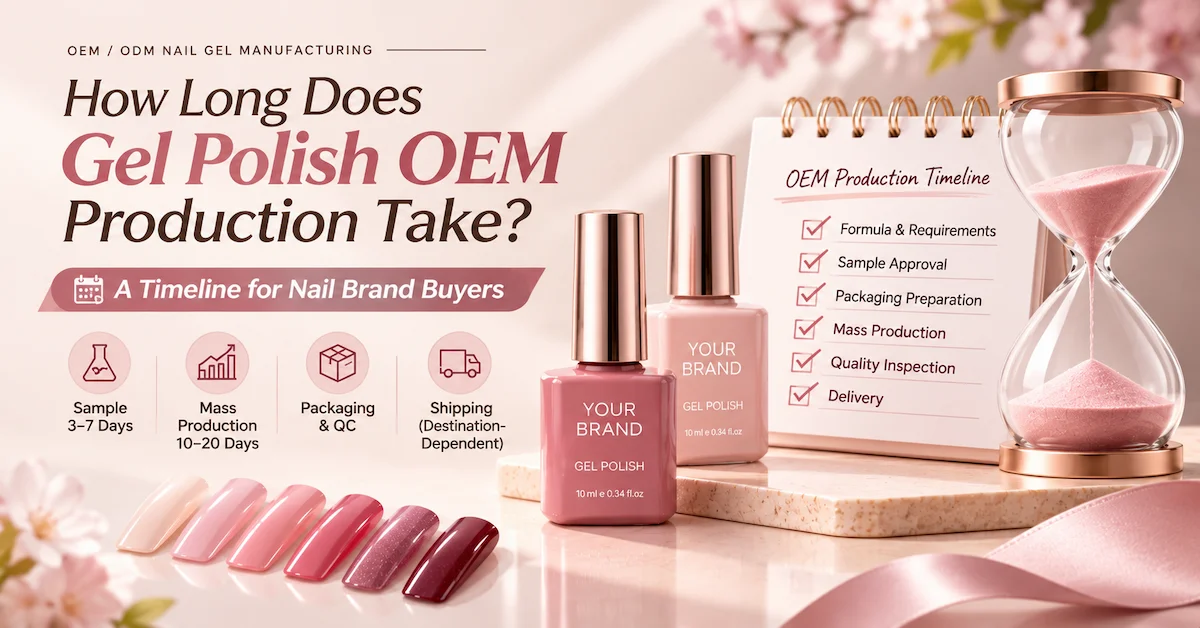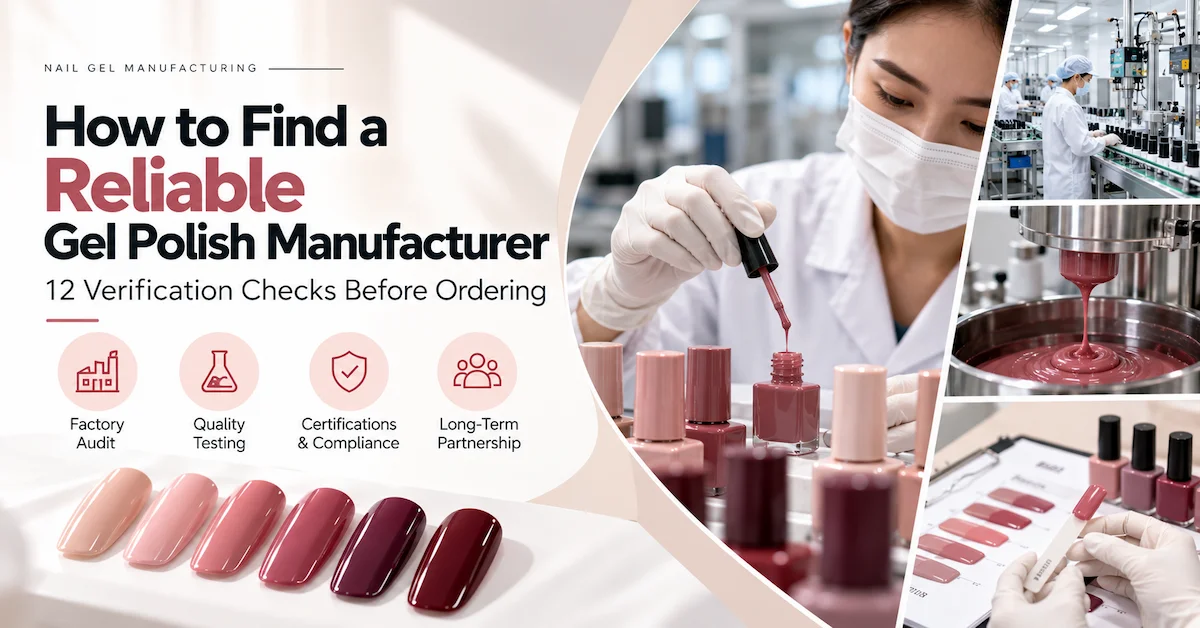

A bulk gel polish supplier for salon chains must provide more than large quantities of professional nail gel at competitive prices. For businesses operating multiple nail salons, the real challenge is ensuring that every location receives compatible products, consistent colors, reliable curing performance, and sufficient inventory to support daily services.
Unlike independent salons, growing nail salon networks must coordinate centralized purchasing, technician training, product standardization, stock distribution, and recurring replenishment.
Quick Answer: Salon chains should select a bulk gel polish supplier based on product-system compatibility, batch consistency, appropriate supply formats, documented quality control, and repeat-order planning. Businesses with qualified central filling operations may purchase bulk gel, while chains without those capabilities can source finished professional bottles through wholesale or OEM manufacturing arrangements.
JOUS supplies professional nail gel formulations, OEM/ODM products, and bulk gel solutions for international beauty businesses, including salon chains and distributors.
This guide explains how to organize a reliable purchasing system across multiple salon locations.
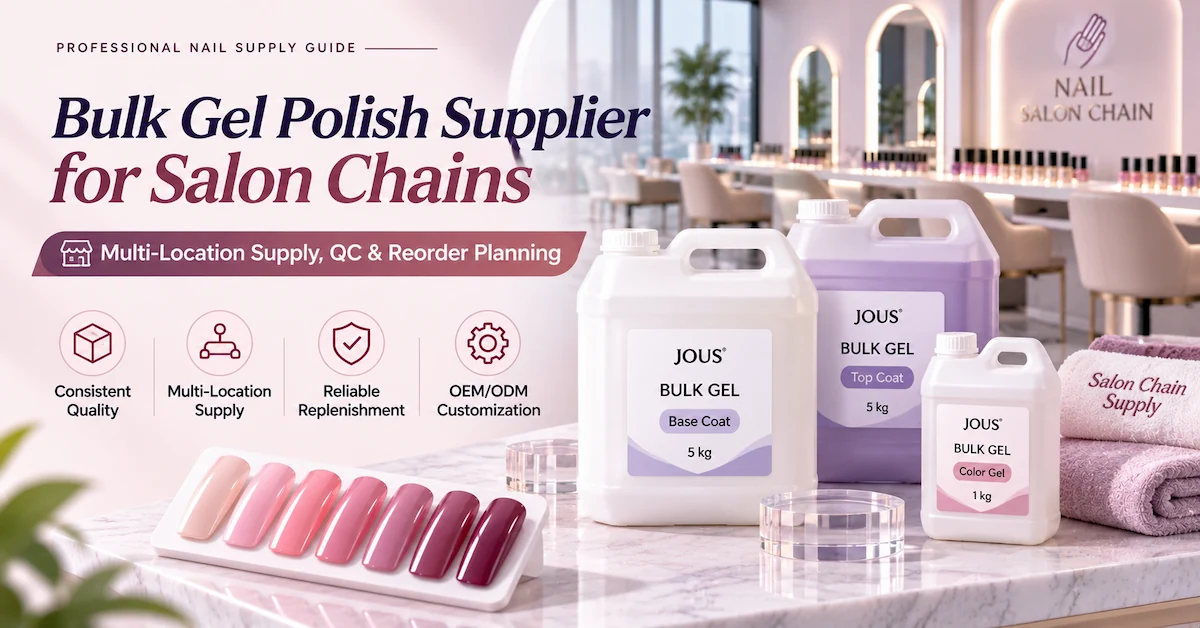
What Should a Bulk Gel Polish Supplier for Salon Chains Provide?
A professional supplier should support the operational requirements of a salon network rather than simply offering a large color catalog.
The most important purchasing considerations include:
-
Consistent gel polish formulas across different production batches.
-
Approved base, color, builder, and top coat combinations.
-
Identifiable shade codes and product specifications.
-
Suitable bulk or finished-bottle packaging.
-
Product-specific UV/LED curing instructions.
-
Reliable production and replenishment planning.
-
Relevant quality and ingredient documentation.
-
Options for private label and customized professional products.
For a multi-location salon business, these factors affect service consistency, procurement efficiency, training requirements, and customer satisfaction.
A low initial quotation offers limited value if a frequently used shade becomes unavailable or a replacement formula performs differently from the approved version.
The objective is to establish one controlled professional nail gel system that can be maintained across the entire salon network.
Bulk Gel or Finished Bottles: Which Supply Model Is Better for Salon Chains?
Before selecting a supplier, salon operators must decide how products will reach their locations.
Bulk gel purchasing and wholesale finished-bottle purchasing are not interchangeable.
Three Supply Models for Multi-Location Salons
| Supply Model | How It Works | Main Advantage | Operational Requirement |
|---|---|---|---|
| Finished Professional Bottles | Manufacturer supplies filled, labeled bottles to the chain or distributor | Simpler downstream handling | Central purchasing and inventory management |
| Bulk Gel + Qualified Local Filling | Manufacturer supplies bulk gel to a controlled filling facility | Flexibility over regional packaging and distribution | Filling equipment, packaging validation, and local QC |
| Private Label OEM/ODM | Manufacturer produces an approved branded nail gel collection | Consistent chain-specific product identity | Formula, packaging, and artwork approval |
JOUS provides Bulk Nail Gel Supply for businesses requiring larger gel quantities, as well as OEM/ODM Nail Gel Manufacturing for branded professional collections.
When Is Bulk Gel Supply the Better Choice?
Bulk purchasing is most suitable when the salon organization or its manufacturing partner already has appropriate filling, packaging, quality-control, and traceability capabilities.
A centralized filling facility may receive approved bulk formulations, package them into suitable professional bottles, and distribute finished products to individual branches.
However, purchasing large containers does not automatically make the model less expensive or safer.
Bulk gel should not be casually repackaged or used to top up partially used salon bottles without a validated, controlled process.
For chains without dedicated filling capabilities, manufacturer-filled professional bottles are generally the more practical starting point.
How to Standardize Gel Polish Products Across Multiple Salons
Product standardization is one of the biggest operational advantages of centralized sourcing.
When every location uses different formulas, technicians may experience inconsistent application behavior, curing requirements, and finished results.
A standardized system should identify which products are approved for each service.
Core Nail Gel Product Matrix
| Product Category | Role in Salon Operations | Standardization Priority |
|---|---|---|
| Base Coat | Foundation for gel manicure services | Adhesion, application and compatibility |
| Color Gel Polish | Core color selection | Shade consistency, opacity, finish |
| Top Coat | Final appearance and surface properties | Gloss or matte finish, curing compatibility |
| Rubber Base Gel | Selected strengthening or leveling applications | Viscosity, flexibility, application instructions |
| Builder Gel | Professional overlays and structural work | Working control, leveling, structural suitability |
| Cat Eye Gel | Specialty-effect services | Magnetic effect and visual consistency |
| Functional Nail Gel | Specific nail art or technical applications | Product-specific performance and training |
JOUS offers these product families through its Professional Nail Gel Products.
For chain-wide implementation, procurement teams should classify products into three groups:
Core products support frequently performed services and require dependable replenishment.
Specialty products support premium or less frequent services, including magnetic effects and decorative gel applications.
Seasonal products are introduced for specific promotions and should be evaluated separately from permanent inventory.
This structure helps avoid stocking every available color in every location.
Which Technical Specifications Matter for Salon Chain Purchasing?
A supplier should provide enough information for the salon chain to identify and evaluate each approved product.
Professional Gel Polish Technical Specification Checklist
| Specification | What Buyers Should Confirm | Why It Matters |
|---|---|---|
| Product and Formula Code | Approved formulation or SKU | Enables repeat-order identification |
| Color Reference | Shade code and physical reference | Supports color consistency |
| Viscosity | Agreed range and measurement conditions | Affects application control |
| Pigmentation | Coverage and intended coat conditions | Supports service standardization |
| UV/LED Curing | Compatible lamp conditions and layer thickness | Helps ensure correct curing |
| Base/Top Compatibility | Approved product combinations | Reduces system mismatches |
| Finish | Glossy, matte, sheer, glitter, or magnetic | Defines service expectations |
| Packaging | Bulk container or approved bottle configuration | Affects handling and distribution |
| Batch Information | Lot identification and traceability | Supports product investigations |
| Storage Conditions | Formula-specific handling requirements | Helps protect product quality |
| Documentation | Applicable ingredient and quality records | Supports procurement review |
These are recommended purchasing specifications rather than universal performance claims for all JOUS products.
Why UV/LED Curing Compatibility Is Critical
A professional salon chain may operate several different nail lamps across its locations.
Curing performance depends on the gel formulation, relevant lamp characteristics, application thickness, pigmentation, and exposure conditions.
A product that performs correctly with one approved lamp should not automatically be assumed compatible with every device.
Industry guidance on artificial nail systems emphasizes correct curing and minimizing contact with uncured gel, which can contain sensitizing acrylate components.
Before launching a new gel system across multiple branches, verify the manufacturer's curing instructions and establish an appropriate technician training procedure.
How to Test Gel Polish Before Introducing It Across a Salon Chain
Rolling out a new product to every salon simultaneously increases the potential impact of an unsuitable formula or unclear application instructions.
A controlled pilot provides a better opportunity to identify problems.
Step 1: Select Representative Salon Locations
Consider testing products in a small selection of branches that represent different technician experience levels, service volumes, and operating conditions.
Step 2: Approve the Complete Product System
Evaluate base, color, builder where relevant, and top coat combinations using the specified application and curing procedures.
Step 3: Record Technician Feedback
Review application control, leveling, opacity, finish, and other product-specific characteristics.
Feedback should be documented against agreed evaluation criteria.
Step 4: Compare Color References
Use approved physical samples and consistent viewing conditions to evaluate shade appearance.
Step 5: Confirm Packaging and Storage Suitability
Check that bottles, labels, closures, and handling instructions are appropriate for the intended branch operations.
Step 6: Approve the Product for Chain-Wide Use
Maintain a record identifying the approved product, formula version, shade reference, application instructions, and any limitations.
A controlled rollout helps the purchasing team separate product suitability from individual technician preferences.
How Can Salon Chains Maintain Consistent Quality Between Batches?
Batch consistency matters because salon chains need customers to receive comparable services across locations.
A familiar shade should not unexpectedly change its appearance or application characteristics when a new shipment arrives.
Recommended Batch Quality Controls
| Quality-Control Stage | Recommended Verification |
|---|---|
| Raw Material Preparation | Approved materials and identification |
| Formula Manufacturing | Controlled formula version and process |
| Color Inspection | Comparison with approved shade reference |
| Viscosity Testing | Agreed test method and acceptance criteria |
| Curing Evaluation | Product-specific testing where required |
| Finished Packaging | Correct bottles, labels, and batch identification |
| Batch Documentation | Traceable product and production records |
| Reorder Review | Comparison against approved product specification |
ISO 22716:2007 provides guidance for cosmetic production, quality control, storage, and shipment.
For procurement teams, the practical requirement is to obtain relevant evidence of the manufacturer's quality processes and maintain adequate records of products distributed to each location.
JOUS describes manufacturing in a controlled clean-workshop environment, with quality-control procedures involving formula preparation, testing, filling, and packaging.
Buyers should request the available quality records for their selected products and agree on acceptable product specifications before ordering.
How to Forecast Gel Polish Demand Across Multiple Salon Locations
One of the largest operational challenges for salon chains is maintaining enough stock without tying up excessive capital in slow-moving shades.
A centralized forecasting model can help.
Start with Consumption per Product
For each approved SKU, calculate:
Weekly Network Demand = Number of Locations × Average Weekly Consumption per Location
Then estimate the quantity required during replenishment.
Reorder Point = Expected Demand During Replenishment Lead Time + Safety Stock
Example: Top Coat Replenishment for 12 Salons
Assume a salon chain operates 12 locations.
Each salon uses an average of two 15 ml bottles of the same top coat per week.
The assumed end-to-end replenishment lead time is six weeks, and the purchasing team wants a safety stock allowance of 48 bottles.
| Planning Variable | Illustrative Value |
|---|---|
| Salon Locations | 12 |
| Weekly Consumption per Salon | 2 bottles |
| Total Weekly Demand | 24 bottles |
| Assumed Replenishment Lead Time | 6 weeks |
| Expected Demand During Lead Time | 144 bottles |
| Safety Stock | 48 bottles |
| Reorder Point | 192 bottles |
This means the purchasing team would consider placing a replenishment order when the relevant inventory position reaches approximately 192 bottles.
These figures are hypothetical planning assumptions, not JOUS production lead times or confirmed salon consumption rates.
In actual operations, purchasing teams should account for outstanding orders, reserved quantities, demand variation, product-specific lead times, and different usage patterns across branches.
The same calculation should be performed separately for each important SKU.
How Should Salon Chains Organize Centralized Inventory Distribution?
Central purchasing allows a salon network to maintain one approved product catalog while distributing inventory according to branch demand.
A practical operating model is:
Approved Supplier → Central Warehouse or Qualified Filler → Regional Distribution → Individual Salon Locations
The responsibilities of each party should be clearly defined.
Multi-Location Inventory Control
| Inventory Control | Recommended Practice |
|---|---|
| Central SKU List | Maintain approved product and shade codes |
| Branch Consumption | Record actual product usage and issues |
| Safety Stock | Set a suitable buffer for critical products |
| Batch Tracking | Record lots received and distributed |
| Stock Rotation | Follow product-specific shelf-life and storage requirements |
| Reorder Planning | Monitor demand and supplier lead times |
| New Product Rollout | Use controlled pilot and approval procedures |
| Product Changes | Communicate updated formula or packaging specifications |
Avoid Overloading Every Branch with Slow-Moving Colors
Not every salon requires an identical quantity of every shade.
A downtown salon may experience different demand from a suburban location.
Central procurement can establish a standard core collection while allowing controlled adjustments to local inventory.
The objective is consistent product quality and service standards, not unnecessarily identical stock quantities.
What Does Bulk Gel Polish Really Cost a Salon Chain?
A lower purchase price per kilogram or bottle does not automatically produce lower service costs.
Purchasing teams should compare total costs under the same operational assumptions.
Bulk Gel vs. Finished Professional Bottles
| Cost Factor | Bulk Gel + Local Filling | Manufacturer-Filled Bottles |
|---|---|---|
| Gel Material | Purchased in bulk | Included in finished product |
| Filling Equipment | Required through filling partner | Normally handled by manufacturer |
| Bottle and Closure | Purchased or arranged locally | Included as quoted |
| Filling Labor | Local operational cost | Included as quoted |
| Packaging QC | Local responsibility | Manufacturer and agreed receiving QC |
| Freight | Bulk container transport | Finished bottle transport |
| Inventory Management | Bulk and finished-stock control | Finished-stock control |
| Main Risk | Additional processing and handling complexity | Finished-bottle pricing and packaging flexibility |
For bulk purchasing, the conversion from weight to finished bottle volume should use the actual formulation's density and expected filling yield.
A kilogram of gel should not automatically be treated as a fixed number of bottles without this calculation.
Calculate Cost per Professional Service
A useful purchasing metric is:
Gel Material Cost per Service = Total Cost of Gel Consumed ÷ Number of Completed Services
For broader operational comparison, also consider packaging, filling, freight, product losses, quality-control costs, and inventory write-offs.
Some chains may find centralized finished-bottle purchasing more economical than building or outsourcing local filling operations.
The correct choice depends on the company's scale, equipment, commercial agreements, and actual usage.
What Should Salon Chains Ask About MOQ and Replenishment Lead Time?
A multi-location network should negotiate supply conditions based on the complete product system, not only a single promotional price.
Important questions include:
-
Is MOQ determined by formula, shade, packaging format, or total order?
-
Can high-consumption products be reordered separately?
-
Which formula and shade references are retained for repeat orders?
-
What triggers the quoted production lead time?
-
Can production or packaging changes be communicated before shipment?
-
What documents accompany each order?
-
How are product-quality concerns investigated?
-
Which shipping and delivery arrangements are available?
JOUS advertises flexible MOQ options and provides custom formula and packaging support. However, minimum quantities and schedules vary by project.
Salon chains should request written quotations that distinguish initial setup requirements from future replenishment conditions.
How JOUS Supports Bulk Nail Gel Supply for Salon Chains
Guangzhou JOUS Fine Chemical Co., Ltd. provides professional nail gel manufacturing, formula development, OEM/ODM services, and bulk gel supply for international B2B customers.
Its product range includes color gel polish, base coats, top coats, builder gels, extension gels, cat eye gels, and functional gel systems.
1. Bulk Gel Supply for Centralized Filling
The JOUS Bulk Gel Supply service supports brands, fillers, and distributors purchasing professional nail gel in larger packaging formats.
JOUS has publicly showcased selected functional gels in 1 kg and 5 kg packaging, including Strong Base Coat (JRB1801), Crystal Leveling Gel (JRC5806), Quick Extension Gel (JRY4803), and High-Gloss Top Coat (JRT2802).
Current availability, packaging sizes, and applicable MOQ should be confirmed for each formula.
2. Product-System Selection
JOUS offers professional Base Coat, Top Coat, and color gel products.
Salon buyers can evaluate suitable combinations according to their services and technical requirements.
3. OEM/ODM Customization
Through JOUS OEM/ODM Services, multi-location salon businesses can discuss customized formulas, color collections, professional bottle formats, labels, and private label branding.
4. Quality and Replenishment Planning
JOUS describes a five-stage bulk ordering process covering formula selection, specification confirmation, sample approval, production with quality control, and shipment or repeat ordering.
For a salon chain, this provides a starting framework for discussing approved formulas, purchasing quantities, production scheduling, and long-term replenishment.
JOUS's website describes manufacturing and supply capabilities, but buyers should verify actual product specifications, available documents, and commercial conditions for their intended projects.
Contact JOUS for Salon Chain Bulk Gel Supply and OEM Manufacturing
What Should a Salon Chain Include in a Bulk Gel Polish Inquiry?
A clear procurement request helps the manufacturer evaluate the scale and technical requirements of the salon network.
Salon Chain Gel Polish RFQ Checklist
| Requirement | Information to Provide |
|---|---|
| Salon Network | Number of locations and countries |
| Business Model | Corporate-owned, franchise, or distributor-supported |
| Supply Format | Bulk gel or finished professional bottles |
| Product Categories | Base, color, top, builder, cat eye, functional gel |
| Core Colors | Approved shades and required color range |
| Formula Requirements | Viscosity, finish, curing and compatibility needs |
| Packaging | Bulk containers or finished-bottle sizes |
| Purchase Volume | Initial requirement per SKU |
| Monthly Consumption | Estimated combined network demand |
| Reorder Frequency | Expected procurement cycle |
| Distribution Model | Central warehouse, regional distributor, or local filler |
| Documentation | Quality, ingredient, and target-market requirements |
| Timeline | Sample evaluation and desired delivery dates |
Before requesting volume pricing, prepare an initial product list and identify the items used most frequently across the network.
You can review the JOUS Product Catalog to identify suitable professional nail gel categories.
Request Samples and a Customized Salon Chain Supply Quotation
Frequently Asked Questions About Bulk Gel Polish for Salon Chains
1. What should I look for in a bulk gel polish supplier for salon chains?
Look for consistent professional gel formulations, compatible base and top coat systems, approved shade references, reliable quality control, appropriate packaging formats, documentation support, and a realistic replenishment process for multiple locations.
2. Can salon chains purchase gel polish directly from a manufacturer?
Yes. Salon chains may source finished professional bottles or arrange bulk purchasing through suitable manufacturing and filling partners, depending on their scale, target market, and operational capabilities.
3. Does JOUS supply bulk nail gel for salon businesses?
JOUS offers bulk nail gel supply for brands, fillers, and distributors and identifies salons and nail chains among its B2B customer groups. Specific bulk formats and supply arrangements should be confirmed with JOUS.
4. What gel polish products should every salon location stock?
The core range commonly includes compatible base, color, and top coat systems. Builder, extension, cat eye, and specialty gels should be selected according to each salon's service menu and professional training.
5. Is bulk gel polish cheaper than finished professional bottles?
Not necessarily. Bulk purchasing may change material and packaging costs, but local filling, equipment, labor, quality control, and product losses must also be included in the comparison.
6. Can JOUS customize gel polish for a salon chain's private label?
JOUS describes OEM/ODM services for formula customization, color development, bottles, labels, and packaging. Availability and order requirements depend on the project.
7. How can salon chains maintain consistent colors across branches?
Use approved physical shade references, controlled product codes, batch identification, consistent application procedures, and a clear process for evaluating new production lots.
8. How should multi-location salons forecast gel polish orders?
Track consumption by SKU and branch, estimate demand during replenishment lead time, establish appropriate safety stock, and review forecasts as actual service volumes change.
9. Can salon chains refill bottles from bulk gel containers?
Refilling should only occur through appropriately controlled and validated processes. Casual refilling at individual salons can create handling, traceability, contamination, and labeling risks. A qualified central filling arrangement is more suitable when bulk packaging is used.
10. How can I request a bulk gel polish quote from JOUS?
Provide the number of salon locations, required products, estimated quantities, target markets, preferred packaging, technical specifications, and replenishment requirements through the JOUS Contact Us page.
Conclusion
Choosing a bulk gel polish supplier for salon chains is a long-term operational decision that affects product consistency, technician performance, purchasing efficiency, and inventory availability across multiple locations.
The right sourcing strategy begins with a standardized professional nail gel system, clear technical specifications, controlled sample approval, and appropriate quality documentation.
For salon networks with qualified central filling operations, bulk gel supply may provide flexibility in packaging and regional distribution. For businesses without those capabilities, manufacturer-filled professional bottles may offer a simpler and more manageable solution.
Centralized purchasing, branch-level consumption tracking, batch traceability, and realistic replenishment planning can help reduce stockouts, unnecessary inventory, and inconsistencies between salon locations.
JOUS supports international salon businesses with professional nail gel manufacturing, bulk gel supply, OEM/ODM customization, and product development services.
Whether your business operates a growing group of salons or an established multi-region nail salon network, clear product requirements and a structured supply plan are essential for long-term sourcing.
Explore JOUS Bulk Gel Supply or Contact JOUS for Salon Chain Product Samples, Volume Pricing, and Replenishment Planning to discuss your professional nail gel purchasing requirements.