
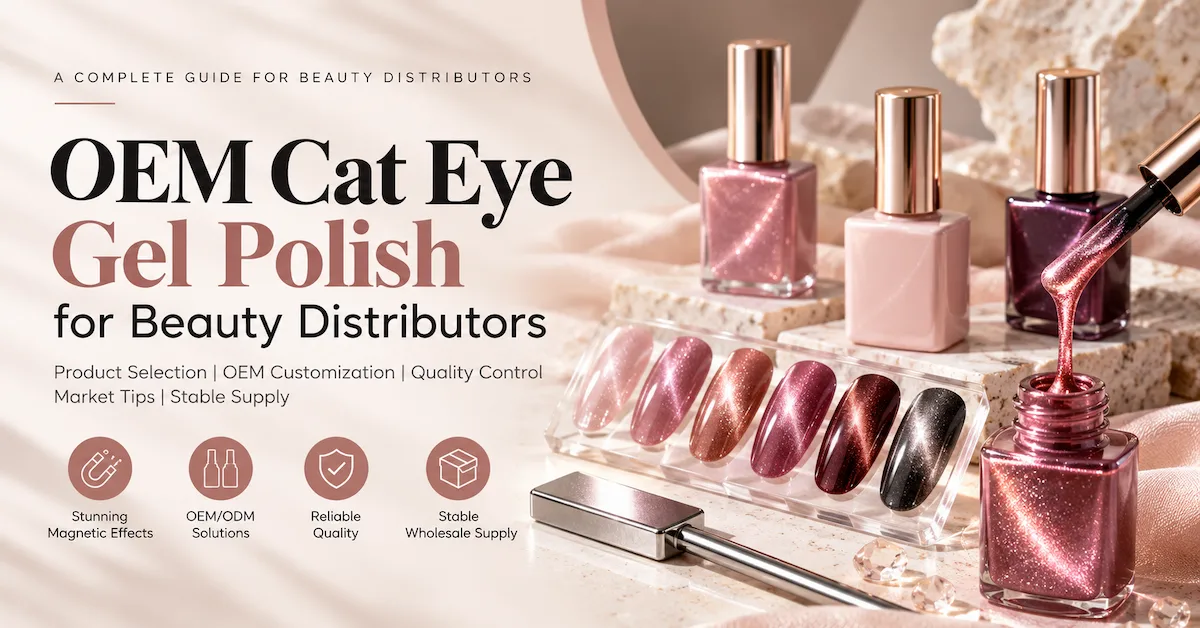
OEM cat eye gel polish for beauty distributors is a sourcing category that combines specialty nail effects with private-label manufacturing and wholesale inventory management. For distributors supplying salons, beauty retailers, nail academies, and professional nail brands, success depends on more than finding attractive magnetic colors. The products must be practical to demonstrate, consistent between batches, suitable for the intended curing system, and available in packaging that supports the distributor's business model.
A cat eye gel that creates an impressive magnetic line in a manufacturer's photograph may behave differently when a salon technician uses another magnet, applies a thicker layer, or works over a different base color. If the effect changes unexpectedly in a replenishment batch, the distributor may face complaints, unsold inventory, and costly product investigations.
The essential buying decision is to select an OEM manufacturer that can reproduce an approved combination of color, magnetic response, application behavior, curing requirements, and packaging—not simply supply the greatest number of shades.
This guide is designed for international beauty distributors, professional nail product wholesalers, salon supply companies, and importers developing their own magnetic gel polish collections. It covers product selection, technical evaluation, magnetic-effect testing, OEM customization, manufacturing quality control, market requirements, pricing, and repeat-order planning.
1. Why Should Beauty Distributors Develop an OEM Cat Eye Gel Polish Collection?
Cat eye gel polish offers something that ordinary solid-color gel products cannot provide in quite the same way: a changeable light-reflective appearance that depends on magnetic manipulation before curing.
For distributors, this creates an opportunity to sell a product based on professional technique, finish, and visual demonstration rather than shade name alone.
A conventional dark red gel polish and a comparable solid-color product may be difficult to differentiate at the wholesale counter. A magnetic red gel, by contrast, can create an illuminated band or shifting shimmer that is immediately recognizable when demonstrated under appropriate lighting.
However, visual distinction does not automatically translate into profitable inventory.
Different distribution channels need different magnetic gel assortments
A professional beauty distributor may serve several customer groups with separate commercial needs.
|
Buyer segment |
Typical purchasing concern |
Suitable product approach |
|---|---|---|
|
Independent nail salons |
Ease of use, attractive results, repeat availability |
Core magnetic shades with clear application instructions |
|
Salon chains |
Consistency across locations and technicians |
Standardized formula, colors, tools, and training material |
|
Beauty supply retailers |
Packaging appeal and manageable inventory |
Branded bottles, color samples, and compact collections |
|
Professional nail academies |
Ability to teach repeatable techniques |
Training-friendly products with effect demonstrations |
|
E-commerce nail retailers |
Visual presentation and product differentiation |
Distinctive effect collections with accurate imagery |
|
Regional sub-distributors |
Wholesale pricing, minimum quantities, replenishment |
Clearly coded SKUs and repeat-order arrangements |
A distributor serving nail academies may prioritize how reliably trainees can recreate an effect. A retailer may prefer a compact collection with strong packaging presentation. A salon chain may be less interested in new decorative trends than in repeatable technician results.
The OEM specification should reflect these differences.
Why a distributor might choose OEM instead of ordinary wholesale supply
Ordinary wholesale purchasing can be efficient when the distributor wants existing products with minimal development.
OEM becomes more relevant when the business needs a recognizable product identity, branded packaging, a controlled color range, or differentiation from competing distributors carrying the same generic items.
The commercial benefit depends on execution. A private-label product creates additional responsibilities for inventory, artwork, labeling, customer education, and product quality.
For that reason, a distributor should consider OEM only when it has a defined customer base, target market, and realistic expectation of ongoing sales.
2. How Does Cat Eye Gel Polish Create Its Magnetic Effect?
Cat eye gel polish typically incorporates magnetic-responsive particles into a curable nail gel formulation. When a suitable magnet is positioned near the uncured coating, the particles respond to the magnetic field and produce a visible reflective pattern.
The resulting effect depends on the particle system, base color, gel rheology, magnet geometry, technique, and viewing conditions.
After the desired appearance has been formed, the product is cured according to its validated instructions.
Magnetic response is different from ordinary glitter
Glitter products typically rely on decorative particles distributed through the coating. Their appearance changes with lighting and viewing angle, but they are not necessarily designed to be repositioned using a magnet.
Cat eye gel has a separate performance requirement: the particles must respond appropriately during the working period before curing.
That response should be evaluated independently of the finished color.
A shade may have an attractive shimmer but produce only a weak directional line. Another formulation may generate a defined magnetic band but become difficult to control because the effect moves before the operator can cure it.
Neither characteristic can be judged adequately from a catalog photograph.
Why magnet design changes the appearance
A magnetic wand, bar magnet, or differently shaped magnetic tool can create a different field distribution.
The distance from the coated surface, orientation, and duration of magnet placement influence the appearance.
For distributors, this has an important commercial implication: an approved product demonstration should specify the tool and technique used.
Marketing images showing a particular magnetic effect should not imply that every customer can obtain the same result with any available magnet.
If a collection requires a specific magnetic tool, buyers should determine whether that tool will be supplied, recommended separately, or incorporated into a starter kit.
What does “9D magnetic gel” actually mean?
Terms such as 5D, 9D, and other dimensional labels are commonly used in product marketing to describe particular visual styles.
They are not, by themselves, standardized measurements of brightness, particle concentration, optical depth, or product quality.
A purchasing team should therefore ask for physical samples and technique-controlled demonstration images rather than assuming that a higher dimensional number indicates technically superior performance.
JOUS lists a 32-color, 15ml cat eye gel collection described as a 9D magnetic nail gel. The listing provides a relevant OEM product reference, but distributors should confirm the available shade codes, actual formulation, magnetic performance, and commercial specifications directly.
3. Which Cat Eye Gel Polish Styles Should Distributors Stock?
The most practical assortment is not necessarily the largest one.
A distributor must consider local customer preferences, salon techniques, available display space, working capital, and the ability to replenish individual colors.
For an initial OEM range, it is often more useful to select a few clearly differentiated effect families than to buy many similar shades.
Compare common magnetic effect directions
|
Effect direction |
Typical appearance |
Distribution application |
Evaluation priority |
|---|---|---|---|
|
Classic cat eye |
Defined directional reflective band |
Professional salon core range |
Band definition and working control |
|
Velvet magnetic |
Soft, dispersed reflective appearance |
Fashion-focused salons and retailers |
Uniformity and ease of recreation |
|
High-contrast magnetic |
Bright effect against a darker base |
Demonstration-led beauty retail |
Contrast under controlled lighting |
|
Soft nude magnetic |
Subtle shimmer over neutral shades |
Salons serving understated styles |
Appearance over different base colors |
|
Shimmer magnetic |
Magnetic response with additional sparkle |
Seasonal and decorative collections |
Particle distribution and final finish |
|
Layered or multi-color effect |
More complex appearance through color and technique |
Specialist nail artists |
Repeatability of demonstrated results |
These are useful merchandising categories, not claims that every JOUS formula is available in each exact effect.
A manufacturer may offer different visual approaches using existing formulations, alternative magnetic particles, custom shades, or different application techniques.
The appropriate development route should be confirmed during sampling.
Start with the distributor's existing sales evidence
If your company already distributes ordinary gel polish, review which color families perform well.
This information is more useful than importing a large trend chart without considering local demand.
For example, a distributor whose salon customers frequently reorder neutral shades could test magnetic versions of comparable color families. A company specializing in decorative nail products may find more value in higher-contrast or shimmering effects.
Neither approach is universally better.
The important step is to connect the proposed collection to an identifiable customer demand rather than ordering colors solely because the samples look attractive.
Separate core, seasonal, and experimental SKUs
A practical assortment can be organized into three groups.
Core products are colors and effects the distributor expects to replenish regularly.
Seasonal products offer planned collection updates tied to customer demand, retail campaigns, or beauty market trends.
Experimental products are new effects tested in smaller commercial programs before additional inventory is committed.
This approach helps protect working capital while giving sales representatives new products to demonstrate.
An importer should also decide which individual shades can be reordered separately. A large set may look commercially attractive, but it can create inventory inefficiencies when only a few colors sell rapidly.
4. How Many Magnetic Gel Colors Should a Beauty Distributor Launch?
There is no universal launch quantity that guarantees sales.
The right number depends on customer coverage, product maturity, retail positioning, and the distributor's ability to replenish popular shades.
A business introducing magnetic gel for the first time may benefit from a concentrated assortment. A mature distributor with proven demand across salon chains may be ready for a much broader collection.
Use assortment scenarios rather than arbitrary color targets
|
Assortment strategy |
Illustrative SKU range |
Suitable business situation |
Main risk |
|---|---|---|---|
|
Focused introduction |
6–12 shades |
Testing interest with selected salon accounts |
Limited customer choice |
|
Regional distributor launch |
12–24 shades |
Established wholesale network |
Excess stock in weaker colors |
|
Expanded specialist collection |
24–48 shades |
Strong professional nail customer base |
Greater approval and replenishment complexity |
|
Broad catalog program |
48+ shades |
Distributor with demonstrated sales and stock control |
Slow-moving inventory and multiple small reorders |
These ranges are planning examples, not JOUS minimum-order requirements or validated sales recommendations.
A distributor should estimate the commercial exposure of every additional shade.
If each shade has a separate purchasing minimum, launching twice as many colors could increase initial inventory even if the total order receives a favorable price.
A similar issue arises with custom-printed packaging. The manufacturer may require quantities that differ from the gel production minimum.
Plan the first reorder before placing the first order
Ask which shades can be replenished individually, whether the original formula and effect can be maintained, and how production changes are communicated.
A successful introductory collection can become commercially difficult if the supplier cannot identify the approved magnetic appearance several months later.
Distributors should keep product references, physical color standards, packaging versions, and purchase records together.
This turns a visually attractive collection into a manageable wholesale product line.
5. What Technical Specifications Matter When Buying OEM Cat Eye Gel Polish?
A magnetic gel polish must satisfy two different expectations.
First, it needs to function as a nail gel under the intended application and curing conditions. Second, it must produce the approved visual effect when the correct magnetic technique is used.
A product can satisfy one requirement without satisfying the other.
Magnetic particle distribution and effect stability
Magnetic particle distribution influences the visual effect. Manufacturers need to manage the relevant formulation and processing conditions so the finished product delivers the intended appearance.
For buyers, this creates several useful evaluation questions.
Does the product show visible settling after appropriate storage? Can the formulation be prepared for use according to the manufacturer's instructions? Does the magnetic response remain consistent across bottles from the same batch?
A sample with an appealing effect immediately after mixing should also be evaluated after a defined storage period where relevant.
However, buyers should not invent an acceptable settling level. The manufacturer's specification should identify what behavior is normal for the product and which changes indicate a quality concern.
Viscosity and magnetic working time
Viscosity influences how the product moves during application. Magnetic responsiveness depends on more than viscosity alone, but gel flow properties can affect how easily technicians create and retain a desired pattern.
If the formula flows excessively, the intended design may be difficult to maintain before curing. If it is difficult to manipulate, producing a sharp or even effect may require adjustments to technique.
The goal is not necessarily to purchase the thickest formulation.
It is to choose a product that gives the intended customer sufficient control with the recommended application method.
Ask manufacturers to describe the expected application behavior and provide samples suitable for professional evaluation.
Pigmentation and magnetic visibility
Base pigmentation and magnetic particle appearance interact.
Some formulations create a pronounced effect over a dark base. Others produce a softer appearance over lighter or more transparent backgrounds.
For OEM development, buyers should define whether the commercial product is intended to achieve its advertised effect independently or as part of a layered nail system.
This distinction should appear in both the product specification and customer instructions.
A distributor selling a gel that requires a separate base color should not advertise the demonstrated result as a single-coat effect unless that result has been confirmed.
UV/LED curing performance
Magnetic gel products are photopolymerizable formulations, so their curing requirements depend on the actual formula and the light source.
Important variables include the photoinitiator system, pigmentation, film thickness, spectral output and irradiance of the lamp, and exposure conditions.
A visually attractive or hard-feeling coating does not by itself prove complete curing.
Highly pigmented products or unusually thick applications may require particular attention because light penetration can differ from that of a thin, transparent formulation.
The supplier should provide product-specific curing instructions and appropriate technical evidence for the intended system.
Do not assume that every LED lamp will provide the same result merely because the product is described as UV/LED compatible.
Create a technical purchasing specification
|
Technical requirement |
What the buyer should request |
Commercial significance |
|---|---|---|
|
Product identity |
Formula or product reference |
Prevents confusion between similar products |
|
Magnetic visual effect |
Approved physical swatch and demonstration method |
Defines the appearance being purchased |
|
Base shade |
Color reference and application conditions |
Supports consistent customer presentation |
|
Magnet requirement |
Recommended tool and technique |
Helps salons reproduce the effect |
|
Viscosity |
Appropriate test method and specification |
Supports application and filling consistency |
|
Working characteristics |
Relevant handling and pattern-forming behavior |
Influences customer usability |
|
Curing conditions |
Validated lamp and application instructions |
Supports appropriate professional use |
|
Packaging compatibility |
Bottle, closure, brush and storage requirements |
Reduces packaging-related problems |
|
Batch identification |
Formula, shade and lot reference |
Helps manage inventory and complaints |
Distributors do not need to publish every technical detail in their retail catalog. Nevertheless, the purchasing team should obtain sufficient information to approve the product and manage its performance.
6. How Should Distributors Test Cat Eye Gel Samples Before Bulk Ordering?
Sample approval is one of the most important stages in sourcing OEM cat eye gel polish for beauty distributors.
Unlike an ordinary shade-matching exercise, magnetic gel approval requires a controlled demonstration technique.
If the manufacturer's sales representative uses one magnet, the distributor uses another, and the salon technician uses a third, the resulting effect comparisons may be misleading.
A sound evaluation protocol should therefore distinguish the formula's capabilities from differences caused by tools and technique.
Step 1: Establish a consistent testing method
Record the magnetic tool, application method, substrate, base color, and lighting conditions.
The sample should be applied according to the manufacturer's guidance, using the recommended film thickness and curing equipment.
Photographs may supplement the evaluation, but retain physical samples or approved swatches when practical.
These references are useful when the same color must be reproduced in future production.
Step 2: Assess the magnetic effect before curing
Observe how the particles respond to the recommended magnetic tool.
The test should identify whether the desired effect can be formed with reasonable technique, whether the pattern remains sufficiently controlled until curing, and whether trained evaluators can obtain comparable results.
Do not rely entirely on a single successful demonstration by an experienced product developer.
A distributor supplying professional salons needs to understand how the formula behaves under the technique its customers are likely to use.
Step 3: Evaluate the finished appearance
After curing, check the visual appearance under defined lighting.
The inspection may include the definition of the reflective band, uniformity of the underlying shade, visible particles or defects, and the final surface appearance when used with the recommended finishing system.
For products intended to produce velvet or dispersed effects, do not judge quality solely by the sharpness of a conventional cat eye line.
The acceptance standard should match the intended effect.
Step 4: Evaluate application-system compatibility
Use the base and top products that will be supplied or recommended alongside the magnetic gel.
Check the supplier's instructions for the complete system.
A sample evaluated over one base may not behave identically over another. Changes in background color can alter the visible contrast of the magnetic particles, even when the magnetic gel itself has not changed.
For a branded OEM product system, application instructions should name the recommended products or describe the validated combination.
Step 5: Compare multiple units and relevant batches
A single sample demonstrates what one product unit can do. It does not establish manufacturing consistency.
Where the project warrants it, request more than one bottle for evaluation. For later production, use the approved master sample and agreed inspection method to compare finished units.
If a pilot or repeat production batch is available, evaluate it separately from the original development sample.
This is particularly important for magnetic products because both color and reflective response can influence customer acceptance.
Sample approval checklist
|
Sample checkpoint |
Approval question |
Suggested record |
|---|---|---|
|
Shade accuracy |
Does the sample match the approved reference? |
Shade code and swatch |
|
Magnetic response |
Can the approved effect be recreated? |
Magnet and technique reference |
|
Working control |
Is application manageable for the intended customer? |
Professional evaluator notes |
|
Visual uniformity |
Are color and reflective particles acceptably distributed? |
Finished sample inspection |
|
Curing |
Does the product meet the defined curing requirements? |
Lamp and test conditions |
|
System compatibility |
Does the product work with its intended companion gels? |
Product combination record |
|
Packaging |
Are bottle, cap and brush suitable? |
Approved packaging sample |
|
Reorder reference |
Can the exact version be identified later? |
Formula and sample approval code |
A practical approval record should include the person responsible, date, formula version, shade identification, relevant evaluation conditions, and whether changes are required.
If the manufacturer revises the formula, the revised sample should receive a new reference.
Ready to evaluate a private-label magnetic gel collection? Contact JOUS to discuss cat eye gel samples, magnetic-effect requirements, and wholesale purchasing specifications.
7. Which JOUS Cat Eye Gel Products Can Support an OEM Distribution Project?
A distributor exploring JOUS products can begin with the manufacturer's Cat Eye Gel collection.
The existing category includes several magnetic gel product directions, offering starting points for wholesale selection and private-label discussion.
These are product references, not independently verified performance rankings.
Product option A: 32-color, 15ml magnetic gel collection
JOUS lists a 32-color cat eye gel polish product with a 15ml bottle format.
This may be relevant to distributors comparing a defined color collection with a professional retail bottle format.
The purchasing team should confirm which shades are currently offered, whether individual colors can be ordered or replenished separately, and which packaging customization options apply.
The product name contains several performance and formulation descriptors. These should be treated as supplier claims until corresponding product-specific documentation and samples have been reviewed.
Product option B: Pink shimmer cat eye collection
Another JOUS listing presents a pink shimmer and glitter cat eye gel polish set.
This direction can be considered for distributors interested in shimmer-oriented specialty effects.
Rather than selecting it purely from marketing images, request a physical sample to determine the appearance under different lighting conditions and confirm whether the magnetic effect fits the planned collection.
A shimmer product may attract different buyers from a sharply defined classic cat eye gel.
Its suitability depends on the commercial range you intend to build.
Product option C: Custom-logo cat eye gel polish
JOUS also lists a custom-logo cat eye gel polish product described as HEMA-free and TPO-free.
The listing provides a relevant example for buyers asking about private-label magnetic gel products with specific ingredient-exclusion requirements.
However, product naming alone does not establish the complete formula composition, finished-product compliance, or suitability for every destination market.
Request the relevant ingredient information and supporting evidence for the exact formula proposed.
How to compare these listings
|
JOUS product reference |
Potential distributor use |
Information to confirm |
|---|---|---|
|
32-color, 15ml cat eye collection |
Coordinated professional color assortment |
Actual available shades, MOQ, individual reorders |
|
Pink shimmer cat eye collection |
Decorative and shimmer-led product selection |
Visual effect, application technique, finished appearance |
|
Custom-logo cat eye product |
Private-label or market-specific development inquiry |
Customization scope, formulation documentation, packaging |
|
Wider Color Gel Polish range |
Coordinating magnetic effects with standard shades |
Compatible product options and shade planning |
JOUS also publishes a 56-color cat eye gel polish set listing, which may provide another reference for buyers considering larger assortments.
The numbers in these product titles identify advertised collection configurations. They should not be interpreted as guaranteed current inventory or confirmed order quantities.
Before building your final assortment, request an updated product catalog, available shade list, specifications, and project quotation.
8. What Can Beauty Distributors Customize Through OEM/ODM?
OEM is not limited to adding a logo to a standard bottle.
Depending on the manufacturer's capabilities and commercial agreement, a magnetic gel project may involve changes to the formula, color palette, decorative effect, packaging, labels, or product presentation.
A distributor should distinguish between customization that can use existing product resources and development that requires additional formulation or packaging work.
Formula and magnetic-effect customization
Some buyers can use an existing product formula and focus on shade selection.
Others may request a different magnetic appearance, altered application characteristics, specific ingredient exclusions, or a particular finish.
Any such adjustment must be evaluated for its effect on the overall formula, including curing behavior, magnetic response, and stability.
A new color or particle effect may not be technically equivalent to changing a label.
Color palette development
Custom color development allows the distributor to align products with its market positioning.
A professional salon supplier may want coordinated neutral and darker magnetic colors. A specialty retailer may prefer a collection with more distinctive visual effects.
Rather than requesting “all popular colors,” provide a color brief that identifies the desired color families, finish references, number of SKUs, and any critical shades.
Color references should be approved through physical samples where practical.
Bottle and packaging design
Packaging can include stock or custom bottles, caps, labels, outer boxes, and display-related materials.
JOUS describes OEM/ODM customization services that cover formula development, color matching, bottles, caps, labels, packaging, and bulk or filling support.
Its published services also mention viscosity customization and support for different project requirements.
These are available service categories rather than guaranteed options for every individual cat eye product.
Decide which level of OEM customization is appropriate
|
Customization level |
Typical scope |
Main advantage |
Purchasing risk |
|---|---|---|---|
|
Basic private label |
Existing formula and stock packaging with branded labeling |
Fewer development variables |
Limited differentiation |
|
Branded finished-bottle range |
Existing product with selected bottles, labels and cartons |
Stronger visual identity |
Packaging quantities and artwork approval |
|
Custom color assortment |
Existing product platform with chosen or adjusted shades |
More distinct collection |
Color approval and repeat consistency |
|
Custom magnetic product development |
Revised formula, effect or performance target |
Greater technical differentiation |
Development cost and testing requirements |
|
Bulk supply for local filling |
Approved bulk gel for downstream packaging |
Greater local packaging control |
Filling, stability and quality responsibilities |
A distributor new to magnetic gel products may prefer to begin with existing formulations and a controlled branded range.
More extensive development can follow once actual sales data confirms which products justify the investment.
9. How Should Beauty Distributors Control OEM Production Quality?
Sample approval and production quality control serve different purposes.
Sample approval establishes the target. Production quality control determines whether the manufactured goods conform to that target.
For magnetic gel products, the approved reference needs to cover more than a shade number.
It should also identify the intended magnetic effect, application method, relevant formula version, and packaging configuration.
Incoming materials and formulation control
Manufacturers should manage raw materials according to defined specifications.
For magnetic gel products, changes affecting pigments, magnetic-responsive particles, or the gel base can potentially change the final appearance or handling behavior.
Buyers should ask how relevant material changes are assessed and whether approved formulas are protected against unapproved substitutions.
This does not require the manufacturer to disclose confidential ingredient percentages to every distributor. It requires a clear quality agreement and suitable product documentation.
Mixing, dispersion, and filling
Manufacturing methods influence the finished product's uniformity.
Insufficient dispersion, unwanted particles, or inconsistent processing conditions can create visual defects or differences in application.
Appropriate in-process checks should be defined by the manufacturer.
For finished retail products, buyers also need controls for fill quantity, closure integrity, labeling, bottle identification, and carton packing.
A technically acceptable gel becomes difficult to distribute if the shade label or package configuration is incorrect.
Finished-batch inspection
A suitable final inspection plan may assess:
-
Product and shade identification.
-
Magnetic effect compared with the approved reference.
-
Appearance and relevant formulation properties.
-
Applicable curing or product quality checks.
-
Packaging integrity and label accuracy.
-
Batch traceability and shipment documentation.
The exact test methods and tolerances should be agreed for the project.
An inspection plan should not be based on vague requirements such as “perfect color” or “excellent magnetic performance.”
Reorder quality and change management
The first successful shipment does not eliminate future quality risks.
Changes to raw materials, formula versions, packaging suppliers, labels, and production methods may affect the commercial product.
Distributors should require notification of relevant changes where agreed and determine when reapproval is necessary.
This is especially important for private-label businesses whose product identity depends on a recognizable appearance.
A repeat order should reference the approved product version, not merely a product name from an earlier quotation.
10. What Compliance Documents Are Important for International Distribution?
Regulatory requirements are a major purchasing consideration for beauty distributors because nail gel products are placed on the market under the rules of their destination countries.
A supplier's general assurance that a product is suitable for export is not enough to establish compliance for every formula and region.
The importer, brand owner, and relevant responsible parties must determine which obligations apply.
European Union: cosmetic product requirements
Under Regulation (EC) No 1223/2009, cosmetic products placed on the EU market are subject to requirements concerning product safety, restricted ingredients, labeling, responsible persons, and appropriate product documentation.
Relevant requirements generally include a Cosmetic Product Safety Report (CPSR), Product Information File (PIF), and notification through the Cosmetic Products Notification Portal (CPNP), where applicable.
The responsible person plays an important legal role. A manufacturer's assistance with documents does not automatically transfer that responsibility.
For cat eye gel polish, buyers should also examine any relevant ingredient restrictions and the evidence supporting marketing claims.
TPO and HEMA require different compliance assessments
TPO, or Trimethylbenzoyl Diphenylphosphine Oxide, has been prohibited in EU cosmetic products since September 1, 2025, under Commission Regulation (EU) 2025/877.
This matters when distributors evaluate photoinitiator systems and request formulations intended for the EU market.
HEMA and Di-HEMA Trimethylhexyl Dicarbamate are subject to different EU restrictions, including professional-use and warning requirements under Regulation (EU) 2020/1682.
These substances should not be treated as though they all share the same legal status.
A request for a HEMA-free or TPO-free formula should identify the exact substances to be excluded and the supporting documentation required.
Neither claim establishes that the finished product is free from every possible sensitizer or automatically compliant with all cosmetic rules.
United States: MoCRA and cosmetic documentation
The Modernization of Cosmetics Regulation Act of 2022 (MoCRA) introduced additional obligations relating to cosmetic facility registration, product listing, safety substantiation, and other responsibilities, subject to applicable requirements and exemptions.
The U.S. Food and Drug Administration has clarified that cosmetic facility registration and product listing do not constitute product approval.
Distributors should not describe a nail gel as “FDA-approved” merely because a facility or cosmetic product is registered or listed.
Instead, determine which regulatory obligations apply to the specific product and responsible business entity.
A practical documentation checklist
|
Documentation area |
Why distributors should request it |
|---|---|
|
Product specification |
Defines the product and its approved characteristics |
|
Ingredient information / INCI |
Supports formula identification and applicable labeling |
|
Safety Data Sheet, where appropriate |
Provides relevant handling and hazard information |
|
Batch quality information |
Supports quality control and traceability |
|
Manufacturing certificates |
Helps verify claimed management or manufacturing systems |
|
Product safety assessment documents |
Supports applicable cosmetic compliance processes |
|
Label artwork and warnings |
Helps confirm target-market presentation requirements |
|
Ingredient-exclusion evidence |
Supports specific HEMA-free or TPO-free claims |
|
Stability and packaging information |
Helps evaluate storage and finished packaging suitability |
Not every document has the same legal role, and the required package varies by market.
The essential procurement rule is to approve the formulation and regulatory documentation before approving final printed packaging.
Late changes to ingredients, warnings, or responsible-party information can make completed packaging unsuitable for the intended market.
11. How Do MOQ, Pricing, Packaging, and Lead Time Affect Distributor Profitability?
The commercial cost of an OEM magnetic gel collection includes more than the gel inside the bottle.
Distributors often concentrate on a per-bottle quotation because it is easy to compare. However, the overall financial exposure may be driven by color count, packaging quantity, development work, regulatory costs, and inventory turnover.
MOQ should be reviewed at several levels
A project may involve different minimum quantities for the base formula, individual colors, customized labels, printed bottles, caps, and outer packaging.
A supplier offering a relatively flexible gel production MOQ may still require a higher quantity for specialized packaging components.
For a multi-color magnetic collection, distributors should therefore request the minimum quantity per shade, per packaging design, and per production configuration.
JOUS advertises flexible MOQ options through its OEM/ODM and bulk supply services, but it does not establish one universal MOQ for every cat eye gel product.
Actual quantities should be confirmed in the project quotation.
Compare the total cost per saleable unit
An appropriate commercial analysis includes:
Estimated landed cost per saleable bottle = Total relevant purchasing, packaging, freight, duty, inspection, compliance, and other landed costs ÷ Expected saleable bottles.
If local filling is involved, add the relevant filling operations and quality-control costs.
A distributor should also consider unsold customized packaging, replacement costs for damaged goods, and slow-moving colors.
A lower unit quotation is not necessarily the more economical option if it requires significantly more inventory than the distributor can sell.
Example: understanding assortment-related inventory exposure
Consider two hypothetical launch strategies.
One distributor selects 12 shades, while another chooses 36 shades. Assume both order the same minimum quantity per color.
The broader range creates three times as many initial shade-level inventory positions. It may also require additional swatches, labels, product photographs, stock records, and replenishment decisions.
This does not mean the 36-shade program is wrong. It means the buyer should justify its additional inventory exposure with customer demand.
The example is a planning illustration, not JOUS production or sales data.
Lead time should be divided into stages
OEM project timing can include formula selection, sample preparation, shade approval, artwork development, packaging procurement, filling, inspection, and export preparation.
A supplier's stated production period may not include every one of these activities.
Ask for a project schedule showing which activities depend on buyer approval.
For instance, a packaging delay caused by unfinished artwork should be distinguished from a production delay.
Similarly, developing a new magnetic effect may require a different timeline from reordering an approved formula.
12. How Can Distributors Present Cat Eye Gel Polish More Effectively to Their Customers?
Magnetic gel is a product category where demonstration quality matters.
A customer viewing only an unmagnetized sample may not understand what makes the product different.
A distributor should therefore consider the selling materials alongside the gel itself.
Provide technique-based swatch displays
Where practical, display the approved effect created with the recommended magnet and application conditions.
For a collection that permits several looks, showing different techniques can help professionals understand the product's creative possibilities.
However, every displayed result should correspond to a reproducible application method.
Do not use promotional images that imply an effect the product cannot reliably achieve under its stated instructions.
Prepare a consistent sales demonstration kit
A practical distributor sample kit may include selected cat eye shades, relevant swatches, the recommended magnetic tool, and application instructions.
Such a kit can be used by wholesale sales representatives, beauty store staff, and professional nail educators.
It is also valuable when the distributor serves several regional sales teams.
Using a consistent demonstration procedure reduces the risk that different representatives describe the same product differently.
Coordinate the collection with companion products
A cat eye product may be purchased alongside base gels, top coats, and ordinary color gels.
Distributors may find commercial value in presenting the specialty collection as part of a compatible professional product system.
JOUS offers a wider Color Gel Polish collection and separate Top Gel products for buyers evaluating broader nail gel ranges.
Compatibility should still be established for the particular selected products before recommending them as one application system.
Plan product photography and training together
Magnetic products can look different under different lighting and camera angles.
Distributors should prepare accurate photographs showing the intended effect while also maintaining representative images of the product under normal viewing conditions.
For professional customers, concise technique videos or illustrated application instructions may be more useful than elaborate advertising language.
The goal is to help salons reproduce the demonstrated appearance and reduce avoidable misunderstanding about the product.
13. What Should Distributors Include in an OEM Cat Eye Gel Polish RFQ?
A request for quotation should define both the commercial product and the desired magnetic effect.
Sending only a photograph and asking for the lowest price leaves too many variables open.
Two manufacturers may quote products with different formulas, magnetic effects, packaging formats, and minimum quantities.
Their prices are not meaningfully comparable unless these variables are aligned.
OEM cat eye gel polish RFQ checklist
|
Requirement |
Information to provide |
|---|---|
|
Target market |
Destination country and distribution region |
|
Sales channel |
Salon wholesale, beauty retail, e-commerce, or mixed distribution |
|
Product type |
Classic cat eye, velvet, shimmer, or another defined effect |
|
Color plan |
Number of colors, references, preferred palette |
|
Formula route |
Existing formula or custom development |
|
Magnetic effect |
Approved visual references and intended technique |
|
Sample requirements |
Testing quantities and acceptance expectations |
|
Bottle size |
Proposed finished-bottle capacity |
|
Packaging |
Stock or customized bottle, cap, label, and outer box |
|
Branding |
Brand logo, color system, artwork requirements |
|
Estimated order |
Quantity per shade and total initial purchase |
|
Reorder plan |
Expected purchasing frequency, if known |
|
Ingredient requirements |
Required exclusions or market restrictions |
|
Documentation |
Product and regulatory information needed |
|
Delivery expectations |
Desired project milestones and destination |
|
Special commercial terms |
Exclusivity, confidentiality, or formula ownership if applicable |
Providing this information helps the manufacturer distinguish a standard product inquiry from a custom development project.
It also helps buyers compare quotations fairly.
Questions to ask before placing the first production order
Confirm whether the quotation refers to an existing or customized formula.
Ask which physical samples and packaging versions will govern production, how relevant batch tests are performed, and whether popular shades can be reordered individually.
Clarify the treatment of remaining custom packaging materials, responsibility for product documentation, and procedures for investigating a nonconforming shipment.
If a distributor expects exclusive rights to a formula, shade, or packaging design, those rights should be addressed through an appropriate written agreement rather than assumed from the term OEM.
How to begin a JOUS OEM cat eye project
JOUS is a Guangzhou-based nail gel manufacturer that describes its business as combining formulation development, nail gel manufacturing, private labeling, and international wholesale supply.
Its published OEM/ODM services cover custom formulas, color development, bottle and packaging options, and manufacturing support.
For a distributor considering private-label magnetic products, the most useful starting point is to review suitable cat eye gel references, prepare a preliminary assortment, identify packaging requirements, and request relevant samples.
A supplier discussion should then establish which options are standard, which require development, and what documentation is available for the destination market.
Planning a private-label magnetic gel launch? Discuss OEM cat eye gel polish customization, product selection, and quotation requirements with JOUS.
14. Frequently Asked Questions About OEM Cat Eye Gel Polish for Beauty Distributors
1. What makes OEM cat eye gel polish suitable for beauty distributors?
OEM cat eye gel polish allows distributors to offer magnetic-effect nail products under their own branding while selecting a product range suited to their customers.
The commercial value depends on more than appearance. Buyers should evaluate magnetic response, application characteristics, curing requirements, packaging, available shades, sample quality, and repeat-order arrangements before launching.
2. How do I choose a reliable OEM cat eye gel polish manufacturer?
Start by evaluating actual cat eye gel samples rather than general factory descriptions.
Ask the manufacturer for information about formulation control, magnetic-effect testing, color references, batch traceability, packaging options, and quality management.
Review applicable documentation and obtain a quotation that identifies the specific formula, colors, packaging, and quantities.
3. Can beauty distributors customize cat eye gel polish colors and magnetic effects?
Many OEM/ODM manufacturers offer color and product development services, although the available options depend on the formula and project.
Customization may include shade selection, color matching, packaging, or more extensive formulation work.
JOUS advertises formula and color customization as part of its OEM/ODM services. Buyers should confirm which adjustments are available for their selected cat eye product and whether additional testing is required.
4. What is the typical MOQ for OEM cat eye gel polish?
There is no universal MOQ applicable to all suppliers and projects.
The minimum order may depend on the formula, color quantity, custom packaging, printing process, and production requirements.
Distributors should request separate minimum quantities for individual shades and customized packaging components. JOUS offers flexible MOQ options, but the actual conditions require project-specific confirmation.
5. How can distributors check magnetic-effect consistency?
Use a controlled evaluation procedure with the same product reference, substrate, application method, magnetic tool, and lighting conditions.
Compare finished samples against approved physical references.
Where relevant, evaluate multiple units and production batches. Record the approved shade, formula version, magnet configuration, and intended effect so future reorders can be assessed consistently.
6. Is TPO-free or HEMA-free cat eye gel polish automatically compliant in the EU?
No. An ingredient-exclusion claim does not establish complete EU cosmetic compliance.
The EU prohibits TPO in cosmetic products from September 1, 2025. HEMA and Di-HEMA TMHDC have different restrictions, including professional-use and warning requirements.
The final formula must also satisfy other applicable safety, documentation, labeling, and regulatory obligations.
7. Is bulk cat eye gel polish suitable for local filling businesses?
Bulk gel supply may be suitable for distributors or brands with appropriate local filling, packaging, and quality-control capabilities.
However, the buyer must verify bulk formulation stability, container compatibility, handling conditions, filling equipment suitability, and downstream responsibilities.
JOUS offers a Bulk Gel Supply service, but availability and specifications for particular cat eye formulations must be confirmed.
8. What information should a beauty distributor send when requesting an OEM cat eye gel polish quotation?
Provide the destination market, intended customer group, product type, desired magnetic effect, number of colors, estimated quantity per color, bottle size, packaging requirements, branding plan, sample needs, and required documentation.
Also specify whether you want an existing formulation or customized development.
This information allows the manufacturer to prepare a more useful product recommendation and project-based quotation.
Conclusion
Sourcing OEM cat eye gel polish for beauty distributors requires a balance between visual differentiation, technical consistency, and commercial inventory control.
A strong magnetic gel collection should have carefully selected shades, reproducible magnetic effects, validated application and curing instructions, clear product documentation, and a reliable reorder system.
For distributors entering the category, a focused assortment using approved formulations may reduce unnecessary development and inventory complexity. Established wholesalers can explore more extensive color customization, branded packaging, or specialized magnetic effects when supported by customer demand.
Before committing to bulk production, confirm the approved samples, magnetic tools, formula references, packaging specifications, target-market requirements, and project-specific MOQ.
JOUS offers cat eye gel products alongside OEM/ODM customization and wider nail gel manufacturing services. These options can provide a starting point for distributors developing a branded magnetic gel collection.