
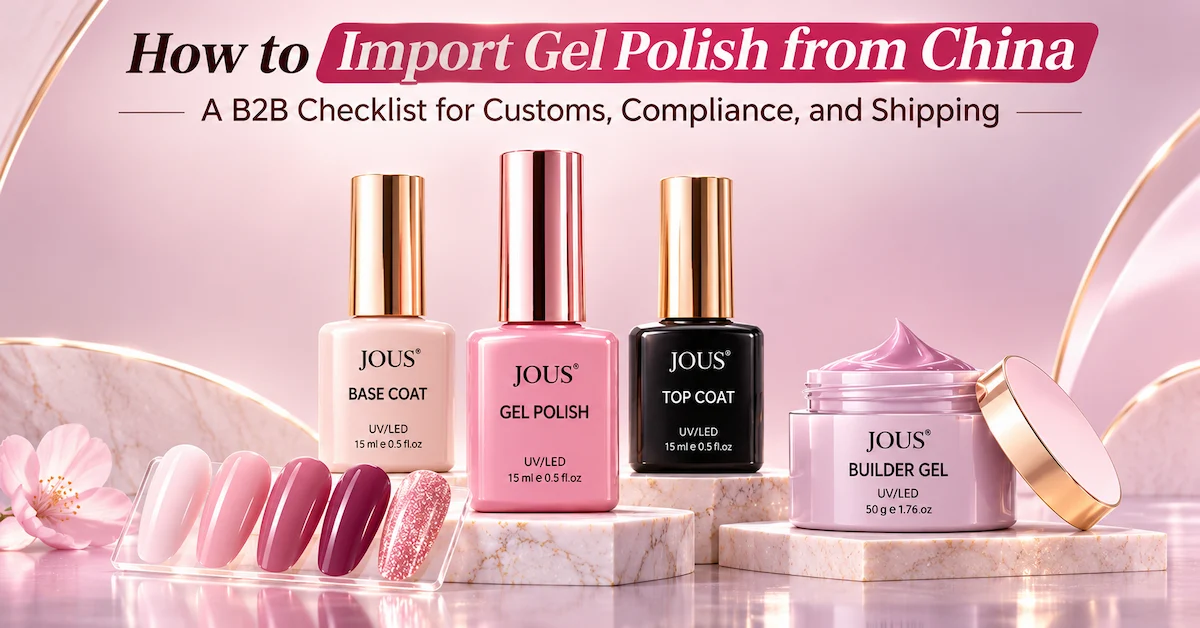
Learning how to import gel polish from China involves more than selecting a manufacturer and negotiating a wholesale price. International nail brands, beauty distributors, and private label importers must verify cosmetic regulations, product formulas, customs documents, freight requirements, and total landed costs before arranging commercial shipments.
Quick Answer: To import gel polish from China successfully, first confirm the destination country's cosmetic requirements. Then select a qualified manufacturer, approve product samples, verify ingredient and quality documentation, confirm customs classification, choose suitable shipping terms, and prepare the import declaration with a licensed customs broker where required.
China offers multiple manufacturing options, from finished wholesale gel polish to customized OEM/ODM products and bulk nail gel for local filling. However, each supply model creates different responsibilities for the importer.
JOUS is a China-based professional nail gel manufacturer providing formula development, private label manufacturing, OEM/ODM customization, and bulk gel supply for international B2B buyers.
This guide explains the import process, identifies common risks, and provides practical checklists for preparing an international nail gel sourcing project.
How to Import Gel Polish from China: 8 Essential Steps
The safest purchasing approach separates product sourcing, regulatory preparation, manufacturing approval, and international logistics.
| Step | Main Action | Required Outcome |
|---|---|---|
| 1 | Define product types and destination market | Clear product and regulatory scope |
| 2 | Verify manufacturer capabilities | Qualified potential supplier |
| 3 | Review formulas and compliance requirements | Product suitable for intended market |
| 4 | Request and test samples | Approved technical specifications |
| 5 | Confirm quotation and Incoterms | Agreed commercial responsibilities |
| 6 | Prepare customs and product documents | Shipment documentation package |
| 7 | Arrange freight and customs clearance | Authorized import and delivery |
| 8 | Inspect goods and plan replenishment | Accepted inventory and repeat-order controls |
Importers should not wait until their shipment reaches the destination port before researching cosmetic regulations.
Certain requirements must be addressed before products are placed on the market, while customs and transport requirements may need to be completed before shipment.
Step 1: Decide What Type of Gel Polish to Import
Different nail gel categories have different technical, packaging, and commercial requirements.
Main Product Categories
| Product Type | Typical B2B Application | Important Import Consideration |
|---|---|---|
| Color Gel Polish | Retail and salon color collections | Pigment, ingredient and shade verification |
| Base Coat | Professional gel manicure systems | Adhesion and formula compatibility |
| Top Coat | Glossy or specialty finishes | Curing and finish performance |
| Builder Gel | Professional overlays and structure | Viscosity and product instructions |
| Cat Eye Gel | Magnetic nail art collections | Pigment effects and curing evaluation |
| Extension Gel | Nail extension applications | Formula and intended-use requirements |
| Bulk Nail Gel | Local filling and packaging operations | Bulk specifications and filling responsibility |
JOUS provides these product categories through its Professional Nail Gel Product Range.
Finished Bottles or Bulk Gel?
Finished bottles are generally suitable for distributors, salon suppliers, and private label brands that do not operate filling facilities.
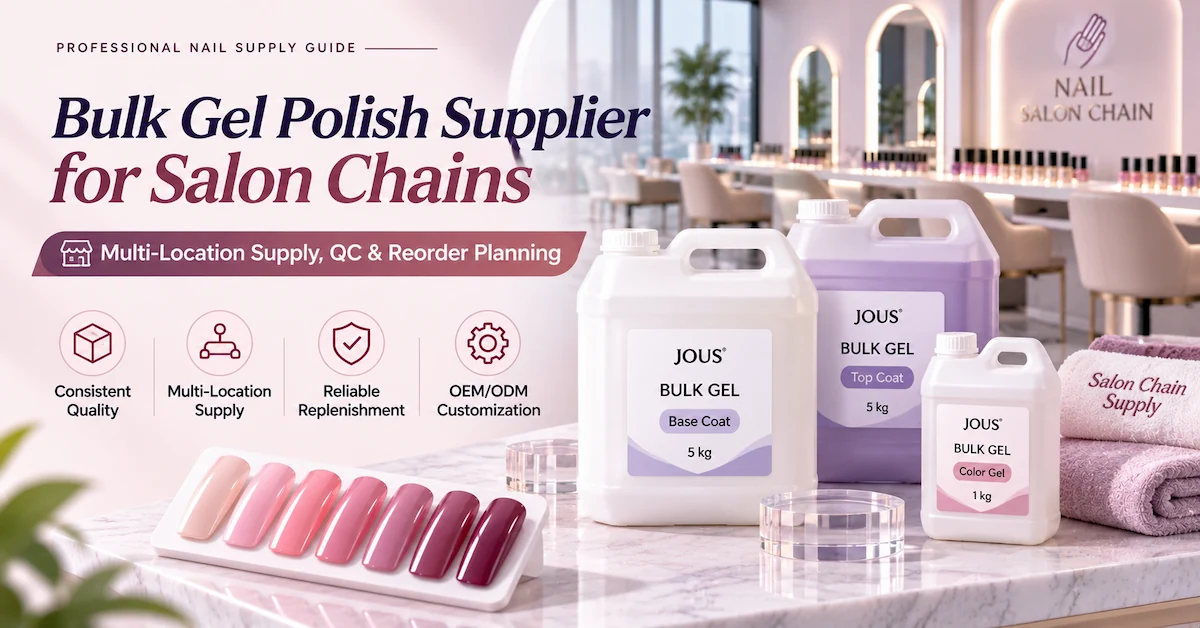
Bulk gel may be suitable for qualified businesses with local filling equipment, packaging validation, traceability procedures, and quality-control capabilities.
JOUS offers both OEM/ODM Finished-Product Manufacturing and Bulk Gel Supply.
A bulk quotation should not be compared directly with a finished-bottle quotation without including local filling and packaging costs.
Step 2: Verify Your Chinese Gel Polish Manufacturer
Before making a payment, establish whether the supplier can manufacture the intended products and provide the required technical support.
A reliable supplier should be able to explain:
-
Which product categories it manufactures.
-
Whether formulas are standard or customizable.
-
How samples and colors are approved.
-
Which packaging configurations are available.
-
How production batches are identified.
-
What quality checks are performed.
-
Which documents can be supplied.
-
How MOQ and production lead times are calculated.
Manufacturer Verification Checklist
| Verification Area | Evidence to Request |
|---|---|
| Business Identity | Registered company information |
| Manufacturing Capability | Facility and production information |
| Formula Development | Available formula options and technical specifications |
| Quality Management | Applicable GMP or quality-system evidence |
| Product Testing | Relevant sample and batch records |
| OEM/ODM | Approved customization scope |
| Packaging | Available bottle, label and box configurations |
| Supply Reliability | Production planning and reorder arrangements |
JOUS states that it was established in 2014 and operates a controlled manufacturing environment with internal formula development and production capabilities.
You can review its About Us and OEM/ODM Services to understand its published manufacturing capabilities.
Buyers should verify relevant claims and documents for their actual project rather than assuming every certification or performance statement applies to every product.
Step 3: Check Gel Polish Import Regulations in Your Market
Cosmetic compliance requirements depend on the destination country, exact formulation, product classification, labeling, and intended users.
A product manufactured legally in China is not automatically authorized for sale in every international market.
Gel Polish Import Requirements: US vs. EU vs. UK
| Requirement | United States | European Union | Great Britain |
|---|---|---|---|
| Primary Regulatory Framework | FD&C Act and applicable MoCRA provisions | Regulation (EC) No 1223/2009 | UK cosmetic regulatory framework |
| Responsible Party | Applicable US responsible person | EU-established Responsible Person | UK-established Responsible Person |
| Product Safety Documentation | Adequate safety substantiation | CPSR and PIF | Safety assessment and PIF |
| Registration / Notification | Applicable facility registration and product listing | CPNP notification | SCPN notification |
| Labeling | Applicable US cosmetic labeling rules | EU cosmetic labeling requirements | GB cosmetic labeling requirements |
| Ingredient Restrictions | US-specific requirements | EU ingredient restrictions and prohibitions | GB-specific applicable restrictions |
| Import Clearance | CBP and applicable FDA import review | National customs authorities | UK customs authorities |
The table provides an overview, not a complete legal determination for every product.
Importing Gel Polish into the United States
The US Food and Drug Administration states that imported cosmetics must comply with the same applicable laws and regulations as domestically produced cosmetics.
Importers should evaluate product classification, ingredient restrictions, permitted color additives, labeling, safety substantiation, and applicable Modernization of Cosmetics Regulation Act of 2022 (MoCRA) requirements.
Certain businesses may qualify for exemptions from specific facility registration and product listing requirements.
FDA registration or product listing is not equivalent to FDA product approval.
For official guidance, consult the FDA's Importing Cosmetics guidance.
US customs entry should also be coordinated with an experienced customs broker.
Importing Gel Polish into the European Union
For EU imports, Regulation (EC) No 1223/2009 establishes important obligations covering cosmetic safety, product documentation, labeling, manufacturing practices, and market placement.
For imported cosmetics, the importer generally acts as the Responsible Person unless an eligible EU-established person is designated through the required arrangements.
Important requirements include:
-
An appropriate EU Responsible Person.
-
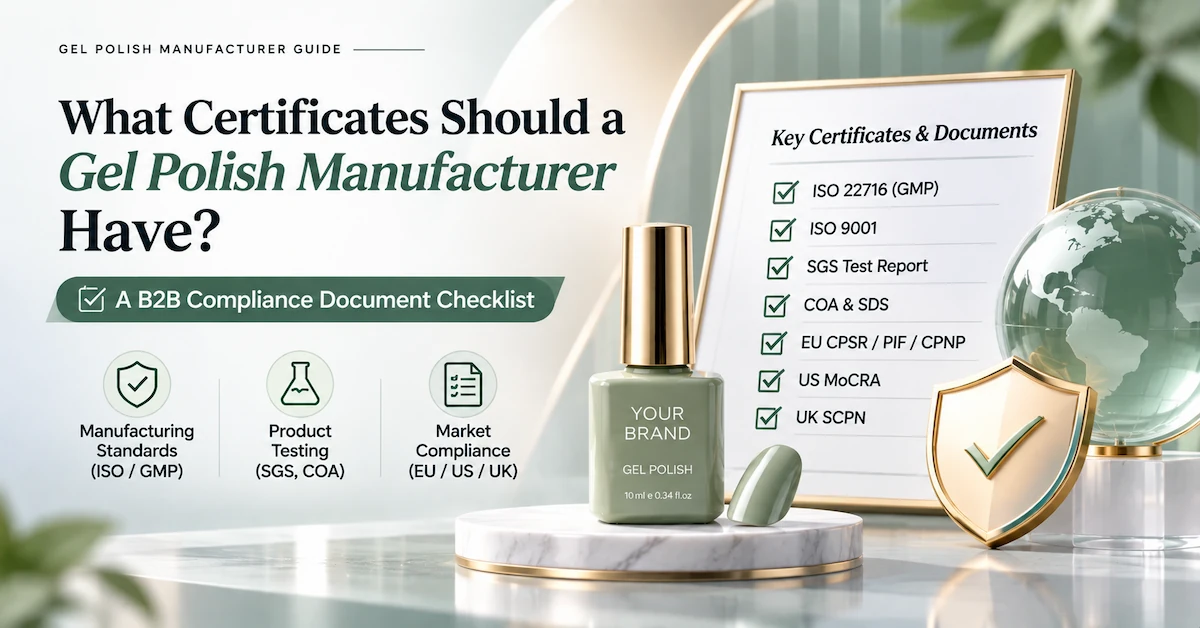
Cosmetic Product Safety Report (CPSR).
-
Product Information File (PIF).
-
Cosmetic Products Notification Portal (CPNP) notification.
-
Appropriate GMP evidence.
-
Compliant ingredients and labeling.
Review the EU Cosmetics Regulation for the legal framework.
Important TPO requirement: Since September 1, 2025, cosmetic products containing Trimethylbenzoyl Diphenylphosphine Oxide (TPO) have been prohibited from being placed or made available on the EU market.
European importers should obtain formula-specific evidence rather than assuming that all products described as TPO-free are automatically compliant.
JOUS provides selected TPO, HEMA and TMPTA-Free Nail Gel Products for buyers to evaluate.
Importing Gel Polish into Great Britain
Great Britain has a separate cosmetic notification system.
Relevant responsibilities include establishing a suitable UK Responsible Person, maintaining product safety documentation, meeting applicable labeling and ingredient requirements, and notifying products through the Submit Cosmetic Product Notifications (SCPN) service before making them available.
The official UK Government Cosmetics Guidance explains these responsibilities.
Northern Ireland has different applicable arrangements and should not automatically be treated as identical to Great Britain.
Step 4: Prepare the Documents Needed to Import Gel Polish
Importing gel polish requires both customs documentation and product-related documentation.
These serve different purposes and should not be confused.
Customs and Shipping Document Checklist
| Document | Typical Purpose | Usually Prepared By |
|---|---|---|
| Commercial Invoice | Product description, transaction value, seller and buyer details | Exporter |
| Packing List | Carton quantities, product units, weights and packaging details | Exporter |
| Bill of Lading / Air Waybill | Transport and shipment information | Carrier or forwarder |
| Customs Classification | Identifies applicable tariff category | Importer with customs specialist |
| Country of Origin Information | Supports origin declaration and applicable trade treatment | Supplier and importer |
| Customs Entry Declaration | Declares goods to destination customs authorities | Importer or broker |
| Import Authorization, if applicable | Meets destination-specific requirements | Responsible importing party |
| Transport Classification Records | Supports appropriate dangerous-goods assessment | Shipper with relevant technical parties |
Some documents are conditional rather than universally mandatory. Requirements vary by destination, transport mode, product classification, and trade arrangements.
Cosmetic Product Documentation
Importers should also request appropriate product records.
| Document | Why It Matters |
|---|---|
| Formula or Ingredient Information | Supports ingredient and regulatory assessment |
| Available Safety Data Sheet (SDS) | Communicates relevant handling and transport hazards |
| Certificate of Analysis (COA) | Supports agreed batch-quality checks |
| Approved Product Specification | Identifies formula and performance requirements |
| Relevant Laboratory Reports | Supports specific tested characteristics or claims |
| Packaging and Label Artwork | Supports destination-market labeling review |
| Batch Identification | Provides traceability |
| Relevant Safety Assessment Information | Supports market-specific product safety obligations |
A COA does not replace a cosmetic safety assessment. Likewise, an SDS is not a universal certificate of customs clearance or proof that a cosmetic is legal for sale.
Before you import gel polish from China, confirm that every document refers to the correct formula, SKU, manufacturer, and shipment.
Step 5: Confirm the Correct Gel Polish HS Code
Customs classification affects duties, import procedures, and trade reporting.
HS heading 3304 and subheading 3304.30 cover manicure or pedicure preparations, making them relevant starting points for examining many gel polish products.
For example, the US Harmonized Tariff Schedule includes 3304.30.00.00 — Manicure or pedicure preparations.
However, importers should not assume that every nail-related product, accessory, chemical material, or bundled kit necessarily receives the same classification.
National tariff codes may extend beyond the common six-digit HS level, and classification must reflect the actual goods.
What Should Buyers Verify?
-
The correct destination-country tariff classification.
-
Whether the shipment contains finished cosmetics or other product types.
-
The applicable country-of-origin treatment.
-
Current ordinary and additional duties.
-
Any restrictions or special reporting obligations.
-
Whether a mixed kit requires separate classification analysis.
Import duties and trade measures can change. In particular, additional tariffs or other measures may apply to goods originating in China depending on the destination and current rules.
Ask a qualified customs broker to verify the applicable tariff treatment before finalizing landed-cost estimates.
Step 6: Choose Shipping Terms and Arrange International Freight
A low factory price is only useful when buyers understand which transportation costs, customs responsibilities, and delivery risks remain.
Compare Common Incoterms
| Incoterm | Main Commercial Meaning | Importer's Main Consideration |
|---|---|---|
| EXW | Goods made available at an agreed location | Buyer assumes extensive logistics responsibilities |
| FCA | Seller delivers to an agreed carrier or location under the rule | Buyer arranges main transport |
| FOB | Seller delivers goods on board the vessel at the named port | Used for applicable sea or inland-waterway transport |
| DAP | Seller arranges delivery to the named destination | Buyer generally handles import clearance and duties |
| DDP | Seller undertakes delivery including import clearance and duties | Verify the seller can legally perform destination import obligations |
The International Chamber of Commerce publishes the Incoterms 2020 Rules.
When requesting a quotation, specify the exact Incoterm, named place or port, and edition.
For example, "FOB China" is insufficiently precise compared with an agreed named port and applicable Incoterms edition.
Can Gel Polish Be Shipped by Air?
Air freight may be possible, but transport acceptance depends on the specific formulation, classification, packaging, and carrier requirements.
Some nail products may be classified as dangerous goods. Others may have different transport classifications.
Do not assume every UV/LED gel polish is either automatically hazardous or automatically exempt from dangerous-goods requirements.
The shipper should determine the applicable classification using reliable product information and relevant transport rules.
Where appropriate, request transport classification information, review the SDS, and confirm packaging and acceptance with the carrier.
The International Air Transport Association's Dangerous Goods guidance explains shipper responsibilities for classification.
Air Freight vs. Sea Freight
| Factor | Air Freight | Sea Freight |
|---|---|---|
| General Use | Smaller or time-sensitive shipments | Larger commercial shipments |
| Cost Structure | Often higher per unit of chargeable weight | Often more economical for larger volumes |
| Transit Planning | Typically shorter | Typically longer |
| Dangerous Goods | Subject to air transport rules and carrier acceptance | Subject to applicable maritime requirements |
| Best Decision | Based on urgency and actual acceptance | Based on volume, landed cost, and lead time |
Never promise a fixed shipping period without confirming the destination, shipment details, customs conditions, and freight arrangements.
Step 7: Calculate the Landed Cost of Imported Gel Polish
The cheapest bottle quotation does not necessarily produce the lowest import cost.
Importers should calculate the total cost of delivering accepted products into saleable inventory.
Landed Cost Formula
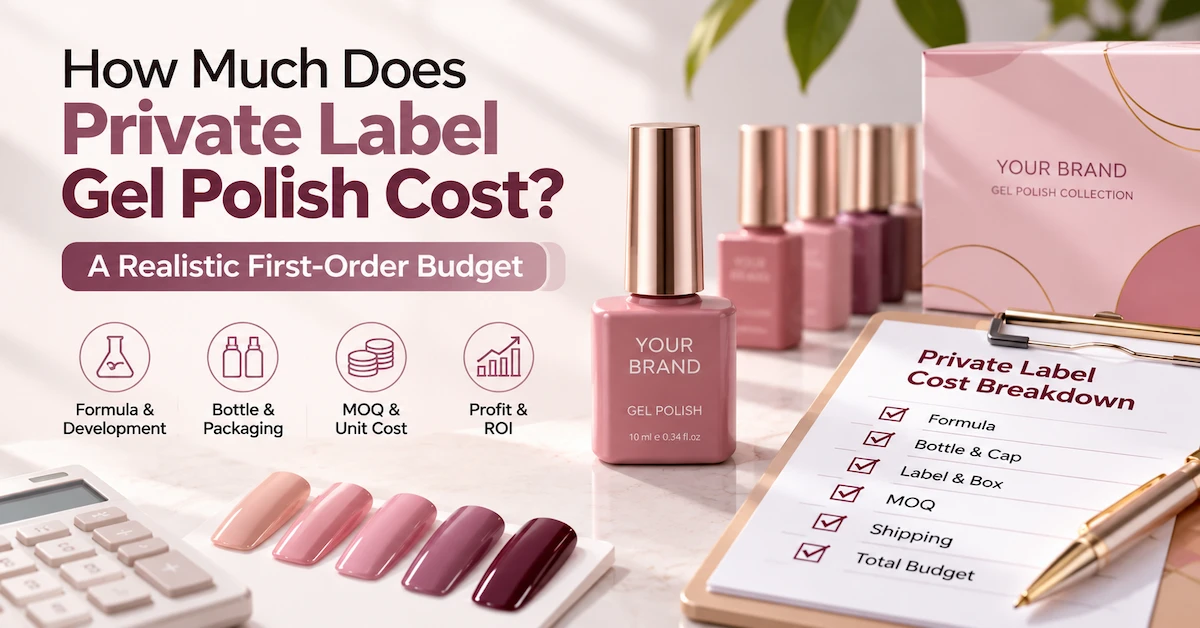
Landed Cost per Accepted Unit = (Product Cost + Freight + Insurance + Nonrecoverable Duties and Taxes + Customs Fees + Applicable Testing and Handling Costs) ÷ Accepted Saleable Units
Treatment of taxes depends on the jurisdiction and whether any import VAT or similar amount is recoverable.
Example: Hypothetical 1,000-Bottle Import
| Cost Component | Example Amount |
|---|---|
| 1,000 Gel Polish Bottles | $2,800 |
| International Freight and Insurance | $640 |
| Assumed Nonrecoverable Duties | $300 |
| Customs Brokerage and Clearance | $160 |
| Allocated Testing and Documentation | $450 |
| Receiving and Handling | $120 |
| Total Illustrative Cost | $4,470 |
Assume 2% of bottles are not accepted as saleable inventory.
Accepted units: 980 bottles.
Illustrative Landed Cost = $4,470 ÷ 980 = $4.56 per accepted bottle.
All amounts, duty assumptions, and inventory losses are hypothetical. They are not JOUS quotations or verified customs rates.
Common Hidden Import Costs
-
Additional tariff measures.
-
Customs brokerage.
-
Port or terminal handling.
-
Storage or demurrage charges.
-
Shipment insurance.
-
Product testing and safety assessment.
-
Label corrections and repackaging.
-
Damaged or rejected inventory.
-
Local warehousing.
-
Currency conversion expenses.
A realistic landed-cost estimate helps importers compare different supplier offers and avoid margin surprises.
Step 8: Inspect the Gel Polish Shipment Before Final Acceptance
Product inspection should begin before shipment, not only after the cartons arrive.
For OEM and private label orders, buyers should retain approved samples and agreed product specifications.
Pre-Shipment Quality Checklist
| Inspection Item | What to Verify |
|---|---|
| Product and Formula | Correct approved SKU and formula |
| Color | Matches approved physical reference |
| Viscosity | Meets agreed product specification |
| UV/LED Curing Information | Matches validated application instructions |
| Bottle Fill | Meets agreed quantity requirements |
| Closure and Packaging | Correct bottle, cap, brush and protective packaging |
| Labels | Correct product, brand and applicable information |
| Carton Quantity | Matches packing list |
| Batch Identification | Traceable production lots |
| Product Documentation | Relevant agreed records available |
After arrival, reconcile the shipment against purchase documents and inspect for transport damage or product discrepancies.
If the shipment includes bulk gel for local filling, additional incoming-material checks and qualified filling operations are necessary.
A batch should not be released for commercial sale solely because customs clearance has been completed.
How JOUS Supports International Gel Polish Importers
Guangzhou JOUS Fine Chemical Co., Ltd. specializes in professional nail gel manufacturing and provides OEM/ODM services for international nail brands, distributors, salon chains, and other B2B customers.
JOUS's public manufacturing services include:
Professional Nail Gel Product Selection
JOUS offers color gel polish, builder gel, base and top coats, cat eye gel, extension gel, and functional nail products.
Buyers can review the JOUS Product Catalog to identify suitable product categories.
OEM/ODM and Private Label Customization
The JOUS OEM/ODM service describes custom formula development, color matching, bottle options, logos, labels, and outer packaging.
Bulk Gel Supply
JOUS provides Bulk Gel Supply for brands, qualified local fillers, and distributors requiring larger quantities of nail gel material.
Sample and Quality-Control Support
JOUS describes sample approval, production quality checks, and documentation assistance.
Buyers should confirm which technical records, packaging options, samples, and market-specific documents are available for their exact products.
Export Project Coordination
JOUS can discuss product requirements, manufacturing quantities, packaging specifications, and shipment preparation with international buyers.
However, product availability, certification scope, customs classification, destination-market authorization, and freight arrangements must be confirmed for each order.
Contact JOUS for Gel Polish Samples and an Export Manufacturing Quotation
What Should You Include in a Gel Polish Import RFQ?
A detailed request for quotation helps the supplier prepare a relevant manufacturing proposal.
International Buyer RFQ Checklist
| Required Information | What to Provide |
|---|---|
| Destination Country | Import and sales market |
| Business Type | Nail brand, wholesaler, distributor, salon chain, or filler |
| Product Types | Color, base, top, builder, cat eye, or bulk gel |
| Product Classification | Intended use and any specific claims |
| Formula Requirements | Existing or custom formula |
| Ingredient Restrictions | Market-specific exclusions or requirements |
| Color Selection | Shade references and number of SKUs |
| Packaging | Bottle size, labels, logo and cartons |
| Quantity | Initial order and estimated repeat volume |
| Documentation | Ingredient, quality and regulatory information needed |
| Shipping Preference | Air, sea or recommended available method |
| Trade Terms | Requested Incoterm and named destination |
| Delivery Schedule | Target warehouse arrival date |
| Importer Details | Responsible importing business and broker arrangements |
For the most accurate quote, ask JOUS to clarify whether pricing includes sampling, packaging customization, quality checks, export documentation, and any shipping services.
Request a Customized Gel Polish Export Quote from JOUS
Frequently Asked Questions About Importing Gel Polish from China
1. Can I import gel polish from China for resale?
Yes, subject to the destination market's customs, product safety, ingredient, labeling, and other applicable requirements. Commercial importers should verify the exact formulation and regulatory responsibilities before shipment.
2. Do I need an import license for gel polish?
Requirements vary by country and business arrangement. A general import license is not universally required for all cosmetic gel polish, but customs registration, responsible-person arrangements, documentation, or specific authorizations may apply.
3. What is the HS code for gel polish?
HS subheading 3304.30 covers manicure or pedicure preparations and is relevant to many gel polish products. The precise destination-country tariff code and classification should be confirmed with customs authorities or a qualified broker.
4. Does imported gel polish need FDA approval in the United States?
Ordinary cosmetic gel polish generally does not require FDA premarket approval. However, imported cosmetics must comply with applicable US laws, including relevant labeling, ingredient, safety, and MoCRA requirements.
5. What documents should a Chinese gel polish supplier provide?
Typical commercial documents include an invoice and packing list. Buyers may also require appropriate product specifications, ingredient information, quality records, transport classification information, and documents relevant to their target market.
6. Can TPO-containing gel polish be imported for sale in the EU?
TPO-containing cosmetic products cannot be placed or made available on the EU market under the prohibition effective September 1, 2025. Importers should verify the actual formula and applicable EU requirements.
7. Is gel polish classified as dangerous goods for shipping?
Classification depends on the actual formulation and relevant transport regulations. Some nail products may be regulated as dangerous goods. The shipper should confirm the correct classification and carrier acceptance before booking freight.
8. What is the difference between FOB and DDP shipping?
Under FOB, for applicable sea shipments, the seller delivers goods on board the vessel at the named port and the buyer takes on the responsibilities defined by that rule. Under DDP, the seller undertakes import clearance and pays applicable duties and taxes, subject to the agreed terms and legal ability to perform those obligations.
9. Is importing bulk gel cheaper than finished gel polish bottles?
It may be, but the importer must include local filling, packaging, equipment, labor, quality control, and potential losses. Comparing prices per kilogram and per bottle without these costs can be misleading.
10. How can I start importing gel polish from JOUS?
Select your target market, product categories, formula requirements, packaging preferences, estimated quantities, and documentation needs. Then contact JOUS to discuss samples, manufacturing specifications, commercial terms, and available export support.
Conclusion
Learning how to import gel polish from China successfully requires careful coordination between product sourcing, regulatory compliance, customs preparation, international freight, and quality control.
For professional nail brands, beauty distributors, and private label buyers, the most important decisions should be made before the first commercial shipment.
Confirm the destination market's requirements, approve the actual product formulas, obtain relevant documentation, verify customs classification, calculate complete landed costs, and establish a clear supplier agreement.
JOUS supports international B2B customers through professional nail gel manufacturing, custom formulas, OEM/ODM packaging, and bulk gel supply.
Whether your business is importing its first private label gel polish collection or expanding an established wholesale product range, a structured purchasing and import process can help reduce avoidable delays, product inconsistencies, and unexpected costs.
Explore JOUS OEM/ODM Manufacturing or Contact JOUS for Gel Polish Samples, Product Documentation, and a Customized Export Quotation to discuss your next international sourcing project.