
For nail product filling companies, sourcing bulk base and top coat for nail product fillers is more than purchasing UV/LED gel at a competitive price per kilogram. The right formulations must perform consistently during dispensing, work with the intended bottles and brushes, cure under validated conditions, and retain their properties after filling and storage.
A suitable supplier should help buyers identify the correct base and top coat formulas, establish technical specifications, approve samples, and manage repeat orders. For companies operating local filling lines, these decisions directly affect production efficiency, product quality, packaging losses, and customer satisfaction.
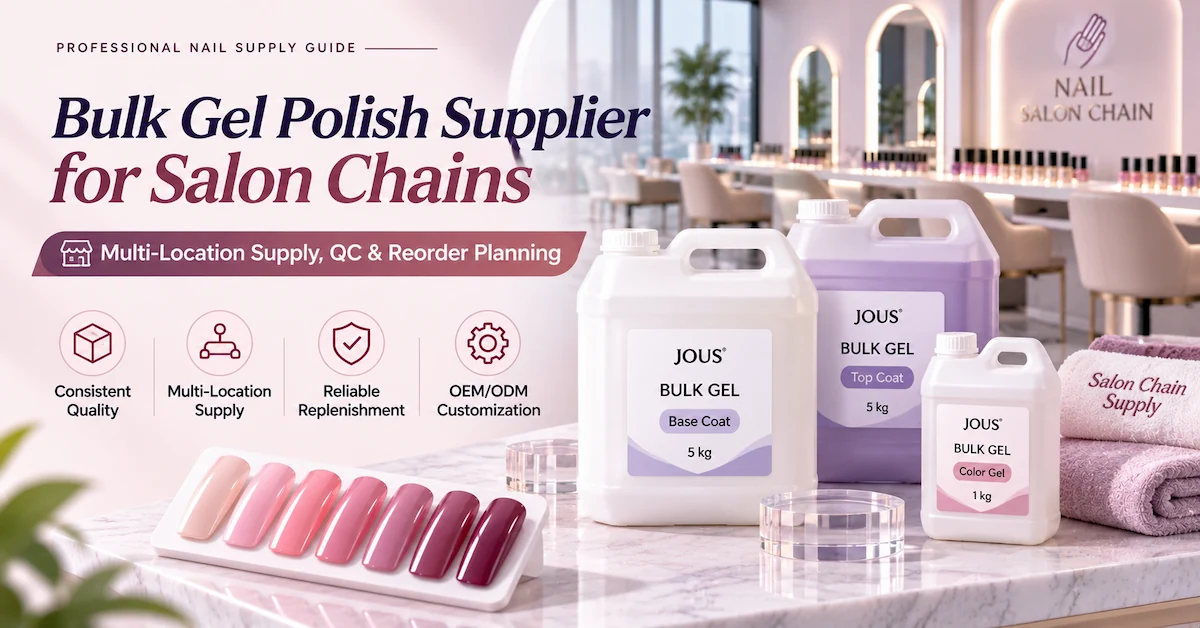
JOUS Bulk Gel Supply supports nail brands, professional fillers, and distributors sourcing gel formulations for local bottling and private label operations.
This guide explains how to evaluate bulk base and top coats before committing to commercial filling.
What Should Nail Product Fillers Look for in Bulk Base and Top Coat?
The most important purchasing criteria are formula compatibility, viscosity, curing performance, filling stability, packaging suitability, and batch-to-batch consistency.
Bulk base coat and top coat are UV/LED-curable nail gel formulations supplied in larger containers for subsequent filling into smaller retail or professional-use bottles.
Unlike finished-bottle wholesale, bulk purchasing transfers additional responsibilities to the filling company, including material handling, equipment setup, packaging validation, fill-volume control, finished-product inspection, and traceability.
The purchasing model is particularly suitable for:
-
Established nail product brands with their own filling facilities.
-
Contract cosmetic filling companies manufacturing for multiple brands.
-
Nail gel distributors operating local bottling or packaging lines.
-
Private label manufacturers requiring bulk UV/LED gel formulations.
-
Professional salon supply companies managing regional packaging and replenishment.
Businesses without controlled filling equipment or technical quality-control capabilities may find finished private label bottles more practical. JOUS also offers OEM/ODM nail gel manufacturing for projects requiring production and packaging support.
Bulk Base Coat vs. Bulk Top Coat: Why Formula Selection Matters
Although base coats and top coats are both part of a gel manicure system, they perform different functions.
Bulk Base Coat: Adhesion and Foundation
Base gel is designed to form the foundation between the prepared nail surface and subsequent product layers.
Depending on the formulation, purchasing priorities may include adhesion, flexibility, application thickness, self-leveling behavior, and compatibility with color gels or builder systems.
JOUS offers several base gel directions, including standard base coat, rubber base, and multifunctional building base formulations.
Explore the JOUS Base Coat product range.
Bulk Top Coat: Finish and Surface Performance
Top coat is applied over the color or construction system to achieve the intended final appearance and surface properties.
The required finish may be glossy, matte, no-wipe, wipe-off, or another specialized effect.
For filling companies, the technical requirements extend beyond appearance. The formulation must also dispense predictably, maintain its intended finish, and function correctly after being transferred into the final bottle.
Explore the JOUS Top Coat range.
Base and Top Coat Formula Comparison for Fillers
| Formula Type | Main Function | Filling Consideration | Suitable Business Application |
|---|---|---|---|
| Standard Base Coat | Foundation and adhesion | Flow, metering, application consistency | General gel polish collections |
| Rubber Base Gel | Flexible base or leveling system, depending on formula | Viscosity, nozzle flow, air entrapment | Professional salon product lines |
| Builder Base Gel | Foundation with additional structural application | Dispensing control and leveling characteristics | Professional strengthening systems |
| High-Gloss Top Coat | Glossy finishing layer | Flow stability, clarity, surface finish | Standard and premium salon collections |
| No-Wipe Top Coat | Intended tack-free finish after validated curing | Curing response and finished surface consistency | Efficient professional manicure systems |
| Wipe Top Coat | Finishing system requiring removal of the dispersion layer | Application behavior and curing instructions | Traditional professional gel systems |
| Matte Top Coat | Non-glossy finish | Dispersion uniformity and visual consistency | Specialty and fashion collections |
These are functional categories, not universal specifications. Exact viscosity, curing conditions, and compatibility must be confirmed for the selected formula.
Why Fillers Should Evaluate Base and Top Coat Together
A base coat that performs well on its own may not provide the same result when combined with a different color gel or top coat.
Similarly, a high-gloss top coat may require particular curing conditions or be unsuitable for certain underlying formulations.
Before bulk approval, test the complete intended manicure system:
Nail preparation → Base coat → Color or builder layer → Top coat → Validated curing and removal process.
This reduces the risk of commercializing individually acceptable products that do not perform consistently together.
Technical Specifications to Confirm Before Bulk Purchasing
A professional bulk gel purchase should begin with a written technical specification.
This document establishes what the supplier is expected to provide and what the local filling company must validate.
Bulk Base and Top Coat Specification Checklist
| Specification | What to Confirm | Why It Matters |
|---|---|---|
| Product identity | Base, rubber base, builder base, glossy top, matte top, or no-wipe top | Prevents incorrect formula selection |
| Formula reference | Product code and revision | Supports repeatable manufacturing |
| Viscosity | Agreed value or range, measurement temperature and method | Affects pumping, nozzle behavior, and filling accuracy |
| Appearance | Clarity, color, finish, and agreed reference | Detects unwanted batch changes |
| UV/LED curing | Compatible lamp conditions and intended layer thickness | Supports correct application and curing |
| Adhesion and flexibility | Product-specific test requirements | Helps assess system performance |
| Finished surface | Gloss, matte uniformity, tack characteristics, or other agreed properties | Supports consistent customer experience |
| Bulk container | Net weight, container material, closure, light protection | Affects transport and handling |
| Packaging compatibility | Final bottle, brush, cap, and liner compatibility | Helps prevent leaks and product deterioration |
| Quality documentation | Batch identification, agreed QC records, available COA and safety documentation | Supports traceability and product release |
| Stability | Agreed storage and filled-package test conditions | Supports inventory planning |
Understanding Viscosity for Nail Gel Filling
Viscosity is especially important when sourcing bulk base and top coat for local filling.
A relatively fluid formulation may move through a dispensing system differently from a thicker rubber base or building base gel. Excessive viscosity can create filling difficulties, while unsuitable flow behavior can affect dosing consistency.
One JOUS bulk base/top coat product listing describes a standard medium-viscosity option at approximately 4,000–5,000 cP at 25°C, with customization options.
This is a product-page reference, not a universal JOUS specification or a guaranteed filling-line tolerance. Buyers should confirm the actual formula, measurement method, and acceptable range for their project.
For accurate evaluation, ask:
-
At what temperature was viscosity measured?
-
Which viscometer method and operating conditions were used?
-
Does viscosity change significantly during pumping or dispensing?
-
Can the formulation fill the intended bottle without excessive stringing or dripping?
-
Does the filled product maintain suitable brush application behavior?
The ideal viscosity is the one that satisfies both the finished product requirements and the validated filling process.
How to Test Bulk Gel on a Nail Product Filling Line
A formulation that performs well during manual sampling may behave differently during repeated production cycles.
Before approving large-volume purchases, professional fillers should conduct controlled filling trials using their intended equipment and packaging.
Step 1: Test the Incoming Bulk Formula
Confirm that the incoming sample matches the agreed formula reference.
Check appearance, container integrity, identification, viscosity under specified conditions, and any required incoming inspection records.
Allow the material to reach the defined testing temperature before comparing results. Temperature differences can change flow behavior and create misleading comparisons.
Step 2: Evaluate Pumping and Dispensing
Use a representative filling process to assess:
-
Consistency of dispensing.
-
Nozzle dripping or stringing.
-
Air-bubble formation.
-
Product retention inside transfer lines.
-
Filling repeatability across consecutive bottles.
Filling parameters should be developed for the actual equipment and formula rather than copied from a different cosmetic liquid.
Step 3: Control Unwanted Light Exposure
UV/LED nail gels contain light-responsive chemistry.
Uncontrolled exposure to relevant light wavelengths can create a risk of premature polymerization or changes in processing behavior.
The filling company should evaluate light protection throughout material transfer, temporary holding, filling, and packaging.
Opaque or appropriately light-protective containers may be necessary, subject to packaging compatibility testing.
Step 4: Validate the Final Bottle and Closure
A suitable formula is only one part of a successful finished product.
Test the actual bottle, brush, cap, closure system, and product-contact materials.
Important checks include leakage, dispensing performance, brush loading, closure fit, and filled-product stability.
Do not assume that a bottle approved for conventional nail polish is automatically suitable for UV/LED gel.
Step 5: Test Finished-Product Performance
After filling, evaluate the product under its intended use conditions.
For base coats, focus on application, adhesion, flexibility, and compatibility with subsequent layers.
For top coats, evaluate the required finish, curing behavior, surface characteristics, and compatibility with the selected base and color system.
Document the results and retain an approved sample as a reference for future orders.
Quality Control: Preventing Expensive Filling and Reorder Problems
For professional filling companies, product consistency affects more than appearance.
Changes in bulk material can create equipment adjustments, inconsistent finished products, additional inspection work, and customer complaints.
A reliable quality program should control the approved formulation from incoming bulk material through finished-bottle release.
Common Filling and Product Risks
| Potential Problem | Possible Cause | Recommended Control |
|---|---|---|
| Inconsistent bottle fills | Viscosity variation or unsuitable filling settings | Verify viscosity and validate dispensing parameters |
| Excessive bubbles | Air introduced during material transfer | Review handling and filling processes |
| Premature thickening | Unwanted light exposure or unsuitable storage conditions | Evaluate light protection and storage controls |
| Base coat lifting | Application or product-system incompatibility | Test the complete manicure system |
| Top coat remains tacky unexpectedly | Formula-specific curing or application issue | Validate the approved formula and curing conditions |
| Gloss or matte variation | Formulation, application, or curing differences | Use agreed finish references and test conditions |
| Leaking retail bottles | Closure or packaging incompatibility | Conduct filled-package and closure testing |
| Different performance on reorders | Uncontrolled formula or batch changes | Maintain approved specifications and traceable lot records |
ISO 22716:2007, Cosmetics — Good Manufacturing Practices, provides internationally recognized guidance covering the production, control, storage, and shipment of cosmetics.
For buyers, the practical lesson is to request relevant process and quality records rather than assuming that a marketing claim or facility description proves every batch meets the intended specification.
Bulk Packaging: Choosing Between 1 kg, 5 kg, and Larger Orders
Bulk packaging should be selected according to production trials, filling volume, storage conditions, and replenishment needs.
JOUS has publicly showcased professional nail gel products in 1 kg and 5 kg packaging, including Strong Base Coat (JRB1801) and High-Gloss Top Coat (JRT2802). Specific formula availability, pack sizes, and order requirements should be reconfirmed before quotation.
Recommended Purchasing Approach
| Project Stage | Packaging Consideration | Procurement Objective |
|---|---|---|
| Formula evaluation | Representative sample quantity | Confirm basic product suitability |
| Pilot filling | Bulk container sufficient for line trials | Evaluate dispensing and packaging compatibility |
| Initial commercial production | Agreed bulk pack configuration | Balance production efficiency and inventory exposure |
| Regular replenishment | Standardized approved packaging and batch records | Support consistent repeat manufacturing |
For contract fillers, bigger packaging is not automatically more economical.
Evaluate how bulk-container size affects opening frequency, material handling, residual product, contamination controls, and stock rotation.
Calculate Cost per Saleable Bottle, Not Just Cost per Kilogram
The lowest bulk price does not necessarily produce the lowest finished-bottle cost.
A more useful calculation is:
Cost per accepted bottle = (Bulk gel cost + Freight + Filling + Packaging + QC + Allocated production losses) ÷ Number of saleable bottles
When comparing kilograms of bulk gel with milliliters of finished product, use the measured product density rather than assuming that one kilogram always produces a fixed number of bottles.
Also account for material remaining in hoses, containers, and nozzles, along with rejected or underfilled units.
This approach creates a more realistic comparison between bulk sourcing and purchasing finished private label bottles.
Why Choose JOUS for Bulk Base and Top Coat Supply?
Guangzhou JOUS Fine Chemical Co., Ltd. develops and manufactures professional nail gel products, including base coats, top coats, builder systems, color gels, and functional nail formulations.
For local filling companies, JOUS offers a relevant sourcing model through its dedicated Bulk Gel Supply service.
1. Base and Top Coat Formula Selection
JOUS provides multiple base and top coat product categories, allowing buyers to discuss the intended formula characteristics rather than treating all clear gels as interchangeable.
2. Formula and Viscosity Customization
Through its OEM/ODM development services, JOUS describes support for formulation adjustments, viscosity matching, and product customization.
The available development scope depends on the technical requirements and feasibility of the selected project.
3. Manufacturing and Quality-Control Support
JOUS describes production in a controlled clean-workshop environment and a process involving material preparation, mixing, testing, filling, and quality checks.
Buyers should request the quality records and acceptance specifications relevant to the exact bulk formulations being purchased.
4. Flexible Bulk and Private Label Options
Customers may explore bulk gel supply for local filling or finished private label manufacturing, depending on their facilities and commercialization requirements.
Minimum order quantities, samples, packaging configurations, and production timelines should be confirmed for each formula.
Request a Bulk Base and Top Coat Quotation from JOUS
Bulk Supply vs. Finished Private Label Bottles: Which Is Better?
The right manufacturing model depends on where a company wants to perform filling, packaging, and quality assurance.
| Purchasing Factor | Bulk Gel for Local Fillers | Finished Private Label Bottles |
|---|---|---|
| Gel manufacturing | Supplier | Supplier |
| Retail bottle filling | Local filling company | Supplier |
| Packaging customization | Managed by local filler or its partners | Coordinated with supplier |
| Filling equipment | Required locally | Not required by the buyer |
| Finished-bottle QC | Primarily controlled through local filling operations | Per agreed manufacturing arrangement |
| Main advantage | Greater control over regional bottling operations | Reduced local manufacturing complexity |
| Key consideration | Equipment, yield, packaging, documentation | Finished-product MOQ and packaging approval |
Bulk supply is generally more relevant for qualified filling companies with sufficient operational capacity.
Finished private label manufacturing may be preferable when a brand wants to concentrate on distribution, sales, and product development rather than local production.
JOUS can discuss both sourcing approaches through its OEM/ODM service.
Destination-Market Documentation and Ingredient Verification
Professional buyers should establish product documentation requirements before placing commercial orders.
These requirements depend on the destination country, formula, intended users, product claims, and the respective responsibilities of the supplier, importer, brand owner, and local filler.
For example, EU cosmetics rules prohibit TPO in cosmetic products from September 1, 2025, under Commission Regulation (EU) 2025/877.
Therefore, buyers supplying the EU market should verify the specific formulation and supporting ingredient documentation rather than relying only on an unverified “compliant” or “free-from” statement.
Depending on the project, procurement documentation may include:
-
Ingredient information relevant to the target market.
-
Available safety and batch-quality documents.
-
Agreed product specifications and formula references.
-
Intended application and curing instructions.
-
Packaging and labeling information.
-
Traceability records and change-control arrangements.
JOUS offers product development and documentation support, but buyers should confirm the exact documents available for the selected product. Compliance responsibilities cannot be transferred or assumed solely through a supplier's marketing description.
How to Request an Accurate Bulk Base and Top Coat Quote
A detailed inquiry helps the manufacturer recommend a more suitable formula and prepare a commercially meaningful quotation.
Instead of requesting only a price per kilogram, provide the information needed to assess your filling operation.
Bulk Nail Gel RFQ Checklist
| Information to Provide | What JOUS Needs to Know |
|---|---|
| Product requirement | Base coat, rubber base, glossy top, matte top, no-wipe top, or multiple formulas |
| Business model | Contract filler, private label manufacturer, distributor, or nail brand |
| Target market | Countries of sale and intended professional or consumer use |
| Filling equipment | Filling method, line characteristics, and operating conditions |
| Desired performance | Viscosity, finish, curing requirements, and product compatibility |
| Packaging | Preferred bulk container and finished-bottle size |
| Order volume | Trial quantity, anticipated commercial quantity, and reorder forecast |
| Documentation | Ingredient, quality, labeling, or market-specific requirements |
| Project timeline | Sample testing, pilot production, and commercial launch requirements |
JOUS describes a five-stage bulk ordering process: formula selection, specification confirmation, sample approval, bulk production with quality control, and shipment or replenishment.
This process provides a useful starting framework for coordinating formula development with local filling validation.
Contact JOUS for Bulk Gel Samples and Manufacturing Discussion
Frequently Asked Questions About Bulk Base and Top Coat for Nail Product Fillers
1. What is bulk base and top coat for nail product fillers?
It refers to UV/LED-curable base and top coat formulations supplied in larger containers for local filling into branded nail product bottles. Buyers should validate formula performance, equipment compatibility, packaging, and quality requirements before commercial production.
2. Can the same filling machine handle base coat and top coat?
Potentially, but suitability depends on the formulas and equipment. Different viscosities, flow characteristics, cleaning requirements, and filling settings may require separate validation before both products use the same equipment.
3. What viscosity is best for bulk nail gel filling?
There is no universal ideal viscosity. The correct value depends on the formulation, temperature, dispensing equipment, and desired application behavior. Ask for a formula-specific viscosity specification and verify it under your intended filling conditions.
4. Does JOUS supply both bulk base coat and bulk top coat?
Yes. JOUS lists base and top coat formulations within its bulk nail gel offering and has displayed 1 kg and 5 kg bulk formats. Buyers should confirm currently available formulations, container sizes, and project-specific minimum quantities.
5. Can I order bulk rubber base gel instead of standard base coat?
JOUS offers rubber base products, and buyers can discuss available bulk options. Rubber base and standard base coat serve different application needs, so select the formula according to intended use, viscosity, system compatibility, and filling performance.
6. Is no-wipe top coat compatible with every color gel?
Not necessarily. Compatibility should be tested using the intended base, color, builder where applicable, and top coat combination, together with validated curing conditions. A no-wipe description alone does not prove universal compatibility.
7. How should UV/LED curing be checked before purchasing bulk gel?
Test the exact approved formulation using specified lamp characteristics, exposure conditions, and intended application thickness. Document the results rather than assuming that one published curing time applies to every gel or lamp.
8. Can JOUS customize base and top coat formulations for a private label project?
JOUS describes OEM/ODM support that includes formula development and viscosity matching. Customers can submit performance and application requirements for technical evaluation. Customization feasibility, samples, costs, and production conditions should be agreed upon before ordering.
9. What quality documents should nail product fillers request?
Request available batch records, agreed specifications, applicable ingredient and safety documentation, and evidence supporting intended product claims. Local fillers should also maintain their own filling, packaging, inspection, and finished-product traceability records.
10. How can I get a bulk base and top coat quotation from JOUS?
Send JOUS your required formulas, target market, expected quantity, preferred bulk packaging, filling conditions, and documentation needs. The team can review the project and discuss suitable formula options, samples, and quotation terms through the JOUS contact page.
Conclusion
Choosing bulk base and top coat for nail product fillers requires more than finding a manufacturer offering attractive bulk prices. The most effective procurement decisions connect formula selection, filling-line compatibility, UV/LED curing validation, packaging performance, and documented quality control.
For established filling companies and private label manufacturers, controlling these factors can reduce production uncertainty, protect finished-product consistency, and make repeat purchasing more predictable.
JOUS offers professional nail gel manufacturing, bulk base and top coat sourcing, formulation customization, and OEM/ODM support for international B2B buyers.
If your business is evaluating bulk gel for local filling, start by confirming the required formula types, technical specifications, intended packaging, and production quantities.
Explore JOUS Bulk Gel Solutions and Request Samples or a Customized Bulk Quotation to discuss your next nail product filling project.