
What Should a Nail Gel Manufacturer Provide to B2B Buyers?
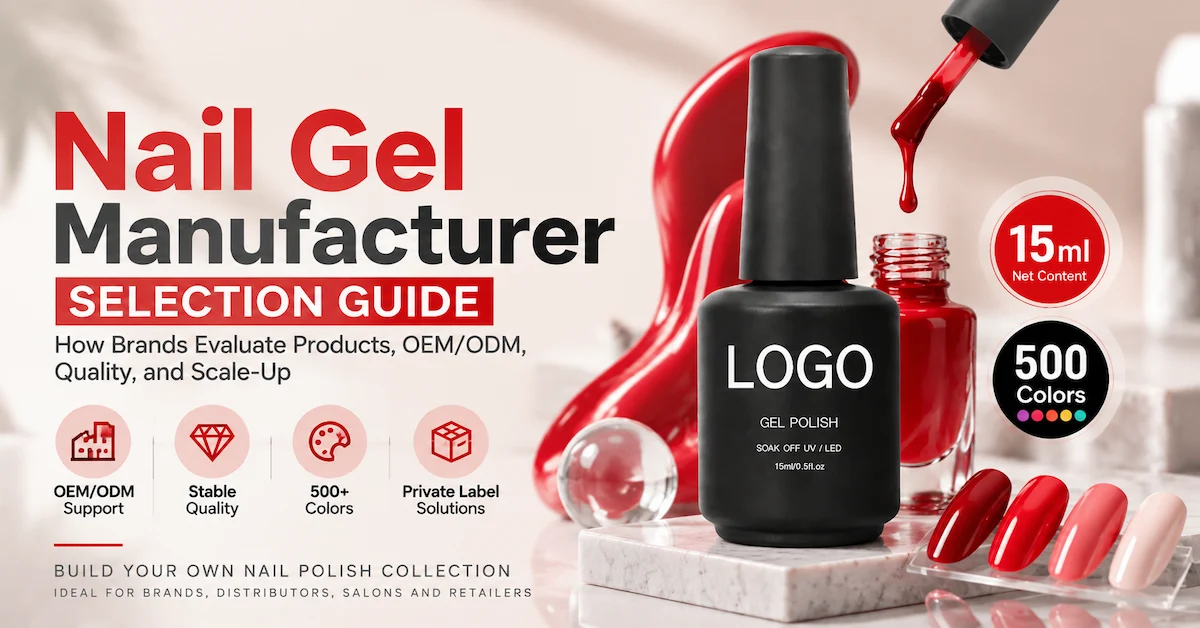
A professional nail gel manufacturer should provide more than bottles of finished color gel. For nail brands, distributors, salon chains, e-commerce sellers, and private-label businesses, manufacturing capability needs to connect product development, formula selection, color planning, functional gel systems, packaging, quality control, and repeat-order supply.
The first sourcing question should therefore not be “Who has the lowest price?” A better question is: Can this manufacturer support the product system, customization level, quality controls, and supply model required by my business?
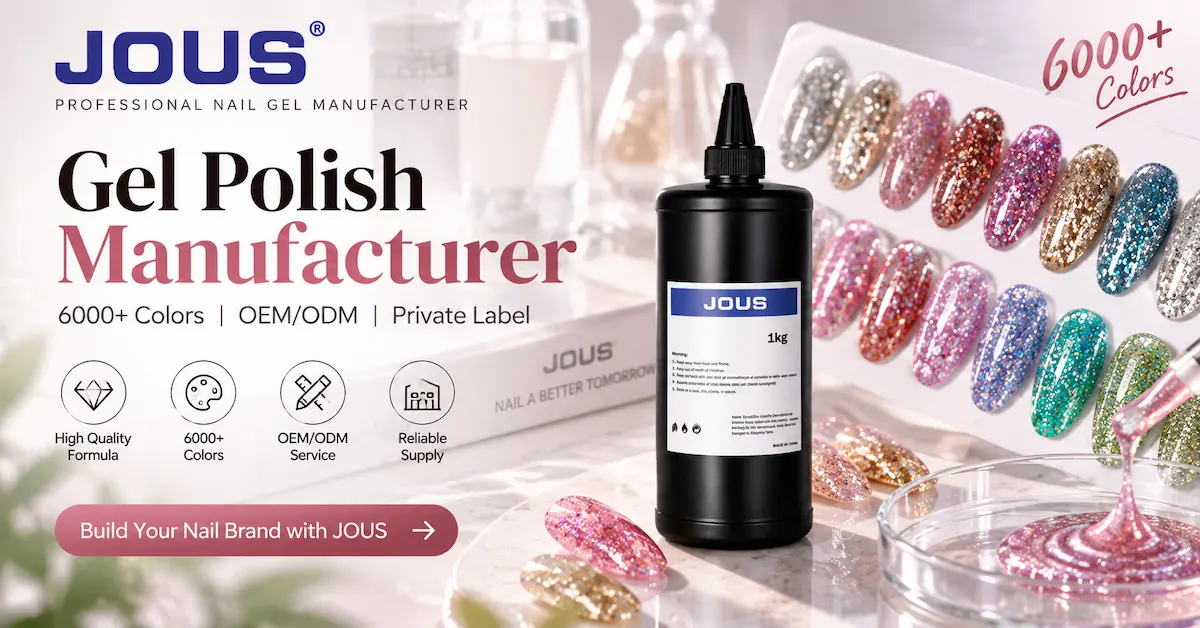
JOUS positions its business around nail gel R&D, formula design, manufacturing, global sales, and OEM/ODM support. Its published product portfolio includes builder gels, base and top systems, color gels, art gels, cat eye gels, extension products, and other functional nail gel categories. Buyers can first review the complete nail gel product range before deciding whether they need standard products, private label manufacturing, deeper customization, or bulk supply.
Who Should Work With a Nail Gel Manufacturer Rather Than a General Beauty Supplier?
A direct manufacturing relationship becomes more important when a buyer needs control over product specifications, color development, packaging, supply continuity, or private-label identity.
Typical B2B buyers include nail brands developing their first collection, established brands expanding into new gel systems, beauty distributors building proprietary product lines, salon chains requiring consistent professional-use products, e-commerce sellers creating differentiated collections, and regional fillers purchasing gel in bulk.
These buyers do not all need the same service.
A startup brand may need a manageable first collection with stock packaging and private labeling. A mature brand may need exclusive colors, custom viscosity, specialized finishes, or a new builder system. A distributor may prioritize broad product coverage and repeat-order stability, while a local filling company may prefer bulk nail gel supply instead of finished bottles.
A suitable nail gel manufacturer should therefore help define the correct sourcing route rather than push every buyer toward the same configuration.
Evaluate the Product Portfolio Before Discussing Customization
A manufacturer with only one strong color-gel series may not be the best choice for a brand planning to build a complete professional nail system.
JOUS currently organizes its catalog across multiple categories, including Color Gel Polish, Cat Eye Gel, Base Gel, Top Gel, Builder Base Gel, Reinforce Gel, Extension Gel, Self-Leveling Gel, Press-on Nail Gel, Blooming Gel, functional products, and additional specialty effects.
For a buyer, the portfolio should be evaluated by function rather than by the total number of SKUs.
| Product Area | Typical Brand Purpose | What Buyers Should Evaluate |
|---|---|---|
| Color gel | Core retail or salon color collection | Shade range, finish, repeat-order color control |
| Base gel | Foundation system | Application, compatibility, formula version |
| Top gel | Final surface finish | Gloss/matte effect, use instructions, system compatibility |
| Builder base | Structure and overlay range | Viscosity, self-leveling behavior, intended application |
| Extension gel | Length and structure systems | Workability, curing guidance, application method |
| Cat eye gel | Special-effect collections | Magnetic effect, shade consistency, sample presentation |
| Self-leveling gel | Efficient structure application | Flow behavior and working control |
| Press-on nail gel | Nail tip/press-on systems | Application method and compatibility |
| Nail art gel | Creative professional use | Effect, control, application technique |
A buyer interested in developing a broad color program can review the Color Gel Polish collection, while brands building specialty lines can separately examine categories such as Cat Eye Gel, Builder Base Gel, or Self-Leveling Gel.
The objective is not to select the manufacturer with the longest category list. It is to determine whether the available product platforms match the brand’s actual product roadmap.
Build a Product Requirement Sheet Before Asking for a Quote
A common sourcing problem occurs when the inquiry contains only a product name and quantity: “We need 1,000 bottles of nail gel. Please quote.”
That leaves important technical and commercial variables undefined.
Before contacting a nail gel manufacturer, prepare a sourcing brief that includes the following:
| Requirement | Information to Prepare |
|---|---|
| Target market | Country or sales region |
| Sales channel | Salon, distributor, retail, e-commerce |
| Product category | Color, builder, base, top, extension, art gel, etc. |
| Formula route | Existing formula or custom development |
| Color requirements | Existing shades or custom color matching |
| Finish | Gloss, matte, glitter, cat eye, sheer, etc. |
| Bottle format | Required size and packaging style |
| Branding | Logo, label, box, artwork requirements |
| Order volume | Sample, initial order, estimated replenishment |
| Supply format | Finished bottles or bulk gel |
| Documentation | Market- or project-specific requirements |
| Launch timing | Target approval and production schedule |
This document allows the manufacturer to separate standard products from real custom development and gives the buyer a clearer basis for comparing quotations.
How Important Is Formula Development Capability?
Formula capability becomes important when a brand needs more than an existing gel placed in new packaging.
JOUS states that its OEM/ODM nail gel service supports formula customization and adjustments involving viscosity, cure time, wearability, and finish, as well as color and packaging development.
For buyers, this means requests should be written in practical performance terms.
Instead of saying:
“Please make a premium builder gel.”
A stronger requirement would describe the intended application, desired flow characteristics, preferred working control, finish, packaging format, target user, and any formula-related requirements that need to be verified.
Words such as “premium,” “professional,” “strong,” and “long-lasting” are marketing descriptions. They do not replace an approved sample or technical specification.
A capable nail gel manufacturer should be able to translate brand positioning into variables that can actually be sampled and compared.
Why Sample Approval Matters More Than a Good First Impression
Sample approval is one of the most important stages in B2B nail gel sourcing.
A buyer may receive an attractive shade and immediately approve it visually, but commercial production requires more control. The final sample should be connected to the product being ordered.
A useful sample record should include the product category, formula or model reference, shade code, sample revision, finish, packaging used for testing, supplied curing instructions, buyer feedback, required revisions, and final approval status.
For color products, the brand should also define how the sample is evaluated. A shade can appear different depending on the color tip, coat thickness, background, lighting, photography, and display settings. The approved physical reference is therefore more useful for production control than an image sent through a messaging app.
If the product changes after testing, assign a new sample version. Do not allow several different samples to be described simply as “the approved sample.”
How Should Buyers Evaluate Nail Gel Quality Control?
Quality control should be evaluated as a process, not as a generic promise.
JOUS states that its manufacturing system includes a Class 100,000 constant-temperature dust-free clean workshop and describes multi-point QC and batch consistency as part of its OEM/ODM support. The company’s About page also identifies independent R&D and formula design as part of its manufacturing operation.
A professional buyer should ask questions such as:
- How is the approved formula version identified?
- How is an approved color reference maintained?
- Which checks are performed before filling?
- Which checks apply after filling and packaging?
- How are incorrect labels or packaging variants prevented?
- How are production changes managed?
- How is a repeat order linked to the originally approved product?
- Which documents can be supplied for the selected formula?
The purpose is not to create unnecessary paperwork. The goal is to reduce the risk that the first shipment, second shipment, and third shipment become slightly different products.
For a brand building long-term sales, batch consistency usually matters more than whether one laboratory sample looks impressive.
Do Clean Workshop and Certification Claims Automatically Mean Every Product Is Approved?
No. Factory-level information and product-level documentation should be reviewed separately.
JOUS’s About page states that the company holds ISO, GMPC, and SGS-related credentials and operates a Class 100,000 clean workshop.
Buyers should still verify the actual scope of any document relevant to their order. Ask which company entity, facility, process, product, formula, or market the document covers.
The same principle applies to ingredient-related product claims. JOUS lists dedicated product categories that include specific formula-positioning language, but a statement associated with one formula should not automatically be extended to every product manufactured by the company.
A careful nail gel manufacturer evaluation therefore separates company capability, manufacturing-system documentation, product documentation, and market-specific requirements.
Compare Standard Supply, Private Label, OEM/ODM, and Bulk Gel
Not every buyer needs full product development.
The sourcing model should match the buyer’s internal capabilities and market strategy.
| Supply Model | Best Fit | Main Benefit | Main Buyer Responsibility |
|---|---|---|---|
| Standard product | Distributors or fast assortment expansion | Lower development complexity | Select suitable existing products |
| Private label | Brands needing their own identity | Brand launch using existing platforms | Approve branding and packaging |
| OEM/ODM | Brands requiring deeper differentiation | Formula, color, performance or packaging customization | Define and approve requirements |
| Bulk gel | Companies with local filling capability | More control over local packaging | Manage filling and downstream packaging |
JOUS describes its OEM/ODM service as covering formula, color matching, bottles, caps, labels, boxes, and production support. It separately provides bulk gel supply for brands, fillers, and distributors.
The manufacturer should help clarify these routes because choosing an unnecessarily complex custom project can increase development work, while choosing an overly standard product can limit differentiation.
When Does Bulk Nail Gel Make More Sense Than Finished Bottles?
Bulk sourcing is especially relevant to companies that already control filling or packaging in their local market.
JOUS’s bulk supply page describes a process based on formula selection, specification confirmation, sample approval, production, QC, shipment, and reorder. The page also lists finished bottle formats of 8 ml, 10 ml, and 15 ml for projects requiring retail packaging.
A buyer considering bulk material should clarify:
- Product category and formula
- Color or finish
- Bulk packaging requirement
- Production batch identification
- Filling-line compatibility
- Storage instructions
- Required documentation
- Sample approval method
- Reorder reference
Bulk gel is not automatically the lower-risk purchasing option. It transfers more responsibility to the buyer or local filling partner. Businesses without suitable filling, packaging, and quality-control capability may find finished products more efficient.
Packaging Capability Can Affect the Success of a Nail Brand
The formula is only one component of the commercial product.
Bottle size, cap, brush, label, outer box, printing quality, product identification, shipping carton, and artwork approval all influence how smoothly the project moves into production.
JOUS states that its OEM/ODM service covers private-label bottles, caps, labels, boxes, stock packaging designs, and custom mold options.
This matters because packaging customization can create separate minimum-order requirements.
A buyer should distinguish between:
Formula MOQ: the quantity required for the gel itself.
Color MOQ: the quantity associated with a custom shade.
Printing MOQ: minimum requirements for bottle printing or labels.
Box MOQ: the quantity required for custom cartons.
Custom mold MOQ: requirements associated with a newly developed packaging component.
Do not assume that one MOQ number describes all five.
When comparing a nail gel manufacturer, ask for the commercial conditions to be broken down by customization level.
How Should Brands Compare Manufacturing Cost and Risk?
Unit price is visible, but sourcing risk is often hidden.
The real cost of a nail gel project can include samples, formula development, artwork revisions, custom packaging, unused packaging stock, freight, documentation, inventory, quality inspection, and future product changes.
A lower bottle price can become expensive if the supplier cannot maintain the approved shade, uses an unclear product revision, or requires a packaging quantity much larger than realistic sales demand.
The right comparison should therefore include:
| Cost or Risk Area | Buyer Question |
|---|---|
| Formula | Is this standard or customized? |
| Color | Is color matching included? |
| Samples | How many development rounds are expected? |
| Packaging | Which items have separate minimums? |
| QC | What is checked before shipment? |
| Documentation | What is included for this product? |
| Lead time | What event starts production timing? |
| Reorder | How is the approved version identified? |
| Changes | What happens if a component or specification changes? |
The best quotation is not always the cheapest one. It is the quotation that makes product scope, responsibilities, and commercial assumptions clear.
How Manufacturing Scale-Up Should Work
A successful sample is not the end of product development. It is the point from which repeatable production needs to begin.
A useful scale-up workflow is:
1. Product definition: Confirm market, category, formula route, colors, packaging, and estimated quantity.
2. Platform selection: Review existing JOUS nail gel products and determine whether a standard platform is suitable.
3. Sample development: Prepare standard or custom samples according to the project.
4. Evaluation: Review application, color, finish, packaging, and relevant project requirements.
5. Revision control: Identify modified samples clearly.
6. Packaging approval: Finalize bottle, cap, brush, label, and box.
7. Commercial confirmation: Confirm applicable MOQ, price, payment arrangement, and production scope.
8. Production release: Manufacture against the approved product definition.
9. Quality control: Apply the agreed inspection and packaging checks.
10. Reorder control: Reference the approved product, formula, shade, and packaging version for replenishment.
This turns a one-time sample into a repeatable supply program.
How to Compare Two Nail Gel Manufacturers
When comparing suppliers, avoid a checklist made only of “factory size,” “number of colors,” and “best price.”
A more useful comparison looks at how well each manufacturer fits the project.
| Evaluation Area | Manufacturer A | Manufacturer B |
|---|---|---|
| Required product categories | Available / Not available | Available / Not available |
| Existing formula suitable | Yes / No | Yes / No |
| Custom formula capability | Scope confirmed | Scope confirmed |
| Custom colors | Terms defined | Terms defined |
| Packaging options | Confirmed | Confirmed |
| Sample control | Defined | Defined |
| QC scope | Defined | Defined |
| Bulk supply | Available / Not required | Available / Not required |
| Documentation | Scope confirmed | Scope confirmed |
| Reorder process | Clear / Unclear | Clear / Unclear |
The “better” supplier depends on the brand’s specific requirements. A small brand that needs stock packaging and flexible entry quantities may select differently from a distributor that needs bulk gel and wide product coverage.
What Information Should You Send a Nail Gel Manufacturer?
A detailed inquiry will usually produce a more relevant response than asking for a catalog and “best price.”
Before using the JOUS Contact Us page, prepare:
- Target country
- Buyer type
- Sales channel
- Product categories
- Estimated number of SKUs
- Required colors
- Existing or customized formula
- Bottle size
- Packaging expectations
- Required logo/artwork
- Finished bottle or bulk supply
- Initial order estimate
- Future volume estimate if available
- Target launch date
- Documentation requirements
Buyers can also review the JOUS product catalog before submitting the inquiry so the discussion starts from a clearer product direction.
Frequently Asked Questions
1. What does a nail gel manufacturer produce?
A nail gel manufacturer can produce color gels, base and top products, builder systems, extension gels, cat eye products, art gels, press-on nail gels, and other functional formulations depending on its portfolio. JOUS currently lists these categories across its product range.
2. What is the difference between a nail gel manufacturer and a supplier?
A manufacturer is directly involved in product development or production, while a supplier may also operate as a distributor or trading intermediary. Buyers should evaluate actual R&D, manufacturing, QC, and customization capabilities rather than rely only on the company description.
3. Can a nail gel manufacturer develop custom formulas?
Some can. JOUS states that its OEM/ODM service supports formula development and customization involving viscosity, cure time, wearability, and finish. The exact scope should be confirmed for each project.
4. Can I create my own private-label nail gel brand?
Yes. JOUS offers private-label and OEM/ODM manufacturing covering formula, color, bottle, label, box, and production-related customization.
5. Does JOUS offer bulk nail gel?
Yes. JOUS has a dedicated Bulk Gel Supply service for brands, fillers, and distributors, with formula selection, specification confirmation, sample approval, production, and reorder stages.
6. What bottle sizes are available?
JOUS’s bulk supply page currently lists finished bottle formats of 8 ml, 10 ml, and 15 ml. Custom packaging requirements should be confirmed separately.
7. How should I approve nail gel samples?
Identify each sample by formula or product reference, shade, revision, finish, and approval status. Evaluate it under consistent application conditions and retain the approved reference for bulk-production comparison.
8. What should I ask about quality control?
Ask how formulas and shades are identified, what checks occur during manufacturing and before shipment, how packaging is inspected, and how repeat orders are tied to the approved version.
9. Is the cheapest nail gel factory always the best choice?
No. Price should be evaluated together with product fit, MOQ, samples, packaging, quality control, documentation, communication, and repeat-order reliability.
10. How do I start sourcing from JOUS?
Review the product range, identify the categories relevant to your brand, decide whether you need standard products, OEM/ODM customization, or bulk gel, and then submit your product, quantity, market, and packaging requirements through Contact Us.
Conclusion
Choosing a nail gel manufacturer is a long-term product and supply-chain decision rather than a simple price comparison. Brands should evaluate whether the manufacturer has the right product platforms, formula-development capability, color resources, sample-control process, packaging options, quality systems, OEM/ODM support, and supply model for the planned business.
The most effective sourcing process begins with a defined product brief. Buyers should clearly identify the target market, product categories, formula route, colors, packaging, quantity, documentation requirements, and whether they need finished bottles or bulk gel. Samples should then be tied to identifiable product versions so that approved characteristics can be carried into production and repeat orders.
JOUS presents itself as a nail gel manufacturer integrating R&D, formula design, production, private-label support, and bulk supply, with product categories ranging from color gels and cat eye gels to builder, base, top, extension, and functional systems. Buyers preparing a new collection can review the JOUS product range, explore OEM/ODM manufacturing options, evaluate bulk gel supply, and then contact JOUS with the specific product, market, quantity, formula, color, and packaging requirements for project evaluation.