
How to Build a Successful Nail Gel Brand with OEM Manufacturing starts with a simple but easily underestimated question: what, exactly, are you asking a factory to help you make? Nail gel is not just a cosmetic SKU with a different label. It is a product category where texture, brush performance, curing behavior, packaging compatibility, shelf appeal, and regulatory discipline all affect whether the brand looks polished or just looks expensive. For sourcing managers and product teams, OEM manufacturing is less about outsourcing and more about making a series of decisions early enough that the launch does not become a troubleshooting exercise later.
That matters because the nail market is crowded, but not all products compete on the same ground. Some brands win on color range, others on salon credibility, and some on social-ready packaging. If the manufacturing plan is loose, the brand can end up with attractive bottles and a formula that is hard to fill, hard to cure, or hard to sell. A successful OEM program gives you a way to balance formulation, packaging, and production scale without losing control of the brand identity.
Start With the Brand Job, Not the Bottle
Before talking to an OEM partner, define what the brand is supposed to do in the market. Is it built for professional salons, quick retail purchases, gifting, or online launches aimed at trend-driven consumers? The answer changes everything from viscosity expectations to carton design.
A salon-first nail gel brand usually needs dependable repeatability and a clear shade system. A consumer-first brand may need stronger shelf presence, easier application, and packaging that photographs well in listings and social content. In both cases, the packaging is not just a container. It is part of the product promise.
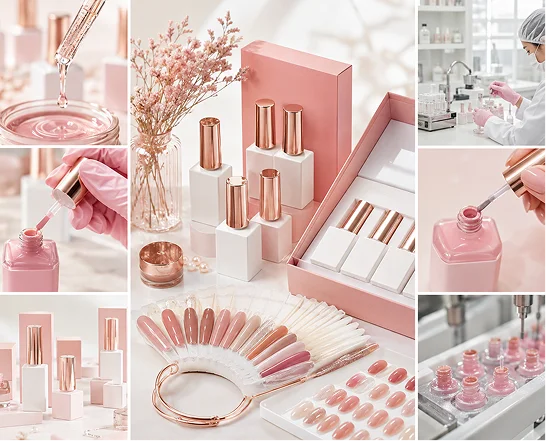
This is where coordinated packaging systems can help. A well-matched set of bottles, caps, inserts, and presentation boxes creates the sense of a finished line, not a single item assembled at the last minute. The cosmetic packaging style visible in many OEM programs - small bottles, metallic closures, display trays, and retail-ready cartons - is a reminder that buyers are often purchasing the whole experience, not just the gel inside.
Choose an OEM Model That Fits Your Control Needs
OEM manufacturing can mean different things from one supplier to another. In practical terms, you need to know how much of the product the factory controls and how much you control. Some brands bring in a formula concept and packaging direction, then rely on the factory for fill, assembly, and packing. Others want a more complete private-label path with standard formulas and faster development.
What to clarify early
Ask who owns the formula, who sources the packaging, who approves the artwork, and who handles the final filling and sealing steps. These details sound administrative, but they shape the whole launch schedule. If there is confusion at the beginning, it usually shows up later as label delays, mismatched component finishes, or packaging that works on paper but not on the line.
For nail gel, this is especially important because the product is sensitive to container choice. A bottle that looks premium may still be a poor match if the applicator is awkward, the neck is too narrow for the fill method, or the cap design complicates sealing. The best OEM partners think about manufacturability at the same time they think about appearance.
Build Around Formula, Packaging, and Production as One System
A successful nail gel brand is rarely built by fixing formula first and packaging later. The better sequence is more integrated. The formula should suit the intended package, and the package should suit the intended production line. That sounds obvious, but many launches break that rule.
Nail gel often asks more of packaging than thinner beauty liquids do. If the gel is dense, stringy, or highly pigmented, the fill process needs to be planned carefully. If the brand wants a glossy, metallic, or pastel visual identity, the packaging materials and finishes must hold that look through handling, storage, and transport. Presentation boxes, rigid inserts, and display stands can add value, but only when they fit the shipment and retail channel.
The packaging imagery associated with OEM cosmetic programs - rose-gold caps, translucent bottles, tray inserts, and display-ready boxes - reflects a useful lesson: buyers respond to consistency. When the bottle, cap, carton, and retail display speak the same design language, the brand feels more established even if it is still new.
What to Evaluate in an OEM Partner
Not every factory that can fill a bottle is ready to support a nail gel brand. You want a partner that understands cosmetic packaging design, filling, capping, and assembly as part of one workflow. That matters because most quality issues appear at the interfaces between steps, not inside any single step.
Look at whether the supplier can manage multiple container formats, especially if your brand plan includes retail sets, sample kits, or launch bundles. A factory that can coordinate bottles, slim tubes, molded trays, and carton packaging is usually better positioned for a scalable beauty program than one that only handles a single stock bottle.
You should also ask how the factory approaches visual consistency. Pastel packaging, metallic closures, and transparent containers can look premium, but only if the finish control is stable from sample to production. In beauty, slight color drift or uneven closure appearance is enough to weaken the brand story. It is a small thing until the product lands on a shelf.
Don’t Treat Compliance and Stability as Afterthoughts
For nail gel, product performance and market access are tied together. Regulations vary by market, and the brand owner is usually responsible for making sure labeling, ingredient declarations, and product claims fit the destination market. A good OEM partner should support documentation and manufacturing discipline, but it is unwise to assume the factory will solve every regional requirement on its own.
Stability is another area where caution pays off. Even if a sample looks good on day one, you still need to think about how the product behaves in storage, during shipping, and after opening. Packaging can influence that more than some teams expect. Closures, liners, neck geometry, and container material all affect leakage risk and user experience. It is one of those unglamorous details that separates a launch that scales from one that produces complaints.
Common Mistakes That Hurt New Nail Gel Brands
The first mistake is overdesigning the package before the formula is stable. A beautiful container cannot rescue a product that is difficult to apply or inconsistent between batches.
The second mistake is assuming all OEM factories are equally suited to cosmetic assembly. Nail gel may share some production traits with other liquid beauty products, but the details matter. Filling, capping, and packaging small-dose cosmetic liquids require different handling than general consumer goods.
The third mistake is launching too many variants too early. A broad shade range can be attractive in theory, but for a new brand it can create inventory pressure, approval delays, and retail confusion. A tighter launch with a clear color story often performs better than a scattered one.
The fourth mistake is ignoring the unboxing moment. If the product is sold online or gifted in sets, the outer carton and internal tray do real work. The clean, coordinated presentation seen in many OEM beauty programs is not decorative excess; it helps protect the item and shapes first impressions at the same time.
A Practical Buyer’s Checklist
When you are comparing OEM options, keep the discussion grounded in practical questions. Can the supplier support your target bottle format? Can they assemble the package cleanly at scale? Do they understand how the final product will be displayed or shipped? Can they adapt if the packaging needs to change after sampling?
For sourcing teams, it also helps to ask for visibility into the production flow. A factory that can show filling and sealing operations, sample assembly, or packaging line coordination usually has a better handle on repeatability than one that only talks about the finished look. You are not just buying a polished sample; you are buying the process that reproduces it.
FAQ: What Brands Usually Ask
How many products should a first launch include?
Usually fewer than the marketing team wants. A focused launch makes it easier to validate demand, packaging quality, and supplier performance before expanding the line.
Is premium packaging worth it for a new brand?
Sometimes, but only when the premium cues support the price point and channel. Decorative packaging without a clear sales strategy can quietly inflate cost.
Should formula or packaging come first?
They should move together. The formula needs to behave well in the chosen package, and the package needs to support the intended fill and end-user experience.
What is the biggest launch risk?
The most common risk is mismatch: a good-looking concept that is not easy to manufacture at scale. That mismatch shows up as delays, inconsistent quality, or awkward user feedback.
What a Strong OEM Launch Looks Like
A successful nail gel brand built through OEM manufacturing usually has three things in common: a clear market position, packaging that supports both production and shelf appeal, and a supplier relationship built on realistic technical discussion rather than just sample approval. The brands that last are not always the loudest at launch. They are the ones that make the hard choices early, keep the line simple enough to scale, and treat packaging as part of the product rather than an afterthought.
If you are planning a new nail gel line, start by mapping the route from formula concept to filled, packed, and display-ready product. Then compare OEM partners on how well they can support that route, not just how good their prototype looks. That is usually where the difference between a promising idea and a commercially workable brand becomes clear.